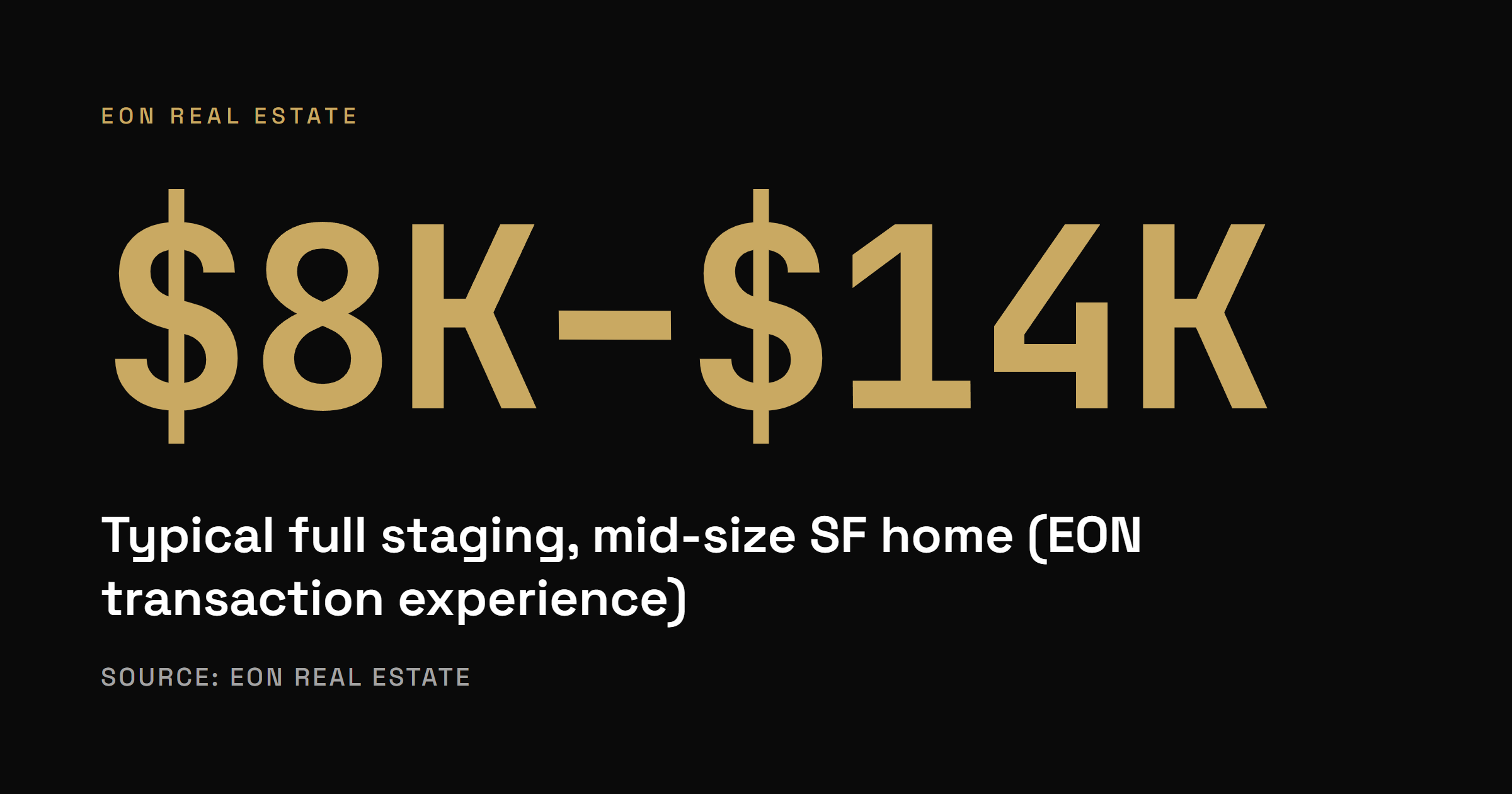
Home staging in San Francisco is priced by property size and tier, not a flat rate. As of Q3 2026, plan on roughly $4,000 to $5,000 for a condo or small home, $8,000 to $14,000 for a mid-size home, and $20,000 to $45,000 or more for a luxury property, from EON transaction experience.
If you are getting ready to list, staging is usually the first real check you write toward the sale, and the number surprises people in both directions. Some sellers expect a few hundred dollars of throw pillows. Others brace for a renovation-sized bill. The honest answer sits in between and depends almost entirely on how big your home is and what tier of the market it competes in. Unless otherwise noted, all market figures in this guide are from MLS data, and the staging costs are EON's closed-transaction averages, not a vendor rate card.
I'm Chris Chour, founder/broker of EON Real Estate. Most of my work is single-family and condo transactions in SF's luxury neighborhoods. Here's what I tell sellers who ask about staging: it is one of the highest-return dollars you will spend preparing a home, but only if you spend it on the right scope for your property and hire someone who actually knows the buyer you are selling to. The citywide median home still closes in 12 days (MLS), and presentation is a large part of what keeps a well-run listing on that fast track. This guide walks the three cost tiers most sellers fall into, the tradeoffs at each, and where the money is wasted.
What home staging costs in San Francisco in 2026
Staging is priced against the space, not per item. A one- or two-bedroom condo takes fewer rooms of furniture and less labor than a four-bedroom house, so the quotes scale with square footage and room count. From EON's closed transactions, a condo or small home up to two bedrooms typically runs $4,000 to $5,000. A mid-size home, larger condo, or entry-luxury property typically runs $8,000 to $14,000 depending on size. A luxury or ultra-luxury home runs $20,000 to $45,000, and a very large home can exceed that.
Those figures are for full-service staging: design, furniture rental, delivery and installation, and removal after the sale closes. Most SF stagers quote a first-month rental period with a monthly rate after that, which matters because the citywide median days on market is 12 and the average is 16 (MLS). A home that shows well and prices right rarely carries staging into a costly second or third month. A home that lingers does, which is one more reason to get the scope and the price right on day one.
SF staging costs by the numbers
Three staging scenarios by property tier
Almost every seller I meet falls into one of three tiers. Find yours, and the budget stops being a mystery.
The condo or small home (up to two bedrooms)
At $4,000 to $5,000 from EON transaction experience, this is the tightest tier and the easiest to get wrong by overspending. A compact condo needs the living area, one bedroom, and the dining nook dressed to read light and open. The recommended approach is a focused full-stage of the rooms buyers photograph and remember, not every closet and hallway. The tradeoff: cram too much rental furniture into a small floor plan and you make the home feel smaller, which is the opposite of what the money is supposed to buy. If you are selling something like a one-bedroom near a walkable retail corridor, editing beats maximalism every time.
The mid-size home or entry-luxury property
This is the tier where I see the widest spread, $8,000 to $14,000 from EON transaction experience, because "mid-size" covers everything from a roomy three-bedroom flat to an entry-luxury single-family home. Size drives the number, so insist on a walk-through quote rather than a phone estimate. The recommended approach is to stage the full public sequence a buyer moves through: entry, living, dining, kitchen sightline, primary bedroom, and one secondary room. The tradeoff is scope creep. Sellers here often add rooms that no buyer weighs heavily, and the bill climbs toward the luxury tier without moving the sale. Stage the rooms that decide the offer, and stop.
The luxury and ultra-luxury home
Luxury and ultra-luxury staging runs $20,000 to $45,000, and a very large home can run past that, from EON transaction experience. At this level the buyer pool is small, discerning, and comparing your home against every other trophy listing on the market. The recommended approach is full staging by a designer who works in this segment and understands the finish level these buyers expect. The tradeoff is stark: the wrong stager at this price point does not just waste money, it actively hurts a multi-million-dollar sale by making the home read generic. Spend the money on the right person, or do not spend it here at all.
What to consider before you spend on staging
Staging is high-return, but it is not automatic, and I don't sugarcoat this part. Here are the tradeoffs worth weighing before you sign a staging contract.
First, an occupied home you already keep tastefully furnished may only need editing and a few rental pieces, not a full stage. Paying for a complete furniture package when your own home already photographs well is the most common way sellers overspend. Second, the calendar matters. San Francisco runs a spring selling cycle from after Valentine's Day through June and a fall cycle from late August to Halloween, and staging is priced by the month, so a listing that goes up and lingers past its rental window quietly runs up the cost. Third, the one line I'd cut first is anything that reads as decoration for its own sake. Do not pay to stage rooms buyers discount, like a fourth bedroom used as storage or a finished attic. And do not treat staging as a substitute for real repairs, because a beautifully furnished home with deferred maintenance still fails inspection and still gets negotiated down.
Staging, photography, and the marketing window
Staging exists to serve the marketing, not the other way around, so time it to the photography and the listing launch. The sequence that works: finish repairs and paint, stage, then shoot photography and video, then launch to hit a spring or fall window while the furniture rental is fresh. Housing type changes the playbook. A period Victorian or Edwardian flat stages differently than a mid-rise condo. The flat wants furniture scaled to tall ceilings and original detail, presenting the architecture rather than fighting it. A newer condo wants a cleaner, contemporary package that matches how its buyers already picture the space. If you are selling houses in Pacific Heights or a flat when selling a home in NoPa, the right stager reads that difference before writing a single line into the quote. The goal is photography that makes a buyer stop scrolling, because most buyers meet your home on a screen long before the front door.
Who should stage your home
Quality varies enormously between staging companies, and price is not the reliable signal. In practice only a small circle of San Francisco stagers are consistently reliable at the level competitive luxury marketing requires, and they are the ones the top-producing agents book. As a Top Agent Network member, an invitation-only group of the top 1% of San Francisco agents by production (Top Agent Network), I work with that small circle of stagers so my sellers get the people who actually move a sale. The practical advice for any seller: do not shop staging on price alone, and do not accept a stager you have never seen work. Insist on the stagers the best agents in the city rely on, through an agent who books them regularly. That single decision protects the entire staging budget, whether it is $5,000 or $45,000.
How much does home staging cost in San Francisco?
As of Q3 2026, full home staging in San Francisco typically runs $4,000 to $5,000 for a condo or small home, $8,000 to $14,000 for a mid-size home, and $20,000 to $45,000 or more at the luxury tier, based on EON's closed transactions. Size and property tier set the number, not a flat per-room rate. A vacant home costs more to stage than an occupied one you are only editing, because the vacant home needs a full furniture package.
Is home staging worth the cost when selling in San Francisco?
For most San Francisco sellers in 2026, yes, but not for all of them. The citywide median home closes in 12 days (MLS), and strong presentation is a meaningful part of keeping a listing on that pace and out of a price reduction. The exception is a home you already keep tastefully furnished, which may only need light editing. Staging is not a fix for deferred repairs, and it will not rescue an overpriced listing.
What share of the sale price does staging cost in San Francisco?
In 2026, staging is a small fraction of the sale price for most SF sellers. On the trailing-12-month citywide median of $1.8M (MLS), mid-size staging at $8,000 to $14,000 works out to under 1% of the sale price. Even a $45,000 luxury package sits at a modest share of a multi-million-dollar sale. That ratio is why staging tends to pencil out: the cost is small relative to the price it helps protect.
How much does it cost to stage a luxury home in San Francisco?
As of Q3 2026, staging a luxury or ultra-luxury San Francisco home runs $20,000 to $45,000, and a very large home can exceed that, based on EON's closed transactions. At this tier the buyer pool is small and comparing your home against other trophy listings, so full staging by a designer who works in the luxury segment is standard. The bigger risk is not price, it is hiring a stager who does not understand this finish level.
Should you stage a vacant home or one you still live in?
In 2026, a vacant home almost always needs full staging, while a home you still live in may only need editing and a few rental pieces. A vacant home reads cold and makes rooms hard to scale, so the full-package tiers above apply. An occupied, well-furnished home can often be styled with your own pieces plus targeted rentals, which lowers the cost. The tradeoff is living around a staged home through showings.
Talk to me about staging your San Francisco home
When you're ready to sell, I can walk your home room by room, tell you where staging dollars actually move the needle for your property type, and connect you with the right stager for your price point. No pressure and no obligation, just a clear scope and a number you can trust before you spend a dollar.