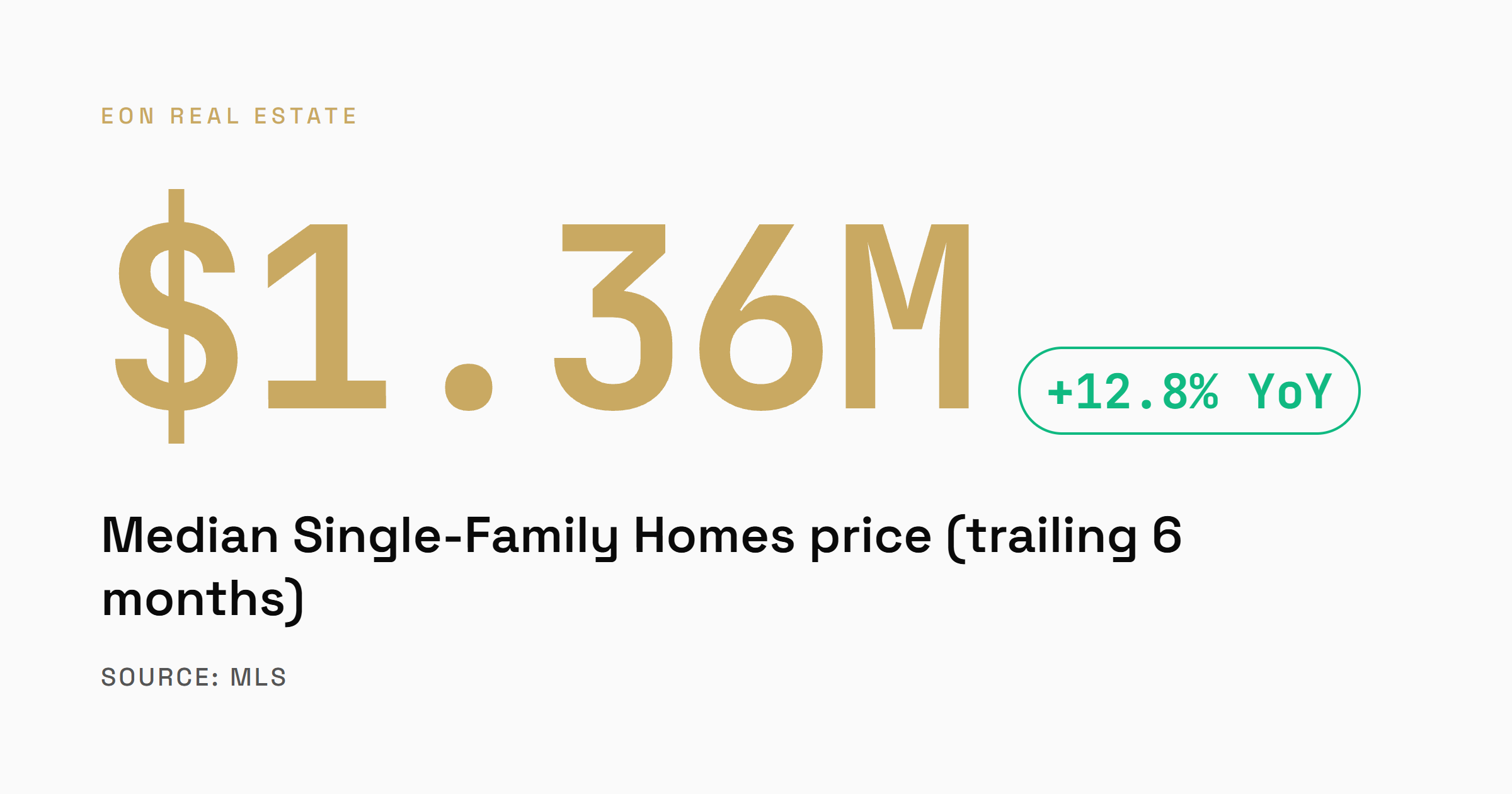
Portola is a neighborhood of single-family houses in ZIP 94134 where, as of November 2026, the trailing six-month single-family median is $1,365,000 across 31 sales, with a median of 13 days on market, and 52 of the past 12 months' 56 sales closed above asking. Unless otherwise noted, all market figures in this guide are from MLS data.
Long before it was a house market, the Portola was a flower market. The neighborhood earned the nickname Garden District for its history of urban farming dating back to the early 1900s, and it once had more than 20 working commercial farms and greenhouses (per Wikipedia). After the 1906 earthquake it grew into a community of nurserymen and their families, who raised much of San Francisco's flower crop here and uphill to the west in the Portola Heights extension (per Wikipedia). Even the name is secondhand: the neighborhood took it from the old Portola School, which was named for the Spanish explorer Gaspar de Portolà (per Wikipedia).
The modern map is drawn by roads. Portola sits northeast of McLaren Park, roughly bounded by San Bruno Avenue and the James Lick Freeway (U.S. Route 101) on the east, Mansell Street on the south, University Street on the west and the Southern Freeway (Interstate 280) on the north (per Wikipedia). San Bruno Avenue, which locals called "The Road," still carries the bakeries, grocery stores and pharmacies, and the old Avenue Theater on it is now a church (per Wikipedia).
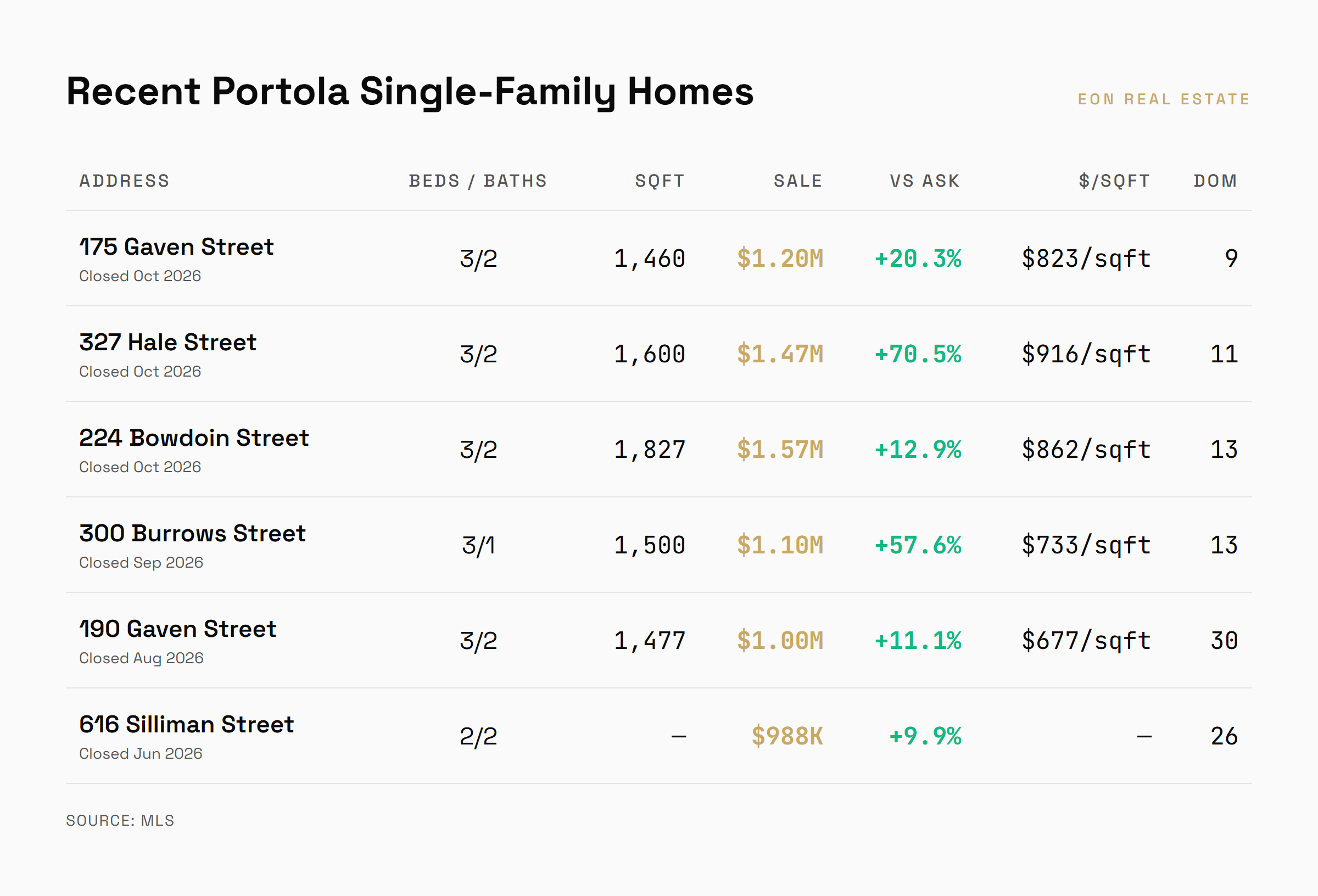
What has changed is the price of a yard. In October 2026, 327 Hale Street listed at $859,000 and closed at $1,465,000. Across the past 12 months, only four of 56 sales closed below their list price, and one of those four was a commercial building. I track the Portola block by block, and the pattern this fall is clear: the houses are modest, the lots are small, and the asking price is an opening bid. Below are the numbers, the blocks that trade most, and the parts of the Portola pitch worth testing before you write an offer.
Portola by the numbers
Read the windows from the most recent back. The 30-day median of $1,201,000 rests on five sales between October 13 and October 23, 2026: four single-family houses and one condo. The four houses closed at $1.2M (28 Madison Street), $1,201,000 (175 Gaven Street), $1,235,000 (150 Boylston Street) and $1,465,000 (327 Hale Street). Widen to 90 days and the median is $1,275,000 on 15 sales with a median of 13 days on market. Over the trailing six months, the single-family median is $1,365,000 across 31 sales, or $906 per square foot.
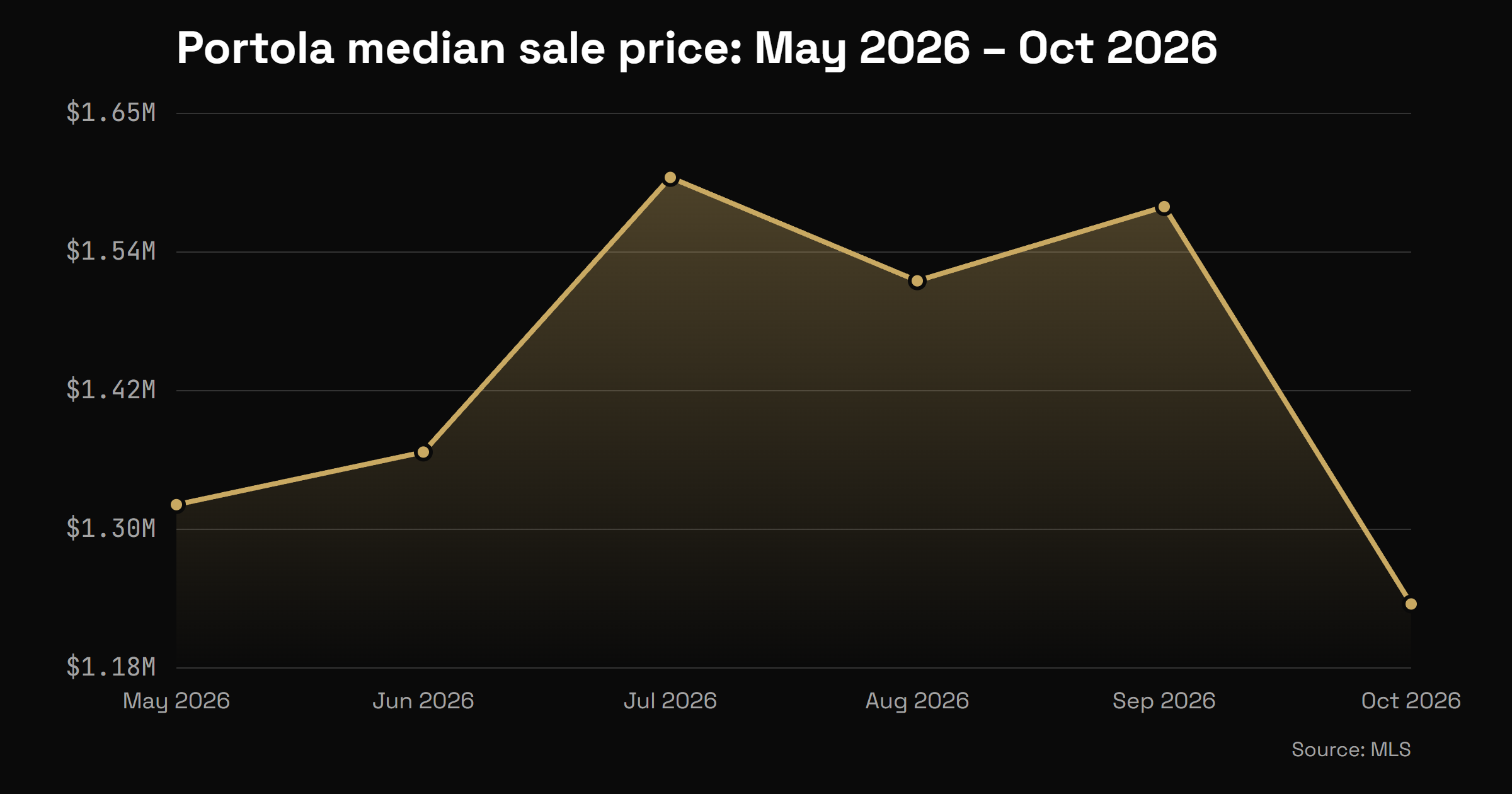
For direction, the 12-month median of all 56 Portola sales is $1.34M, up 10.7% from $1.21M in the prior 12 months, while average days on market fell from 24 to 22. That is the backdrop, not the headline. The monthly chart below moves sharply because no month carried more than nine sales, so a single large or small house can move a month's median sharply.
The price tiers: what each budget buys in the Portola
The 56 sales of the past 12 months fall into three working tiers for houses. One commercial building closed at $4,995,000 on San Bruno Avenue in February 2026; it is not housing, so it stays out of the analysis below. Nothing residential closed above $3M, and 85.7% of the year's sales landed between $1M and $2M.
Under $1M: six sales, small and older
Six sales closed under $1M: five single-family houses and one condo, four of them two-bedrooms and two of them three-bedrooms. This is where small, older houses trade. 107 Dwight Street, a 627-square-foot two-bedroom built in 1906, closed at $365,000 in December 2025. 625 Girard Street, a 750-square-foot house from 1900, sat 143 days and closed at $720,000, under its $748,000 list price. The lone condo, 753 Burrows Street #14, an 818-square-foot two-bedroom marked as-is, closed at $870,000 after 94 days. Under $1M, expect work, and expect a longer sale than the neighborhood's 13-day median.
$1M to $2M: the Portola market
This tier is the neighborhood: 48 sales, 47 of them single-family houses plus one duplex. Three-bedrooms lead with 21 sales, two-bedrooms follow with 13, four-bedrooms add 10 and five-plus bedrooms add four. Across the full year, three-bedroom sales ran a $1.35M median at an average of 1,618 square feet, and two-bedrooms a $1.2M median at 1,106 square feet. 224 Bowdoin Street, a 1,827-square-foot 1940 three-bedroom with a remodeled kitchen, closed at $1,575,000 in October 2026. 1133 Silver Avenue, a six-bedroom of 2,040 square feet, closed at $1.85M in September. The one duplex, 329-331 Woolsey Street, closed at $1,445,000 in May.
$2M to $3M: one sale
Only one residential sale crossed $2M in the past year: 268 Madison Street, a six-bedroom, four-bath house of 3,128 square feet built in 2014, closed at $2.1M in January 2026 after seven days. One sale is not a tier you can price against. If you are selling a large or newer Portola house, the comp set will come from the top of the $1M to $2M range, and the case for a price above it rests on size and finish, not on precedent.
Where homes actually trade in the Portola
No single Portola block dominates the year. The busiest block range produced three sales, and the next seven produced two each. Walk Scores on the scored blocks run from 56 to 89, so the block you pick changes daily life as much as price.
The 100 block of Gaven Street
Three sales over the past 12 months at a $1,201,000 median, the most of any Portola block. 147 Gaven Street closed at $1,285,000 in May, 190 Gaven Street (vacant and renovated) at $1M in August after 30 days, and 175 Gaven Street at $1,201,000 in October after nine days. Its 89 Walk Score (Very Walkable) is the highest of the blocks scored here, with a 70 Transit Score.
The 300 block of Hale Street
Two sales at a $1,392,500 median. 326 Hale Street closed at $1.32M in May, and 327 Hale Street, a renovated 1,600-square-foot three-bedroom from 1948, listed at $859,000 and closed at $1,465,000 in October. The block scores an 81 Walk Score and a 70 Transit Score.
The 0 block of Dartmouth Street and the 0 block of Madison Street
Dartmouth's first block produced two sales at a $1,292,500 median: 46 Dartmouth Street at $1.2M after 82 days in December 2025, and 54 Dartmouth Street at $1,385,000 after 12 days in August 2026. It carries a 75 Walk Score. The first block of Madison Street also produced two sales, at a $1.3M median: 16 Madison Street at $1.4M in June and 28 Madison Street at $1.2M in October. Madison posts the highest Transit Score of the blocks scored here, 77 (Excellent Transit), with a 71 Walk Score.
The 1100 block of Burrows Street and the 100 block of Princeton Street
These two blocks score lower for walking: a 56 Walk Score on Burrows and a 63 on Princeton. On Burrows, 1167 Burrows Street listed at $859,000 and closed at $1,111,000 in May, while 1179 Burrows Street, a 2,000-square-foot four-bedroom, closed at $1,615,000 in September. On Princeton, 101 Princeton Street, a 2,655-square-foot three-bedroom, closed at $1.6M in May, and 120 Princeton Street closed at $1.08M in February, below its $1,188,000 list price.
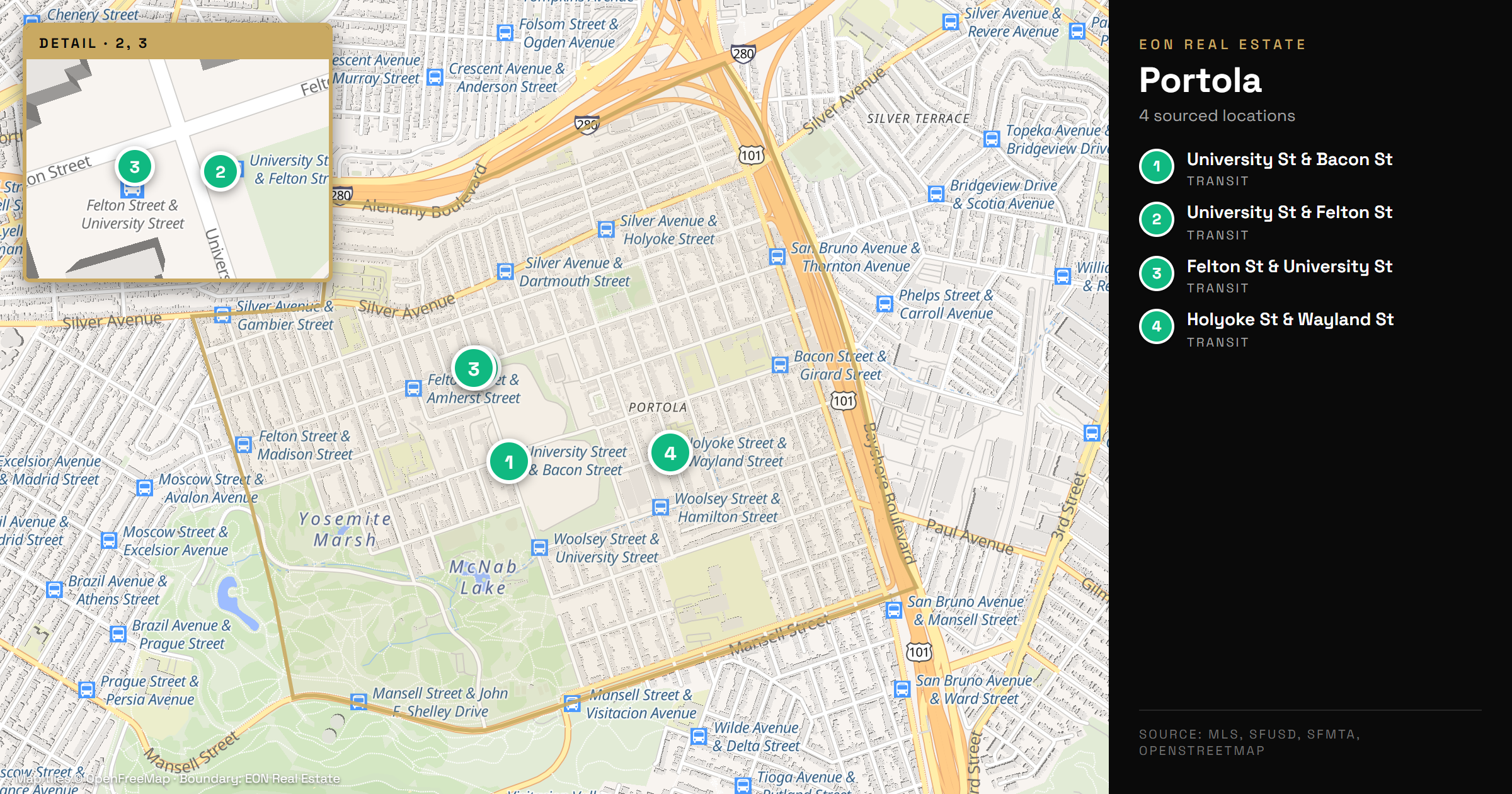
Transit here runs on buses. From the neighborhood center, the 54 Felton stops 173 meters away at University and Bacon Streets, the 44 O'Shaughnessy stops 466 meters away at Silver Avenue and Dartmouth Street, and the 8 Bayshore and 9 San Bruno lines stop 734 meters away at San Bruno Avenue and Bacon Street (SFMTA). The center itself scores a 66 Transit Score (Good Transit).
How the Portola's houses break down
This is a house neighborhood in the plainest sense. Of the 56 MLS sales in the past 12 months, 53 were single-family houses (94.6%), with one condo, one duplex and one commercial building. SF Assessor records count 3,986 parcels in the Portola, and 3,425 of them carry the single-family dwelling use code. Another 192 are coded as flat-and-store buildings of four units or less, and 55 as apartment buildings of four units or less.
The houses are mostly mid-century and pre-war. Per SF Assessor records, 37.1% of parcels were built between 1950 and 1979, 26.6% between 1930 and 1949, 18.5% in the Edwardian years of 1910 to 1929, and 7.3% between 1900 and 1909. The median parcel dates to 1948. Only 3.7% date to 2000 or later, per assessor records that lag recent completions.
The lots and houses are compact. The median Portola lot is 2,500 square feet and the median building is 1,403 square feet (SF Assessor). In the 2023 Census ACS block group at the neighborhood center, 87.5% of occupied units are owner-occupied, and the median home value reported by residents is $1,190,700 (US Census ACS).
If you are comparing the Portola with other single-family neighborhoods, the closest parallels on our blog are Sunnyside and Parkside, along with the Outer Sunset.
What to consider before buying in the Portola
The list price is not the price
I don't sugarcoat this part: in the Portola, the list price tells you almost nothing about the closing price. Fifty-two of the past 12 months' 56 sales closed above asking. 932 Silliman Street listed at $998,000 and closed at $1.6M in April 2026. 300 Burrows Street, a probate sale, listed at $698,000 and closed at $1.1M in September. If you shop by list price, you will spend your weekends at open houses you cannot win. Shop by the closed comps for the block and the size.
Older houses mean real inspections
Per SF Assessor records, more than half of Portola parcels were built before 1950, and the 1900 to 1929 houses are now close to a century old or older. Foundations, original wiring, drainage and unpermitted garage conversions are the issues to price in. Read the full disclosure package and the permit history before you write, and get your own inspection when the timeline allows it. A clean-looking renovation can hide old systems behind new finishes.
Transit is buses, and two edges are freeways
The center of the Portola scores a 66 Transit Score, and the stops within 800 meters of it are all bus lines (SFMTA). If your commute needs a train, map it door to door before you fall for a house. The neighborhood's northern and eastern edges are Interstate 280 and U.S. Route 101 (per Wikipedia). Freeway access is a real convenience for a car commute, but walk any block near those edges at rush hour and listen before you decide.
Condos and multi-unit buildings are thin
One condo and one duplex closed in the past 12 months. If you want an attached unit or a small income building, the Portola rarely offers one, and you cannot price one confidently from a single sale. One condo was active on November 10, 2026, after 50 days on market. For buyers set on a condo, this neighborhood is usually the wrong search.
Schools run on the citywide lottery
San Francisco Unified assigns students through a citywide lottery rather than guaranteed neighborhood zones, so a Portola address does not lock in a specific public school (SFUSD). Edward R. Taylor Elementary on Burrows Street and Hillcrest Elementary on Silver Avenue sit in ZIP 94134 (NCES). Treat proximity as a convenience, not a guarantee.
Buyer playbook and seller playbook for the Portola in 2026
If you are buying
Start with the closed sales of the last 90 days: 15 sales at a $1,275,000 median with 13 days on market. Then match on size and condition, because that is what moves the number here. In the six-month comp set, the renovated three-bedrooms closed between $1.4M (825 Olmstead Street) and $1,575,000 (224 Bowdoin Street), while 1167 Burrows Street and 175 Gaven Street, with no renovation noted, closed at $1,111,000 and $1,201,000. Here's what I'd tell you to do before writing an offer in the Portola this fall: decide your walk-away price from those comps before you see the list price, and do not let a low asking price reset your expectations.
Then work the levers at the table. A clean, all-cash or well-documented financed offer with short contingencies competes with a higher offer that carries risk. Ask how many offers the listing agent expects; a lone offer is a different negotiation from a crowded one. Check whether the house is vacant or tenant-occupied, since an occupied house brings San Francisco's tenant protections and Owner Move-In rules into the timeline. Parking matters here as well: seven of the eight houses in the six-month comp set have parking, and a house without it should price below the block.
If you are selling
Price against the closed comps, not against the rest of the city. A list price set below the comps draws buyers in this market, but the closing price comes from the comps, and the six-month set says renovated three-bedrooms close in the $1.4M to $1.6M range. Expect a short campaign: the 30-day median was 12 days on market. The two slowest sales of the year were the exceptions: 625 Girard Street took 143 days and 753 Burrows Street #14 took 94. If your house needs work, price it for the work and say so. Buyers here have reliable comps and they read them.
Frequently asked questions about the Portola
How much does a house cost in Portola in 2026?
As of November 2026, the trailing six-month single-family median in the Portola is $1,365,000 across 31 sales, or $906 per square foot. In the last 30 days, four houses closed between $1.2M and $1,465,000. Over the past 12 months, three-bedroom sales ran a $1.35M median and two-bedrooms a $1.2M median, and 48 of 56 sales landed between $1M and $2M. Only one residential sale, a 2014 six-bedroom, crossed $2M.
Are Portola home prices going up or down in 2026?
Up over the year, softer in the last month: the 12-month median of all 56 Portola sales to November 10, 2026, is $1.34M, up 10.7% from $1.21M in the prior 12 months. The last 30 days ran lower, at a $1,201,000 median on five sales, including one condo. With so few sales a month, read the 90-day median of $1,275,000 and the six-month single-family median of $1,365,000 before calling a turn.
How fast do homes sell in Portola in 2026?
In the last 30 days to November 10, 2026, Portola sales spent a median of 12 days on the market, and the median over the past 12 months was 13 days. Average days on market fell from 24 to 22 year over year. The two slowest sales were specific: an as-is condo at 753 Burrows Street took 94 days, and a small 1900 house at 625 Girard Street took 143 days before closing under its list price.
Do Portola houses sell over the asking price?
Yes, almost always: 52 of the 56 Portola sales in the 12 months to November 10, 2026, closed above list price. Some premiums were large. 327 Hale Street listed at $859,000 and closed at $1,465,000, and 932 Silliman Street listed at $998,000 and closed at $1.6M. Of the four sales that closed below list, one was a commercial building and the others included 120 Princeton Street, which closed at $1.08M against a $1,188,000 asking price.
What schools are near the Portola in San Francisco?
As of the 2024 to 2025 school year, public schools in ZIP 94134 include Edward R. Taylor Elementary at 423 Burrows Street, Hillcrest Elementary at 810 Silver Avenue, Martin Luther King Jr. Academic Middle at 350 Girard Street and Phillip and Sala Burton Academic High at 400 Mansell Street (NCES). Private options in the ZIP include Alta Vista School on Somerset Street. SFUSD assigns students by citywide lottery, so an address does not guarantee a school.
Why is the Portola called the Garden District?
As of 2026, the nickname still recalls the neighborhood's farming past: the Portola earned the name Garden District for its urban farming history dating back to the early 1900s, when it had more than 20 working commercial farms and greenhouses (per Wikipedia). Nurserymen and their families grew much of San Francisco's flower crop there and in Portola Heights to the west. Today it is mostly single-family houses on lots with a 2,500-square-foot median (SF Assessor).
Talk to me about the Portola
I'm Chris Chour, founder/broker of EON Real Estate. Most of my work is single-family and condo transactions in SF's luxury neighborhoods. When you're ready to look at a specific Portola house, I can pull the closed comps for that block and size, so your offer or your list price starts from what actually sold.