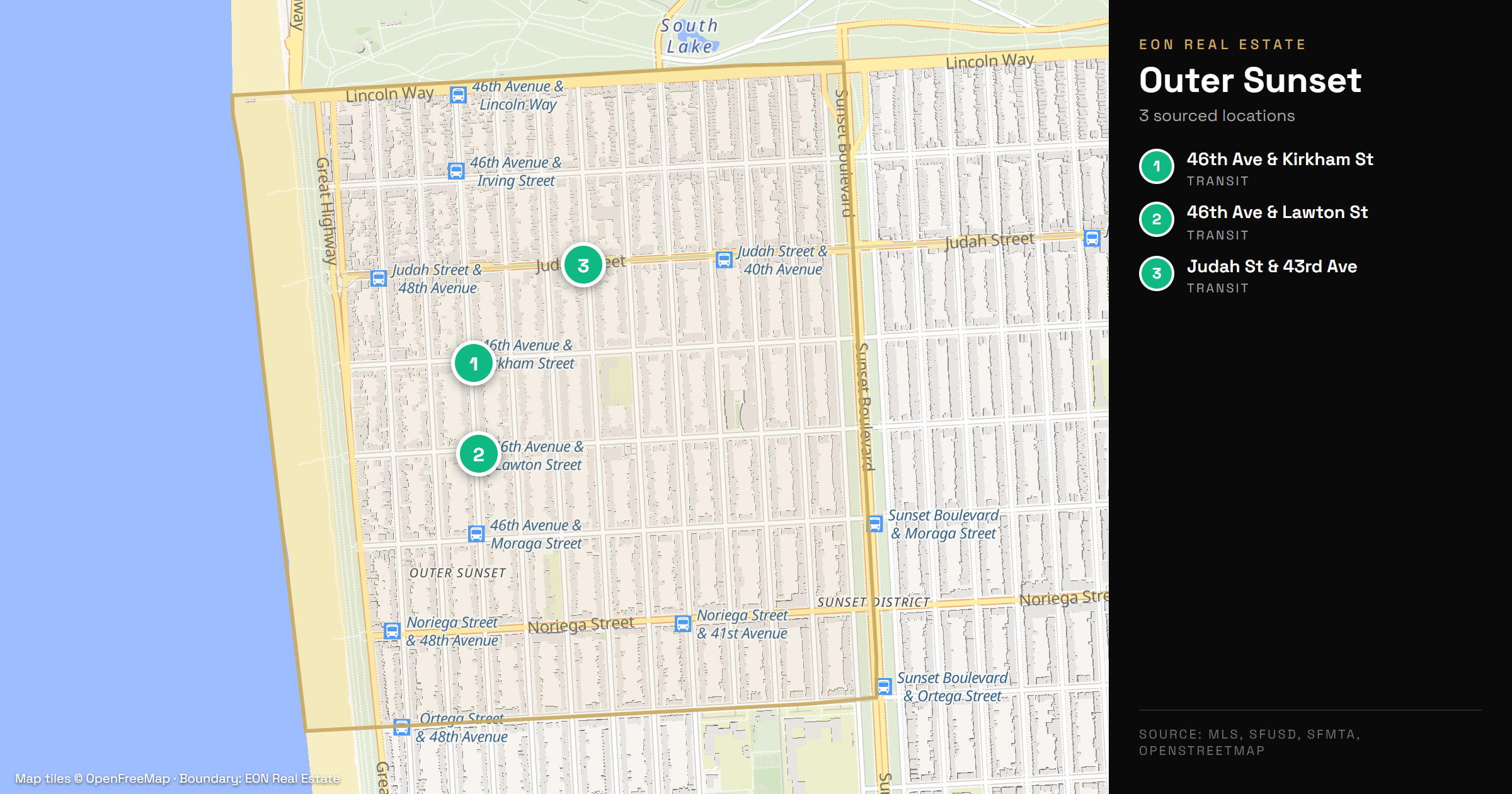
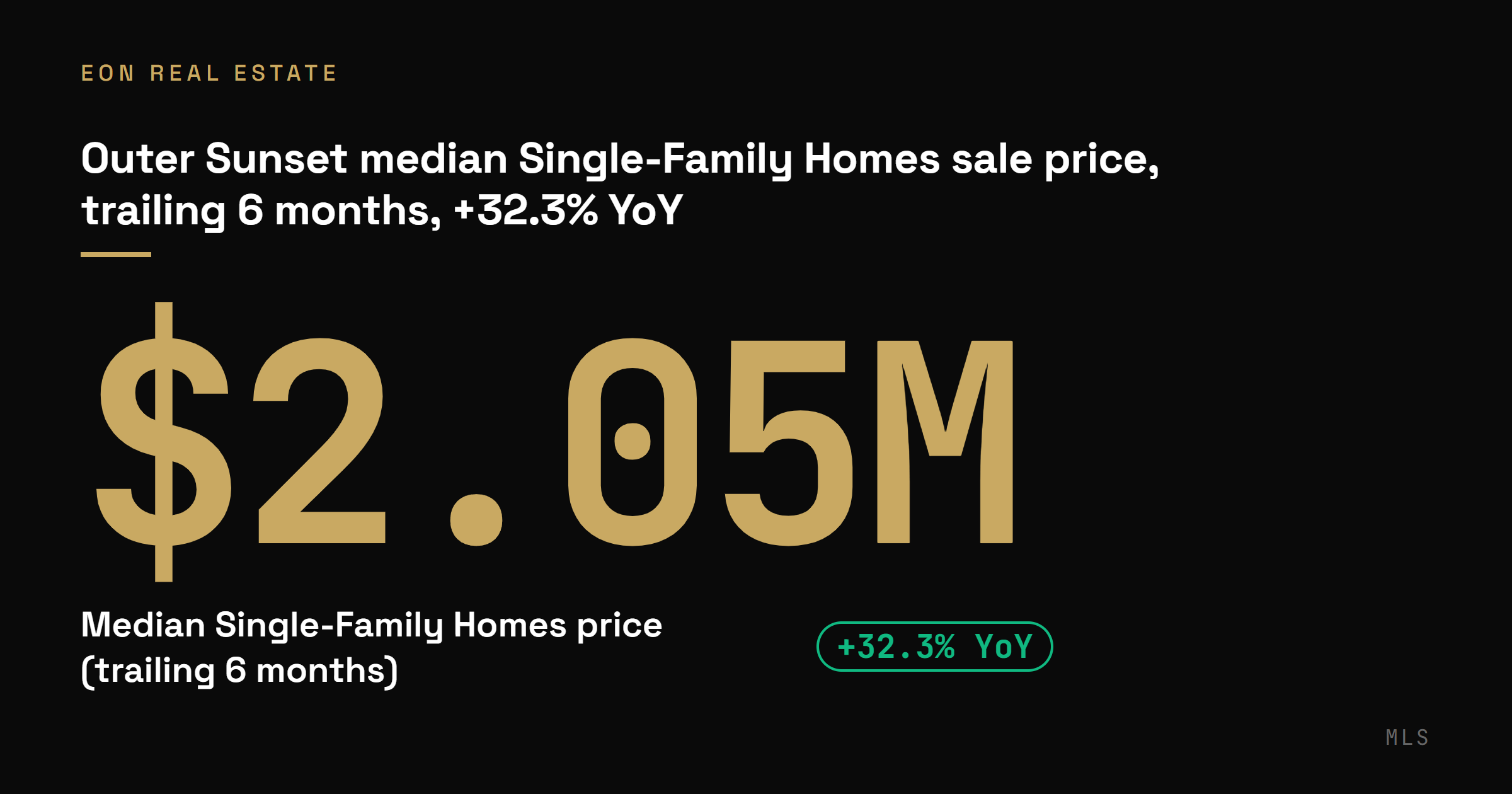
The Outer Sunset is a mostly single-family corner of San Francisco's west side where the median single-family home closed at about $2.05M over the trailing six months of 2026. It costs less per square foot than the citywide median, so buyers priced out of the eastern neighborhoods keep coming here for room.
Unless otherwise noted, all market figures in this guide are from MLS data.
The Sunset District, which wraps the Outer Sunset into the larger western grid, is the most populous neighborhood in San Francisco (Wikipedia). That shapes how the market behaves out here. More rooftops means more turnover, and over the trailing twelve months, 57 homes closed against just 7 on the market today. Inventory is structurally thin: roughly one home active for every eight that traded in the past year.
I'm Chris Chour, founder and broker of EON Real Estate. Most of my work is single-family and condo transactions in the city's luxury neighborhoods, and the Outer Sunset is one corner I track block by block. After running comp sets across the avenues this year, here is the honest version of the neighborhood, including the parts of the pitch I would treat with some skepticism.
Start with what the Outer Sunset actually is: a flat grid of early-20th-century row houses running from the low-numbered avenues out to the Pacific. The homes that trade fastest are updated three-bedrooms on the numbered avenues. The homes that linger are the ones that still need work. The gap between those two outcomes is wide, and closing it in your head is the most useful thing you can do before writing an offer here.
Outer Sunset by the numbers
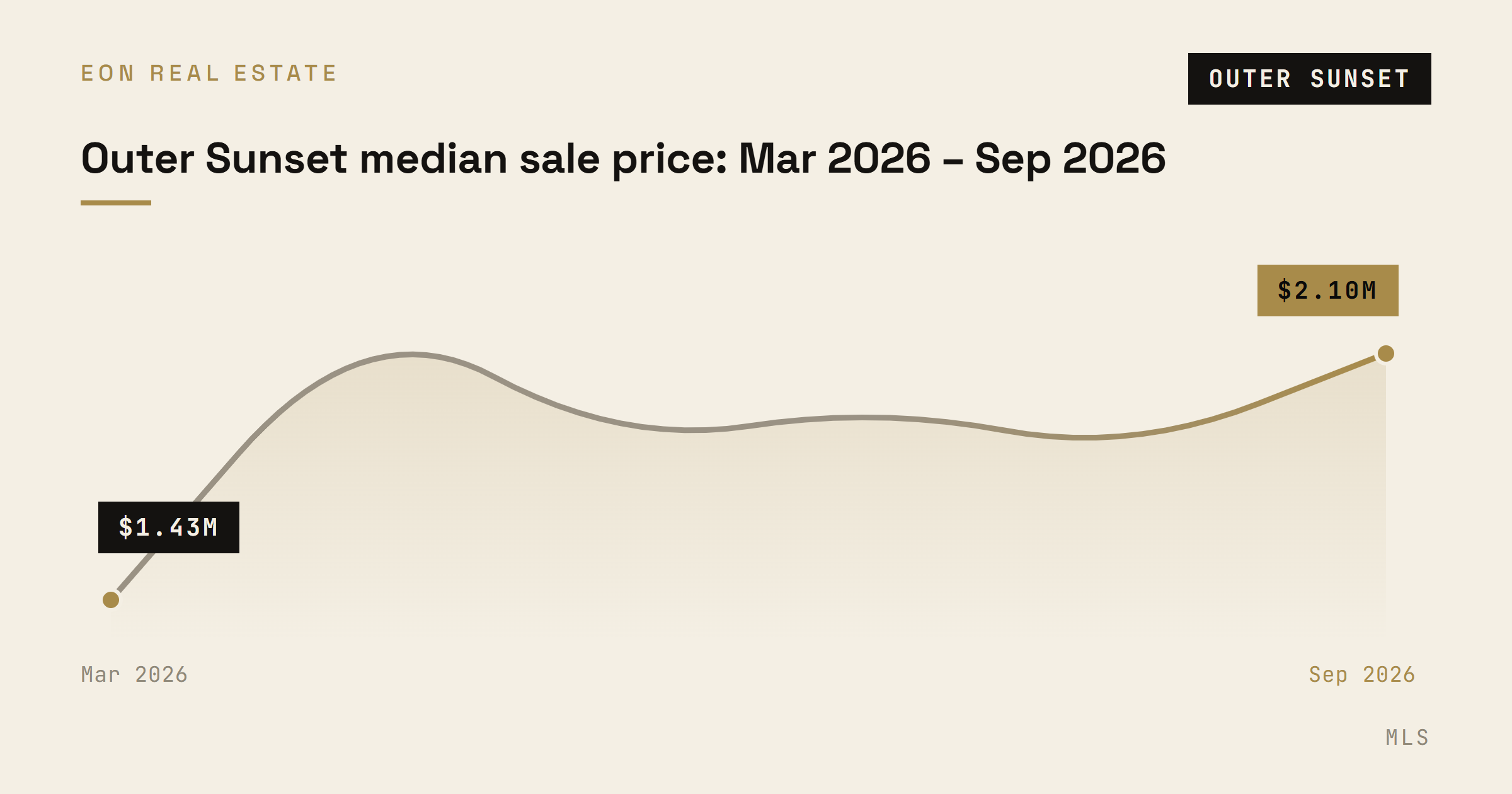
A quick note on recency. Only two homes closed in the last 30 days, so the cleaner read comes from the trailing 90 and 180 days, where the median sat near $1.93M and $1.88M across 28 sales. The six-month single-family median of $2.05M runs above the trailing twelve-month figure of $1.72M, which tells you the stronger, more updated homes have carried the recent run. Month to month the median has swung between roughly $1.43M in March and $2.23M in April of 2026, a reminder of how few homes trade in any single month out here.
The price tiers, and what trades in each
Two-thirds of the Outer Sunset market lives in one tier. Over the trailing twelve months, 38 of 57 sales, about 66.7%, closed between $1M and $2M. These are the bread-and-butter avenue homes: mostly single-family, with a handful of two-to-four-unit buildings mixed in, and the bed counts cluster at two and three bedrooms. If you are shopping the neighborhood, this is the tier you will spend most of your weekends in.
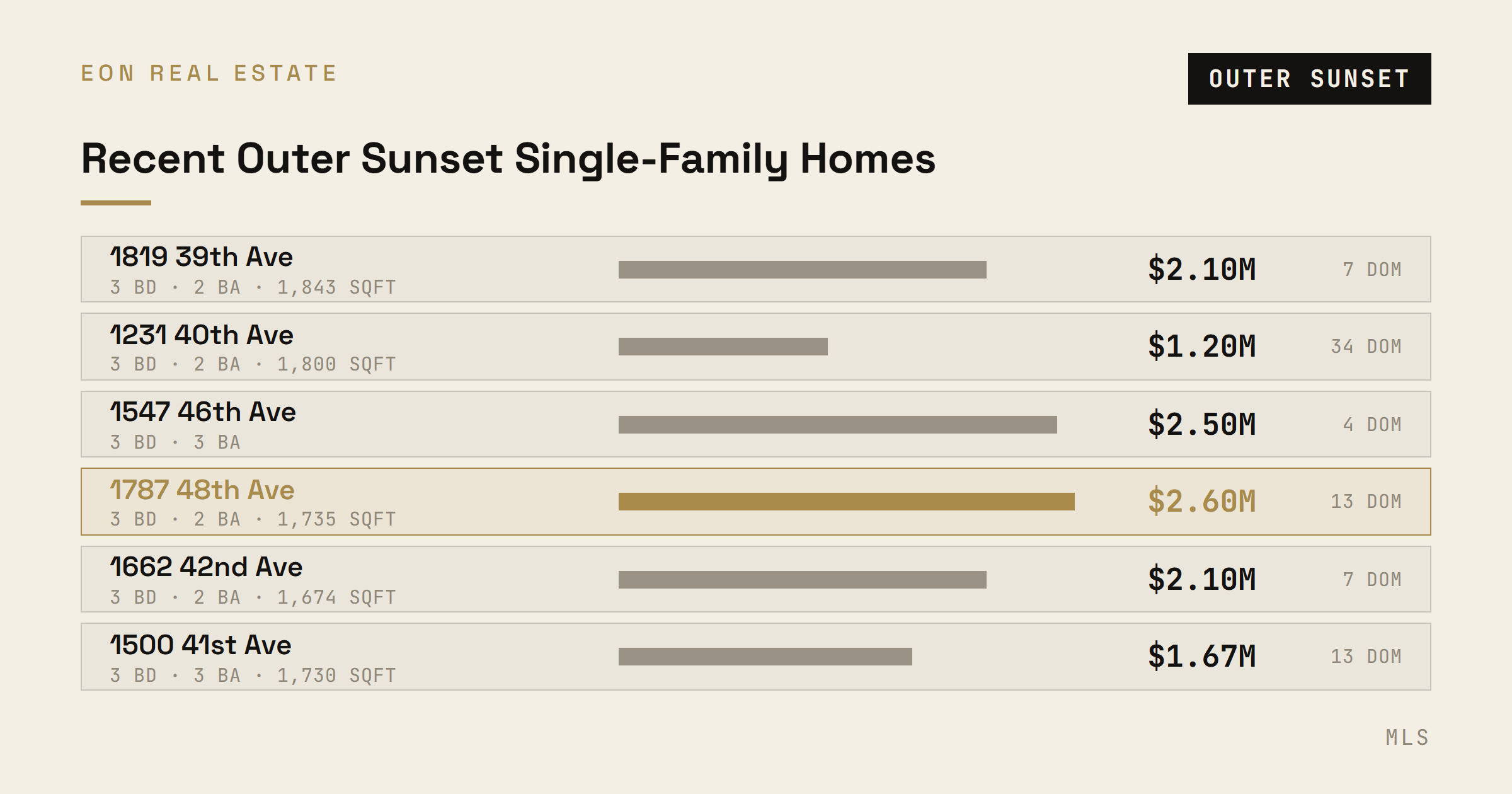
The next step up, $2M to $3M, took 24.6% of sales, 14 closings, and it is almost entirely single-family. This is where the renovated three-bedrooms land. A home like 1787 48th Avenue, a renovated 1952 three-bedroom, closed at $2.6M in May 2026 after 13 days. 1575 43rd Avenue, a renovated 2,170-square-foot three-bedroom, closed at $2.55M in April. The premium for a turnkey home in this neighborhood is real, and it concentrates right here.
The tails are thin. Below $1M you get 5.3% of the market, three sales, and they skew to the smallest condos and a lone tenancy-in-common unit. Above $3M there were only two closings all year, both single-family, and nothing crossed $5M. If your budget tops $3M, understand that you are shopping a very short list and should widen your timeline accordingly. There is no luxury-tower layer here the way there is downtown or in the city's priciest neighborhoods.
Where homes actually trade
The blocks that turn over most sit on the numbered avenues in the mid-40s and on Lawton Street. The 1500 block of 44th Avenue saw the highest-value pair of sales, a median near $1.95M. The 1700 block of 40th Avenue traded at a $1.72M median but a much higher $1,414 per square foot, which is what a smaller, fully updated home does to the per-foot math. The 1700 block of 47th Avenue and the 3800 block of Lawton Street both sat in the $1.44M to $1.58M range.
The pattern on these blocks is consistent: the number that moves the price is condition, not location, once you are inside the core avenues. Walkability is uniformly strong here, an 86 Walk Score across the neighborhood and a 91 Bike Score, so a buyer is rarely paying a premium for one block being more walkable than the next. The premium is for whether the kitchen and systems were done. Two nearly identical-looking homes a block apart can close hundreds of thousands of dollars apart on that basis alone.
One caution on the block data: a cluster near La Playa Street shows a median under $400K, far below everything around it. That is a non-representative, far-below-market sale, not the going rate for the block, and it is the kind of outlier that quietly drags a neighborhood average if the sales are not read one by one. It should be thrown out of any honest comp set.
How the homes break down
The Outer Sunset is a single-family neighborhood first. Over the trailing twelve months, single-family houses were 73.7% of sales at a $1.72M median, duplexes 10.5% at $1.875M, and the rest split among three-unit, four-unit, five-plus, and a very small condo and tenancy-in-common slice. The condo count was two, with a sub-$400K outlier among them, so there is no meaningful condo median to quote here. If you want a condo, this is not your neighborhood.
On age and style, the homes I reviewed were built between 1900 and 1960, concentrated in the 1920s through the 1950s. That is the classic western-avenues form: attached and semi-attached row houses over tuck-under garages. For how those vintages price against newer construction across the city, our San Francisco home styles guide breaks the pattern down. The practical point for a buyer is that most of these homes carry original layouts and systems unless a prior owner invested, which brings us back to the condition premium.
What to consider before buying here
Wind and marine air off the Pacific
I don't sugarcoat this part. The Outer Sunset ends at the ocean, and the afternoon wind and marine air are a daily fact of life, not a seasonal one. The National Weather Service stations EON tracks put the neighborhood within about a third of a degree Fahrenheit of the citywide average temperature, so it is not meaningfully colder on paper. What the thermometer misses is the wind and the gray that roll in off the water most afternoons. Some buyers love it. Some tour a home in July and never call back. Spend an afternoon on the block before you fall for a listing.
Parking is better than downtown, but lots are narrow
Most homes here have a one-car tuck-under garage, which already puts the Outer Sunset ahead of much of the city for parking. The catch is that the lots are narrow, so that garage is often a tight single and the street spots fill up near the commercial stretches of Irving Street and Noriega. If you run two cars, confirm the garage dimensions and the curb cut before you assume it works.
You are trading commute time for space
The Outer Sunset is one of the farther points from downtown, and that distance is the price you pay for the per-foot discount. The N Judah light rail is the spine, with a stop at Judah Street and 43rd Avenue, and the 7, 18, and 29 Muni lines fill in the grid, but a downtown trip is a real commitment on transit. For a remote or hybrid worker this is a non-issue. For a daily in-office commuter, test the trip at rush hour before you commit.
The renovation premium cuts both ways
The updated homes command a stiff premium, which is great if you are selling a finished house and sobering if you are buying one. The flip side is that the lower end of the market can hold genuine value for a buyer with the appetite and the budget for work. 1231 40th Avenue, a 1911 three-bedroom, closed at $1.195M in June 2026 after 34 days, the longest market time in my comp set, and it came to market tenant-occupied, which is its own complication at the table. That is the opportunity and the warning in one sale.
Buyer playbook for the Outer Sunset
If you are buying here in 2026, build your comp set off the last 90 days and segment ruthlessly by condition. A renovated three-bedroom like 1547 46th Avenue, which closed at $2.5M in four days in June, is simply not a comp for a home that needs work, even on the same block. Beyond the comps, the outcome at the table turns on the deal-specific levers. A clean all-cash offer can beat a higher financed one. A lone offer is a different negotiation than four offers. A vacant home closes cleaner than a tenant-occupied one, which carries San Francisco's owner-move-in rules and real timing risk. Here is what I'd tell you to do first: decide honestly whether you are a turnkey buyer or a project buyer, because the two shop different halves of this market and overpay in different ways.
Seller playbook for the Outer Sunset
If you are selling, the data is clear that condition pays. The renovated homes in my comp set closed inside two weeks and at the top of their tier, while the slower sales took longer and settled lower. That does not mean you should gut-renovate before listing. It means you should fix the cheap, visible things, stage to what buyers here actually want, and price to the last 90 days rather than to a hopeful ceiling, because fast sales here come from honest pricing, not from waiting out the market. Before you set a number, make sure you understand what seller closing costs really cover so your net is what you think it is.
How much does a house cost in the Outer Sunset in 2026?
In 2026 the median single-family home closed at about $2.05M over the trailing six months and $1.72M over the trailing twelve months. Two-thirds of all sales land between $1M and $2M, and the $2M-to-$3M tier is where the renovated three-bedrooms sit. Priced per square foot, the neighborhood runs near $1,064, below the citywide median, which is the core of its value story for space-hungry buyers.
Are Outer Sunset home prices going up or down?
Up: across 2026 the median rose 6.1% over the past year, from about $1.55M to $1.645M across the neighborhood, with price per square foot up roughly 5% in the same stretch. Days on market ticked up slightly, from 23 to 26 on average, so the market is appreciating without the frenzy of the peak years. The recent six-month single-family median of $2.05M reflects a run of updated homes at the top of the range.
How fast do homes sell in the Outer Sunset?
Fast: over the last 90 days of 2026 the median home sold in 11 days, and across the trailing six months the median was 12 days. Renovated listings move quickest, with 1547 46th Avenue closing in four days and 1662 42nd Avenue in seven. Homes needing work sit longer, as 1231 40th Avenue did at 34 days. Speed here is a direct function of condition and pricing discipline.
What kind of homes are in the Outer Sunset?
Mostly single-family houses: in 2026 they made up 73.7% of sales, with duplexes next at 10.5% and only a tiny condo and tenancy-in-common slice. The building form is early-20th-century row houses, most built between the 1920s and 1950s, typically three bedrooms over a one-car garage on a narrow lot. Three-bedroom homes alone were 42.1% of sales, which tells you the kind of home that dominates here.
Is the Outer Sunset a good place to buy in 2026?
For the right buyer, yes: as of 2026 it offers single-family houses below the citywide price per square foot, strong walkability with an 86 Walk Score, and a quiet residential feel near the ocean. The tradeoffs are real: afternoon wind and marine air, a long commute to downtown, and narrow lots. If you want space and quiet over a short commute and sun, it fits. If not, look elsewhere.
What are the schools and transit like in the Outer Sunset?
As of the 2024-25 school year the neighborhood sits near several SFUSD schools, including Jefferson Elementary on Irving Street, Key Elementary on 43rd Avenue, the K-8 Lawton Alternative, and Giannini Middle on Ortega Street, per NCES enrollment data. On transit, the N Judah light rail anchors the neighborhood, with the 7, 18, and 29 Muni lines filling in the grid. SFUSD assigns by a city-wide lottery, not by address, so proximity is not a guarantee.
Talk to me about the Outer Sunset
If you are weighing the Outer Sunset, the honest work is sorting the turnkey homes from the projects and pricing each against the right comps, because the neighborhood average will mislead you every time. When you are ready, I can pull a block-by-block comp set for the avenues you are considering and walk you through what your budget actually buys out here. Reach out and let's look at the real numbers together.