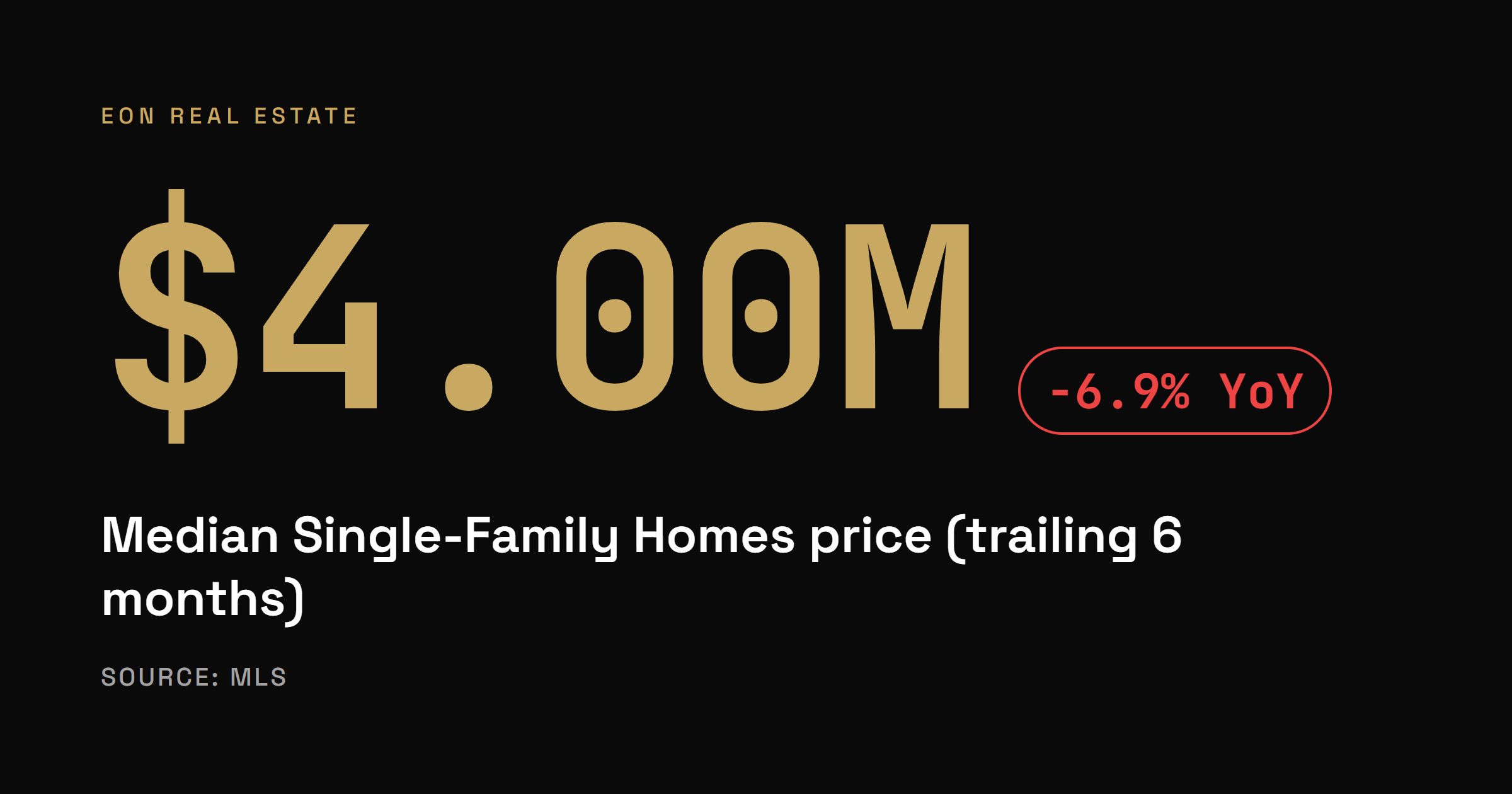
Lake Street is the quiet northern edge of San Francisco's Richmond District, running along the southern edge of the Presidio. As of the trailing six months ending September 2026, single-family homes here close at a $4.00M median, condos at $1.80M, and two-unit buildings at $3.50M. Unless otherwise noted, all market figures in this guide are from MLS data.
If you are searching "lake street san francisco," you are usually trying to answer one question the listing sites blur: what does it actually cost to buy here, and what am I getting for the number. The honest answer is that Lake Street does not have one price. It has several, and they split sharply by property type and by how far east or west of the Presidio you sit. I'm Chris Chour, founder/broker of EON Real Estate. Most of my work is single-family and condo transactions in SF's luxury neighborhoods, and Lake Street is one segment where the type-by-type spread is wide enough that a blended "neighborhood median" will mislead you. This guide walks the real numbers, block by block, so you can read a Lake Street listing the way an appraiser would.
How to read Lake Street prices without getting fooled by the average
The single most useful habit on Lake Street is to price by property type before you price by anything else. Over the trailing six months ending September 2026, the four active type segments closed at very different levels: single-family homes at a $4.00M median, condos at $1.80M, two-unit buildings at $3.50M, and the lone three-unit sale at $2.13M. A single "neighborhood median" that blends those would land near $3.40M (the 180-day blended median across 19 closings) and describe almost none of them accurately.
Per-square-foot tells the same story from another angle. Single-family homes ran a $1,349 median per square foot, condos $1,374, and two-unit buildings $939 over that six-month window. The two-unit discount per foot is not a quality signal. It reflects that duplex square footage includes a second kitchen and the systems of a second dwelling, which buyers value differently than one large single-family floor plan. Here is what I tell buyers first: pick your type, then compare only within it.
The last piece is speed. Single-family homes closed in a median of 10 days on market over the trailing six months, condos in 17. That gap is the market telling you that detached houses in this corridor clear faster than attached homes, so a house buyer needs financing and inspections lined up before the first showing. For a fuller picture of that timeline, see our guide on how long the buying process takes in San Francisco.
Lake Street by the numbers
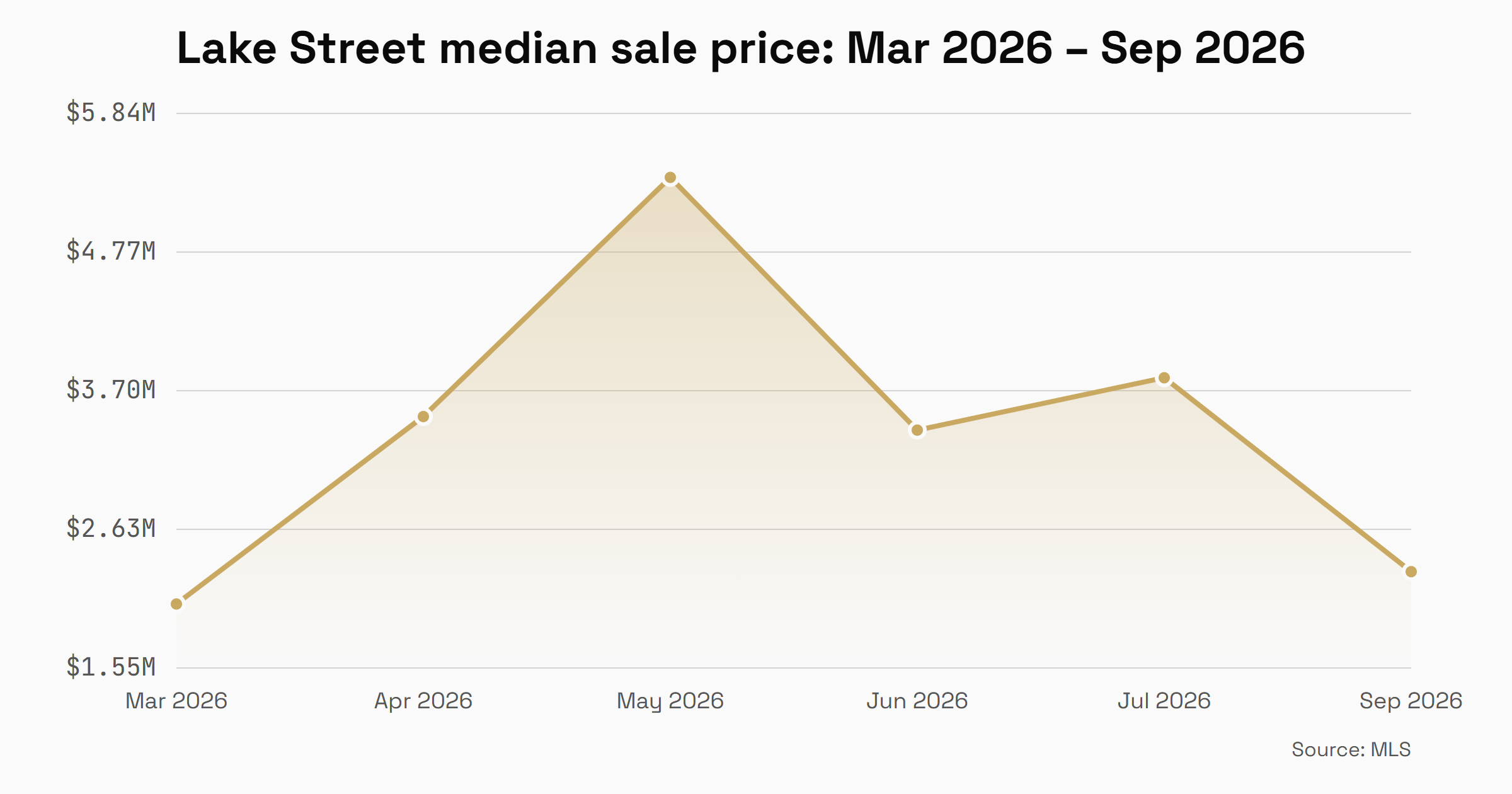
The month-to-month line above swings hard, from a $2.05M median in March 2026 to $5.35M in May and back to $2.30M in September. Do not read that as a market crashing and recovering. Lake Street closes only a handful of homes a month (three in September 2026), so a single trophy sale or a run of small condos moves the monthly median more than any real price shift. This is exactly why the type-segmented medians above are the numbers to anchor on.
The decision tree: which property type fits your budget
Single-family houses ($2.1M to $11.0M)
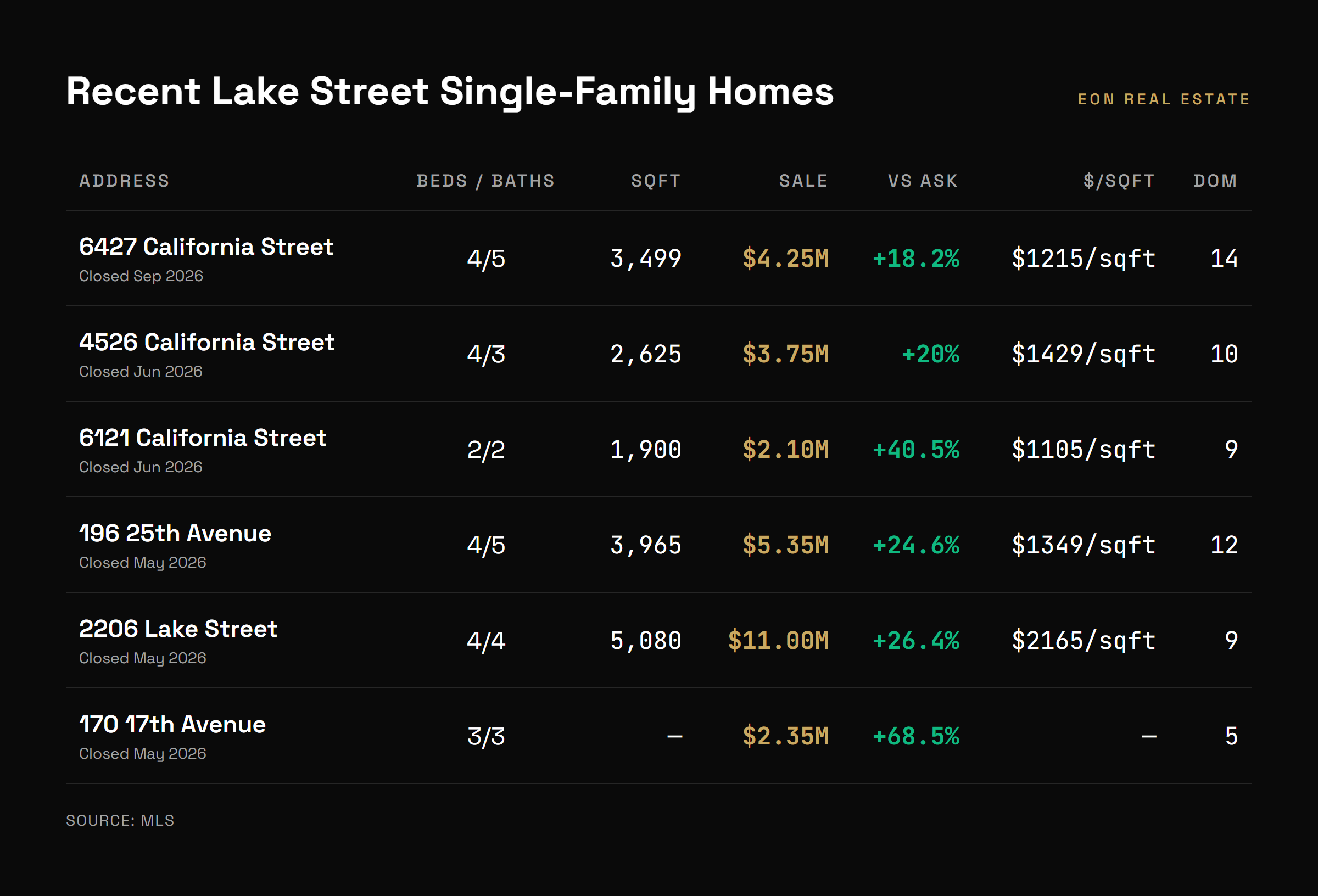
Detached houses are the anchor of Lake Street and the widest range. Over the past six months closings ran from a $2.10M as-is fixer at 6121 California Street to the $11.0M sale at 2206 Lake Street, a renovated 5,080-square-foot house with bridge and ocean views that closed at $2,165 per square foot in May 2026. Condition and view drive nearly all of that spread. The renovated, view-forward houses north of Lake Street command the premium; the as-is and estate-sale houses set the floor.
Condos ($1.2M to $4.1M)
Condos are the entry point and the fastest-growing segment, with the median up 26.3% year over year to $1.80M. The range runs from a $1.2M one-bedroom to the new-construction units at 4135 California Street, where a four-bedroom closed at $4.1M in July 2026. If a condo is your path in, read our full guide to buying a condo in San Francisco before you tour, because HOA structure and warrantability matter more here than the sticker price.
Two-unit and three-unit buildings ($2.8M to $5.55M)
Edwardian duplexes are a Lake Street signature, and the vacant ones command a real premium. A two-unit at 38-40 7th Avenue closed at $5.55M in June 2026 against a $3.495M ask, and 167-169 11th Avenue, a vacant Edwardian duplex, closed at $2.91M in April 2026. Delivered-vacant multi-unit buildings avoid San Francisco's tenant-protection timelines, which is why they clear well above list. A legalized ADU, as at 134-136A 17th Avenue ($3.5M), adds a rentable third dwelling.
The block premium, east versus west
Walkability and price both climb toward the eastern blocks. The east blocks near 7th Avenue and 4100 California Street carry a 98 Walk Score and a 71 Transit Score, versus a 93 walk and 67 transit at the neighborhood center. West Clay Park, the enclave north of Lake Street, is among the top of the market: 29 West Clay Street closed at $7.2M in April 2026, its first sale in over 70 years.
What a purchase looks like in practice
Take the two houses that best show how condition sets price. In June 2026, 6121 California Street, a 1,900-square-foot two-bedroom sold as-is out of a trust, closed at $2.10M, or $1,105 per square foot. By contrast, the renovated, view-forward houses closed near $1,349 per square foot, the six-month segment median. On a 2,000-square-foot house, that gap is roughly $500,000 of value tied entirely to condition and view.
When I pull a comp set on Lake Street, that is the first adjustment I make: strip out the renovated-versus-as-is difference before comparing anything else. A recent, clean example is 6427 California Street, a fully renovated four-bedroom of 3,499 square feet that closed at $4.25M in September 2026 after 14 days, against a $3.595M ask. It sold above list because it was turnkey and vacant. The as-is houses sell too, just to buyers pricing in a renovation budget. Both are fair trades once you know which one you are looking at.
There is also an off-market channel here worth knowing about. Over the trailing window, 32 Lake Street homes closed off the public market (20 single-family, 11 condo, and one tenancy-in-common), per MLS aggregate data. A buyer working only from public listings never sees a large share of the real transaction volume in this neighborhood.
What to consider before you write an offer
The monthly median is noise, not signal
I do not soften this part: the headline "Lake Street median" you will see quoted swings by millions month to month because so few homes trade. Anchor to the type-segmented six-month medians and to per-square-foot within your type. A number built on three September closings is a data point, not a trend.
Condition and view are most of the price
The spread from $1,105 to $2,165 per square foot in the past six months is almost entirely condition and view, not location alone. If you are comparing an as-is house to a renovated one, you are not comparing prices. You are comparing your appetite for a project against someone else's finished work.
Climate and getting around
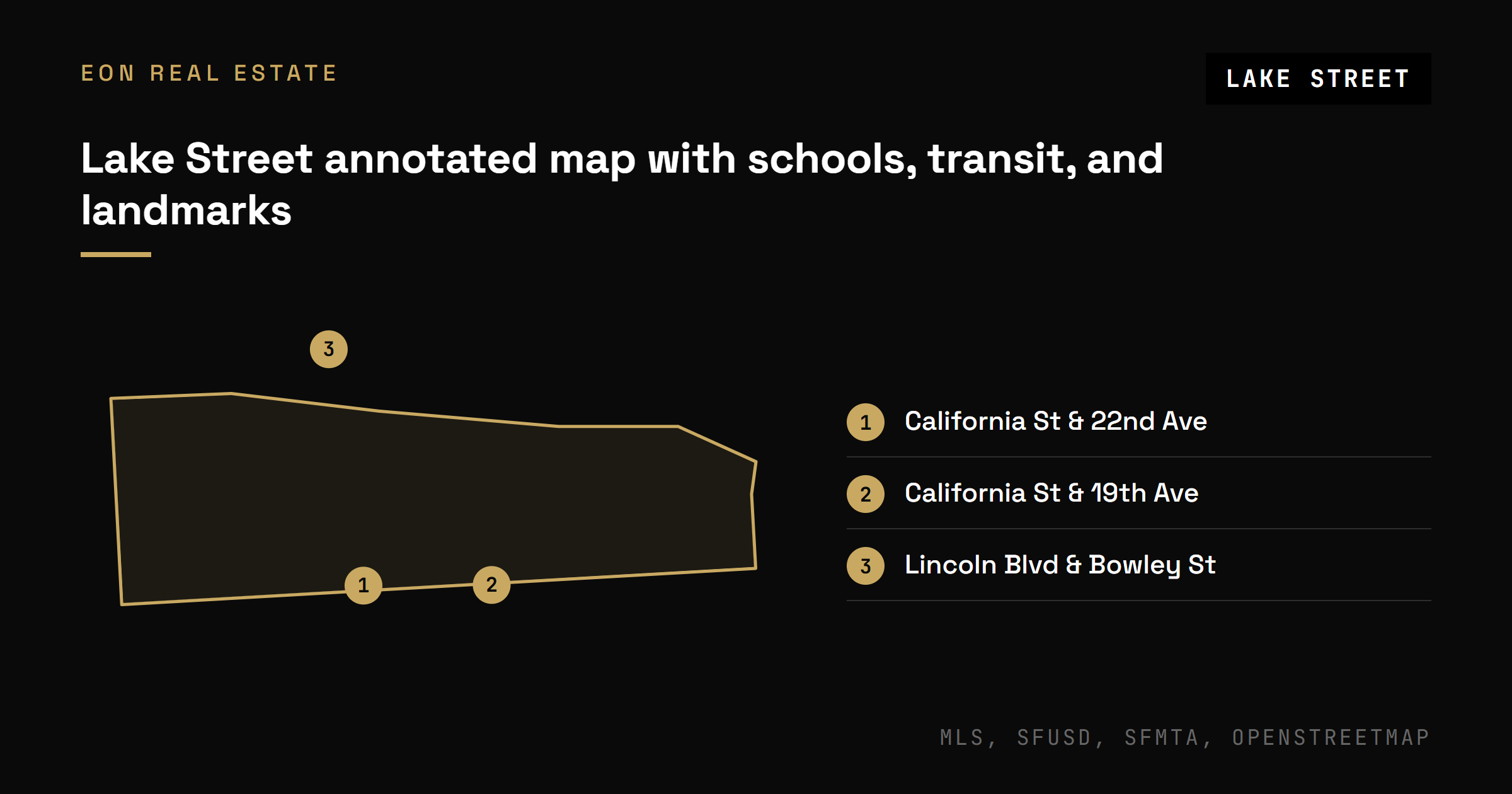
Lake Street runs about a degree cooler than the citywide average (National Weather Service). Transit is the bigger tradeoff: six stops sit within 400 meters of the center on the 1 California and 29 Sunset bus lines, and this is a bus-and-car neighborhood with no rail line. The discipline I would want you to bring is simple: walk your block in the morning and again in the evening before you commit, because the marine influence and the parking picture both shift by time of day.
How much do homes cost on Lake Street in 2026?
Single-family houses carry a $4.00M median close price over the trailing six months ending September 2026, with individual sales ranging from $2.10M to $11.0M. Condos run a $1.80M median and two-unit buildings a $3.50M median over the same window (MLS). Because so few homes trade each month, price by property type rather than by any single blended neighborhood average, which lands near $3.40M and describes almost nothing accurately.
Are Lake Street home prices going up or down?
Up overall: the median close price rose 14.6% over the trailing 12 months ending September 2026, to $2.91M from $2.54M a year earlier. Price per square foot rose 15.9% over the same window (MLS). The picture splits by type, though: condos climbed 26.3% year over year while single-family homes eased 6.9%, so the direction you feel depends entirely on which property type you are shopping.
How fast do homes sell on Lake Street?
Fast: over the trailing six months ending September 2026, single-family homes closed in a median of 10 days on market, and condos in a median of 17 days (MLS). Turnkey, delivered-vacant homes move quickest and frequently above ask: 6427 California Street closed at $4.25M in September 2026 after 14 days against a $3.595M list. Have financing and inspection contingencies ready before you tour.
What is the Lake Street neighborhood known for?
Lake Street is known in 2026 for early-1900s architecture along the Presidio's southern edge, anchored by Mountain Lake Park and the West Clay Park enclave. The housing is overwhelmingly detached houses and Edwardian duplexes built around a 1938 median year (US Census, 2023), on a walkable street grid scoring 93 on Walk Score. It is a low-turnover, owner-occupied pocket: owner occupancy runs 26.2% at the block-group level (US Census, 2023).
Is a house, a condo, or a two-unit building the better buy on Lake Street?
It depends on your budget and your appetite for tenants, as of 2026. A condo is the entry point at a $1.80M median and the fastest-appreciating type, up 26.3% year over year. A house at a $4.00M median gives you land and the widest resale pool. A two-unit building at $3.50M adds rental income but carries San Francisco's tenant-protection rules, which is why vacant duplexes here trade at a premium (MLS).
Talk to me about Lake Street
When you are ready to look seriously, I can pull the block-by-block comps for your exact property type and price tier, including the off-market activity you will not find on the public sites. EON is a member of Top Agent Network, an invite-only group of the top 1% of local agents by production (Top Agent Network). If you are weighing Lake Street against nearby options, our guides to Jordan Park and San Francisco's richest neighborhoods are a good next read.