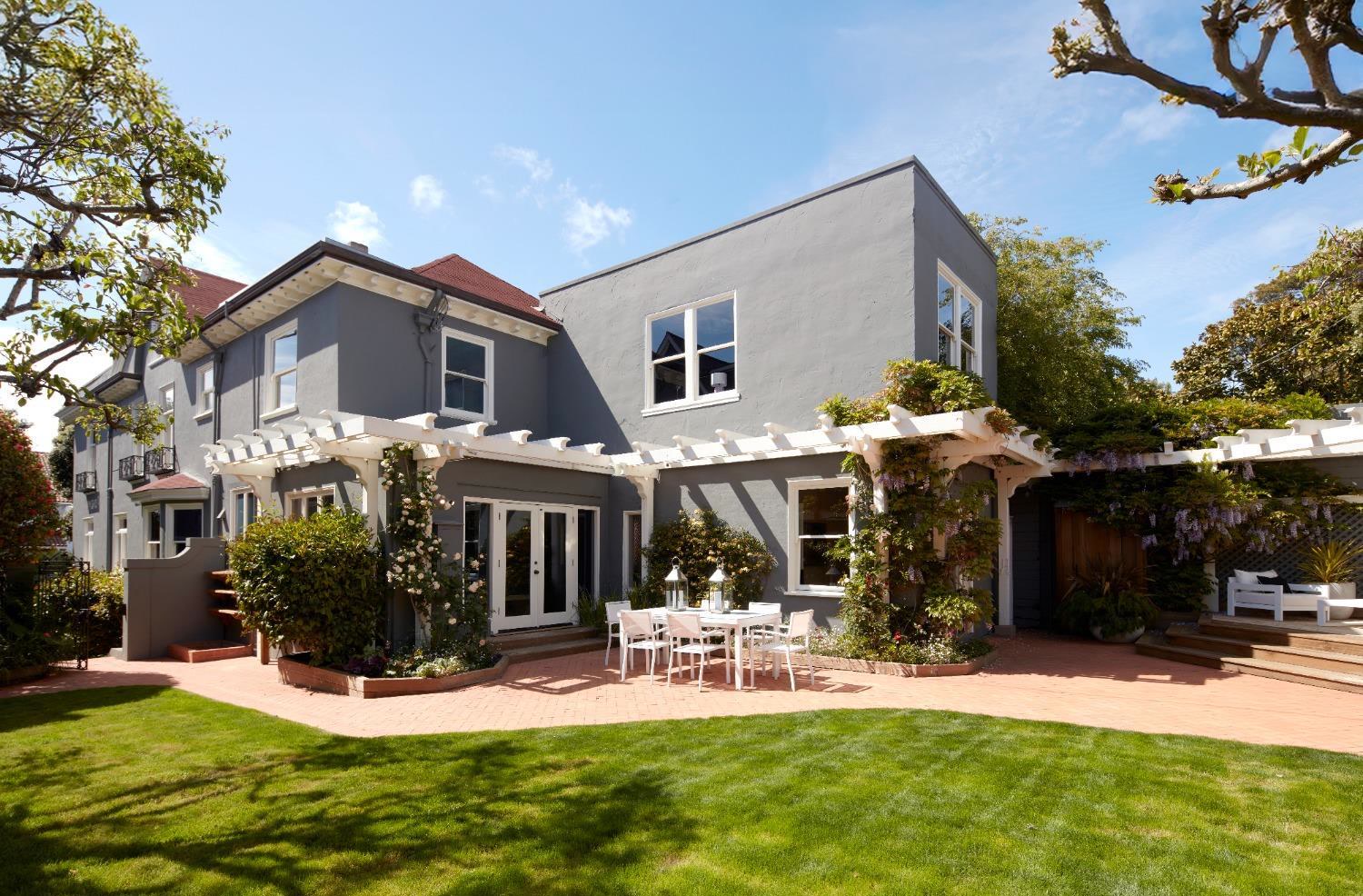
Jordan Park is a small, low-turnover residential pocket in San Francisco's District 1, between Presidio Heights and Laurel Heights. As of Q3 2026, single-family homes close at a median near $2.7M and condos near $1.44M, but only about ten homes trade across the neighborhood in a two-year span.
Unless otherwise noted, all market figures in this guide are from MLS data.
The first thing to understand about Jordan Park is scarcity. Across the whole neighborhood, roughly ten sales closed over the past two years, and none were active on the market as I write this in September 2026. That is the defining fact here, more than any single price. I'm Chris Chour, founder and broker of EON Real Estate. Most of my work is single-family and condo transactions in SF's luxury neighborhoods, and after running comp sets across Jordan Park's recent closings, the pattern I keep seeing is fast, quiet sales of early-1900s homes to buyers who already knew the block they wanted. The postcard version of this neighborhood is calm streets and mature trees. The market version is a handful of homes a year, most of them gone in under two weeks.
Jordan Park by the numbers
These figures come from recent closed sales across Jordan Park and the immediately similar blocks around it. Because the neighborhood trades so rarely, the picture is built from a two-year window rather than a single quarter, so read each number as a structural read rather than a monthly pulse.
For context, the citywide median close over the trailing twelve months sits at $1.75M at about $1,196 a square foot (MLS). Jordan Park's overall median of roughly $1.98M runs about 13% above that citywide number, and its per-square-foot figure is around 12% higher. The premium is real but not extreme: this is a quiet residential enclave, not a trophy-view corridor, and the numbers reflect solid pre-war homes rather than penthouses.
What actually trades, and at what price
Jordan Park sells across three property types, and mixing them into one number would hide more than it shows. So here is each segment on its own, drawn from the recent closed sales.
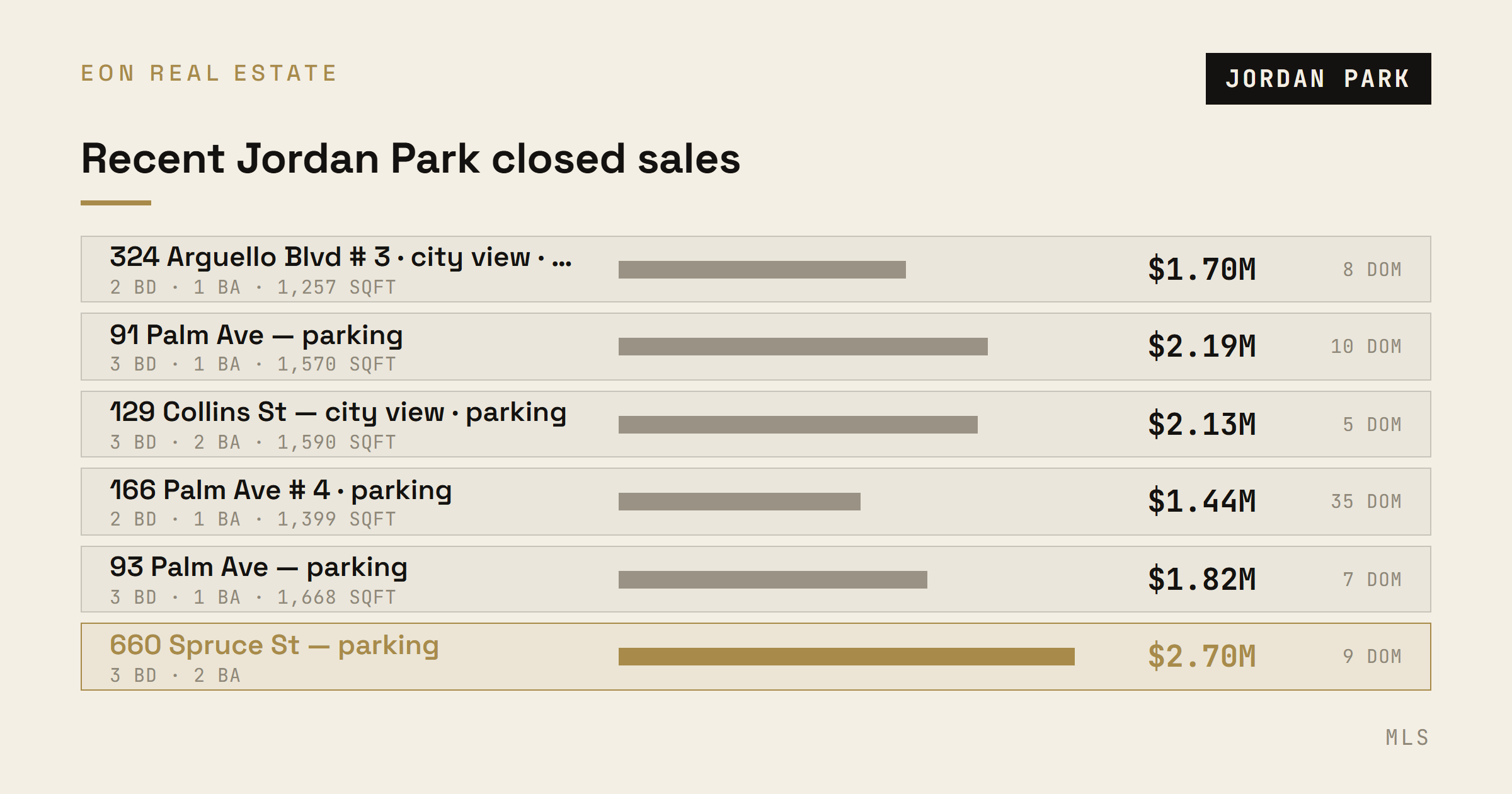
Single-family homes are the top of the market and the widest range. Five detached houses closed recently, from 22 Wood Street at $1.675M up to 35 Commonwealth Avenue at $7.5M, a nearly 4,800-square-foot home that closed in six days. The 35 and 44 Commonwealth Avenue sales (the latter at $5.4M) show the neighborhood's high end: large houses, both over 4,000 square feet, on its most prized street. The median single-family close landed at $2.7M, so most buyers here are not shopping at the Commonwealth ceiling. They are competing for three-bedroom houses in the $2M to $2.7M range, like 129 Collins Street, which closed at $2.13M in just five days.
Condos are the entry point. Three condo sales closed from $1.225M to $1.7M, a median near $1.44M. The spread tracks finish, view, and timing: 166 Palm Avenue #3, a renovated two-bedroom, closed at $1.225M in September 2025, while 324 Arguello Boulevard #3, a remodeled two-bedroom with a city view, reached $1.7M in August 2026. If your budget tops out around $1.5M and you want into this neighborhood, the condo segment is where you will find room. Our 2026 guide to buying a condo in San Francisco walks through the HOA and warrantability questions worth asking before you write that offer.
TICs (tenancy-in-common units) sit in between, and the sample is thin: two closings, at 93 Palm Avenue for $1.825M and 91 Palm Avenue for $2.185M, both renovated. Two sales is not enough to publish a reliable median, so treat TIC pricing here as case-by-case. It matters because TIC financing is different from a standard mortgage, a point I come back to in the buyer playbook below.
Where homes actually trade
Because Jordan Park is compact, the same handful of streets carry most of the volume. Palm Avenue is the workhorse: four of the ten recent closings were on Palm, spanning condos and TICs, from $1.225M to $2.185M. Commonwealth Avenue is the prestige address, home to both multimillion-dollar sales. Collins Street, Spruce Street, Wood Street, and Arguello Boulevard round out the rest. On walkability the whole area scores a 95 Walk Score, described as a Walker's Paradise, with a 71 Transit Score and an 87 Bike Score.
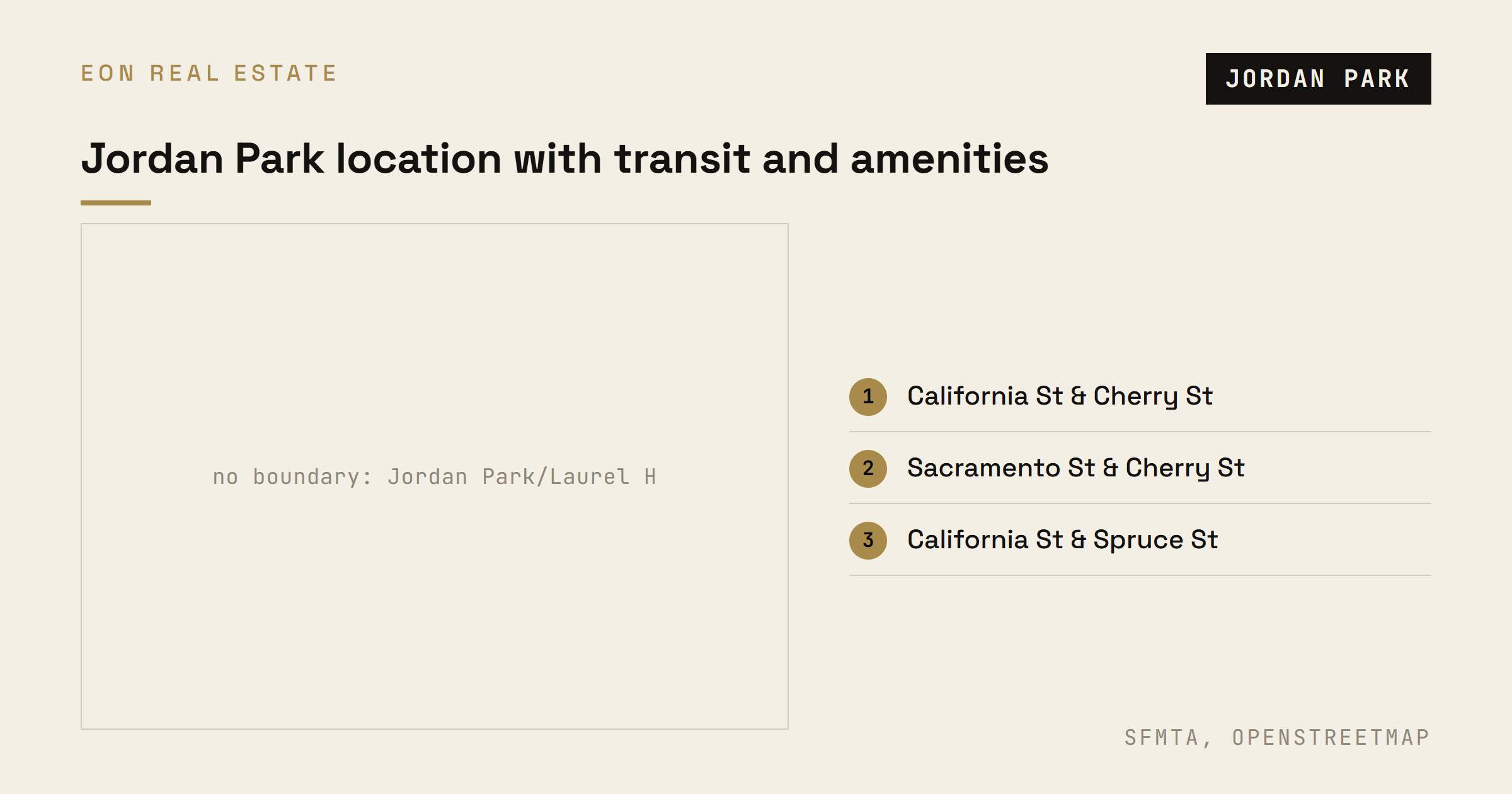
Transit is bus-based and close. The 1 California and 1X California Express run along California Street a two-minute walk from the neighborhood's center, and the 33 Ashbury-18th Street line stops at Sacramento and Cherry (SFMTA). The Geary Boulevard corridor sits within roughly a half-mile to the south. What you will not find nearby is a rail or subway station, so daily commuters lean on the California Street buses or a car.
How the homes break down
Jordan Park is a pre-war neighborhood. The recent closings were built largely in the 1910s and 1920s (MLS), and the local block group carries a median build year of 1938 (Census ACS), so most of what trades here is Edwardian-era and early-mid-century, not new construction. That shows up in the floor plans: paned-glass windows, refinished hardwood, one-car garages tucked under the living floors, and periodic gut-renovations behind period facades. Six of the ten recent sales were flagged as renovated.
The ownership picture is mixed. In the local block group, only about 110 of 633 occupied units are owner-occupied (Census ACS), which tells you a meaningful share of the building inventory is rented or held as TIC and condo tenancies rather than owned single-family houses. For a buyer, that means the detached-house segment is genuinely scarce, and the condo and TIC segments carry the tenancy and financing considerations you would expect in an older, denser pocket.
What to consider before buying here
Every neighborhood has tradeoffs, and Jordan Park's are specific. Here are the three I raise with buyers before they fall for the tree-lined streets.
Inventory is structurally thin
I don't sugarcoat this part: you cannot shop Jordan Park on your own timeline. With about ten sales across two years and nothing active as of September 2026, you may wait months for a home in your segment to list, then face fast competition when it does. Most recent closings went pending in under two weeks. If you need to buy by a fixed date, treat this neighborhood as one option among several nearby, not the only target.
TIC and condo financing is not a standard mortgage
A good share of the more affordable homes here are TICs and condos, and both carry considerations a detached house does not. TIC purchases often use fractional or shared financing rather than a conventional loan, and condo lending depends on HOA health and warrantability. Confirm the financing path and any HOA questions with your lender before you write an offer, because it can affect both your rate and your timeline.
Transit is buses, and the fog is close
This is a car-friendly, bus-served pocket, not a rail neighborhood, so weigh your commute honestly. On climate, National Weather Service station readings near Jordan Park run about 1.2°F cooler than the citywide average, so expect crisp afternoons rather than a warm-side sun pocket. Neither is a dealbreaker, but both are worth feeling out on a weekday afternoon before you commit.
Buyer and seller playbook for Jordan Park
If you are buying in Jordan Park in 2026, here is the discipline that wins. Start your comp set with the recent in-neighborhood closings, then adjust for the levers that actually move price at the table. Parking is close to universal here (nine of ten recent sales had it), so a home without it should price below the comps, not with them. Condition matters: a renovated, move-in-ready interior supports price, and a fixer should be underwritten with a real renovation budget, not hope.
Offer strategy turns on deal-specific dynamics, not a single timing rule. A clean, well-qualified offer can beat a higher one that carries financing risk, especially on a TIC where the lending path is narrower. Ask how many offers are in: a lone offer is a negotiation, several offers is an auction. And check occupancy, because a tenant-occupied unit carries San Francisco's owner move-in rules and timing that a vacant home does not. Here's what I'd tell you: pick your segment, get your financing pre-approved for that property type, and be ready to move the week a home lists.
For sellers, the scarcity cuts in your favor. With so little competing inventory, a correctly priced, well-presented home in a wanted segment tends to sell fast and clean, as the sub-two-week sale times show. The sellers I work with here do best when they lean into what the data rewards: parking, a renovated interior, and honest disclosure that keeps a fast deal from unraveling in escrow. EON is recognized among the Top 1% of agents by Top Agent Network, and the way we earn that is by pricing to the comps and the buyer levers, not to a hopeful headline. If you want to see how Jordan Park stacks up against the city's priciest pockets, our ranking of San Francisco's richest neighborhoods in 2026 puts it in context.
Where is Jordan Park located?
As of 2026, Jordan Park is a small residential neighborhood in north-central San Francisco's District 1, bordered by Presidio Heights to the north and Laurel Heights to the west, roughly between California Street and Geary Boulevard around Palm, Commonwealth, and Jordan Avenues. It sits just east of the Richmond District and a short drive from the Presidio. The area is compact, low-density, and almost entirely residential, which is part of why it trades so rarely.
How much do homes cost in Jordan Park?
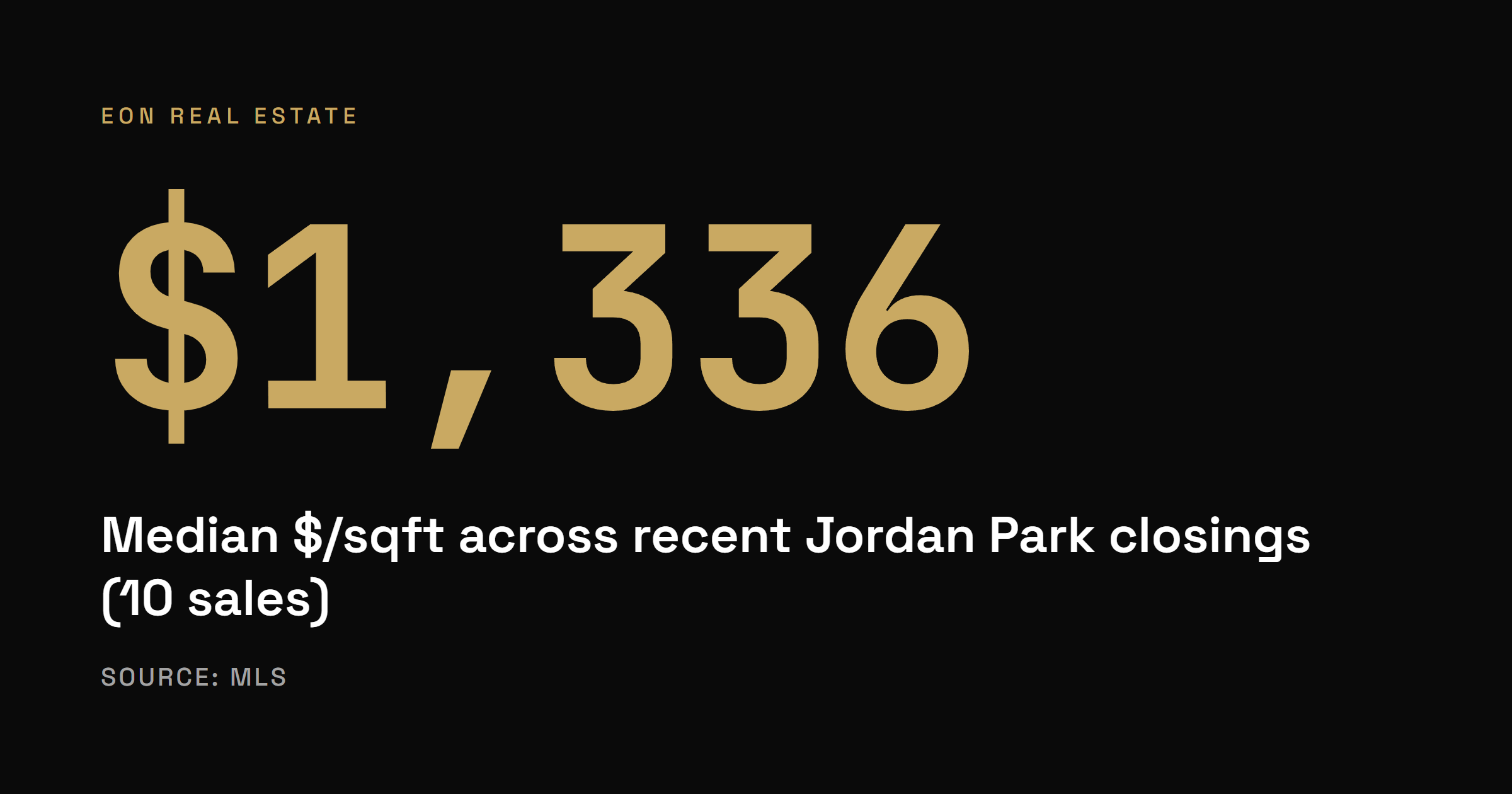
As of Q3 2026, single-family homes in Jordan Park close at a median near $2.7M, with recent sales ranging from $1.675M to $7.5M depending on size and street (MLS). Condos run lower, a median near $1.44M, and the two recent TIC sales landed at $1.825M and $2.185M. On a per-square-foot basis, recent closings averaged about $1,336, roughly 12% above the citywide figure of $1,196.
Is Jordan Park a good place to buy in 2026?
As of 2026, Jordan Park suits a buyer who values a quiet, walkable, pre-war residential pocket and can be patient, because inventory is very thin: about ten sales across two years and nothing active in September 2026 (MLS). The upside is a 95 Walk Score, near-universal parking, and homes that hold value. The tradeoff is limited choice and fast competition when a home in your segment finally lists.
How fast do homes sell in Jordan Park?
As of 2026, homes in Jordan Park sell quickly. Most recent closings went pending in under two weeks, with several selling in under ten days, including 129 Collins Street in five days and 35 Commonwealth Avenue in six (MLS). That pace runs ahead of the citywide median of about twelve days. The exception was a condo that took 35 days, a reminder that finish and pricing still decide speed within the neighborhood.
What types of homes are in Jordan Park?
As of 2026, Jordan Park offers three property types: detached single-family houses, condos, and TICs, most built in the 1910s and 1920s with a local median build year of 1938 (Census ACS). Single-family houses form the high end and the widest price range, condos are the entry point near $1.44M, and TICs sit in between. Six of the ten recent sales were renovated, so move-in-ready and period-original homes both trade here.
Does Jordan Park have good transit and walkability?
As of 2026, Jordan Park earns a 95 Walk Score (Walker's Paradise) and a 71 Transit Score (Excellent Transit). The 1 California and 1X California Express buses run along California Street within a two-minute walk, and the 33 Ashbury-18th Street stops nearby (SFMTA). There is no rail or subway station in the neighborhood, so daily commuters rely on buses or a car. An 87 Bike Score makes it very bikeable for the confident cyclist.
Talk to me about Jordan Park
When you are ready to look at Jordan Park, the useful next step is a real comp set for your exact segment, single-family, condo, or TIC, priced against the recent closings and the levers that move them. I can pull that for you, flag what is likely to list next, and walk the financing path for a condo or TIC before you are up against a two-week clock. Reach out and let's map it to your budget and timeline!