San Francisco's richest neighborhoods, measured by closed sale price in 2026, are Presidio Heights, Russian Hill, Cow Hollow, Pacific Heights and Sea Cliff for single-family homes, while the Marina, Presidio Heights and Cow Hollow lead for condos. Ranking by property type matters, because a blended median mixes two very different markets into one misleading figure.
The headline number people chase is the single-family top of the market, and in 2026 that title belongs to Presidio Heights at an $8.08M median across 4 closings over the trailing 6 months. Unless otherwise noted, all market figures in this guide are from MLS data. After pulling every closed sale in the city and ranking neighborhoods by property type, I keep single-family homes and condos on separate lists, because the "richest neighborhood" answer flips depending on which one you buy. The Marina, which does not even crack the top single-family tier, is the most expensive condo market in the city.
A word on what "richest" means here. This ranking is built from what homes actually closed for, not list prices or asking prices, and not from who happens to live where. A neighborhood with four eight-figure sales reads differently from one with forty seven-figure sales, so I print the closed count beside every median. Where a neighborhood had fewer than three closings of a property type in the window, its number is a single sale price rather than a median, so it is flagged as thin data rather than ranked.
San Francisco's richest neighborhoods by the numbers
The most expensive neighborhoods for single-family homes
Ranked by single-family median over the trailing 6 months, with at least three closings to qualify, the top of the market looks like this. Presidio Heights, Cow Hollow, Pacific Heights, and the Marina all sit in District 7, and Russian Hill and Telegraph Hill in District 8, so the single-family premium is concentrated in the northern hills more than anywhere else in the city.
| Rank | Neighborhood | District | Median close | Closings | Avg days on market |
|---|---|---|---|---|---|
| 1 | Presidio Heights | 7 | $8.08M | 4 | 8 |
| 2 | Russian Hill | 8 | $7.80M | 8 | 8 |
| 3 | Cow Hollow | 7 | $7.13M | 5 | 12 |
| 4 | Pacific Heights | 7 | $6.85M | 25 | 45 |
| 5 | Sea Cliff | 1 | $6.25M | 9 | 8 |
| 6 | Marina | 7 | $5.75M | 10 | 36 |
| 7 | Alamo Square | 6 | $5.70M | 4 | 39 |
| 8 | Haight-Ashbury | 5 | $4.90M | 5 | 11 |
| 9 | Telegraph Hill | 8 | $4.65M | 6 | 14 |
| 10 | Buena Vista / Ashbury Heights | 5 | $4.61M | 8 | 14 |
Two things stand out. Pacific Heights is the deepest of these markets, with 25 single-family closings behind its $6.85M median, so its number is the most reliable read on where the top tier actually trades. The Presidio Heights figure at the very top, by contrast, rests on 4 closings, which is enough to rank but thin enough that one or two large sales move it. Sea Cliff, at a $6.25M median across 9 closings, sold in a median of 8 days, faster than Pacific Heights at 45, a reminder that a higher price and a quicker sale do not always travel together.
The priciest condo neighborhoods
The condo ranking is a different map. The Marina leads at a $2.40M median across 18 closings, and Cow Hollow matches it for depth with 18 condo closings at $2.13M. Presidio Heights and the northern-hill neighborhoods still show up, but the condo premium spreads wider across the city than the single-family premium does.
| Rank | Neighborhood | District | Median close | Closings | Avg days on market |
|---|---|---|---|---|---|
| 1 | Marina | 7 | $2.40M | 18 | 13 |
| 2 | Presidio Heights | 7 | $2.35M | 8 | 10 |
| 3 | Jordan Park / Laurel Heights | 1 | $2.20M | 3 | 7 |
| 4 | Cow Hollow | 7 | $2.13M | 18 | 20 |
| 5 | Lake Street | 1 | $2.05M | 5 | 30 |
| 6 | Lone Mountain | 1 | $2.05M | 8 | 11 |
| 7 | Cole Valley / Parnassus Heights | 5 | $1.94M | 12 | 18 |
| 8 | Treasure Island | 9 | $1.90M | 3 | 84 |
| 9 | North Panhandle | 6 | $1.84M | 26 | 15 |
| 10 | Central Richmond | 1 | $1.82M | 11 | 10 |
Treasure Island is the outlier to read carefully: its $1.90M condo median across 3 closings came with an 84-day average on market, roughly six times the Marina's 13 days, which tells you the price and the speed of sale are two separate stories. If you are weighing a condo purchase against a house, the condo buyer's guide walks through how HOA dues, floor level, and parking move a unit's value inside the same building.
What the ranking hides
A price rank is a starting point, not a verdict. Three things it does not show on its own are worth naming before you use it to pick a neighborhood.
First, closing counts. Presidio Heights ranks first among single-family homes on 4 closings, and Alamo Square ranks seventh on 4. A median built on four sales can swing hard with the next big transaction, while Pacific Heights (25 single-family closings) and Noe Valley (38 condo closings) are far steadier reads. When two neighborhoods sit near each other in the rank, the one with more closings behind its number is the more trustworthy one.
Second, days on market. Speed and price do not move together. Sea Cliff and Russian Hill both closed in a median of 8 days at the top of the single-family list, while Pacific Heights took 45 and the Marina 36. A fast sale at a high price signals real depth of demand. A slow one at a high price can mean a single trophy sale dragged the median up while the rest of the market sat.
Third, district clustering. The richest single-family neighborhoods are not scattered evenly. They pile into District 7 (Pacific Heights, Cow Hollow, Presidio Heights, the Marina) and District 8 (Russian Hill, Telegraph Hill, Nob Hill). District 7's single-family median alone is $6.80M across 44 closings, the highest of any district in the city. At the other end, District 10 in the city's southeast carries a $1.30M single-family median across 169 closings, a reminder that "the SF market" is really ten markets in a trench coat.
How the housing breaks down across the city
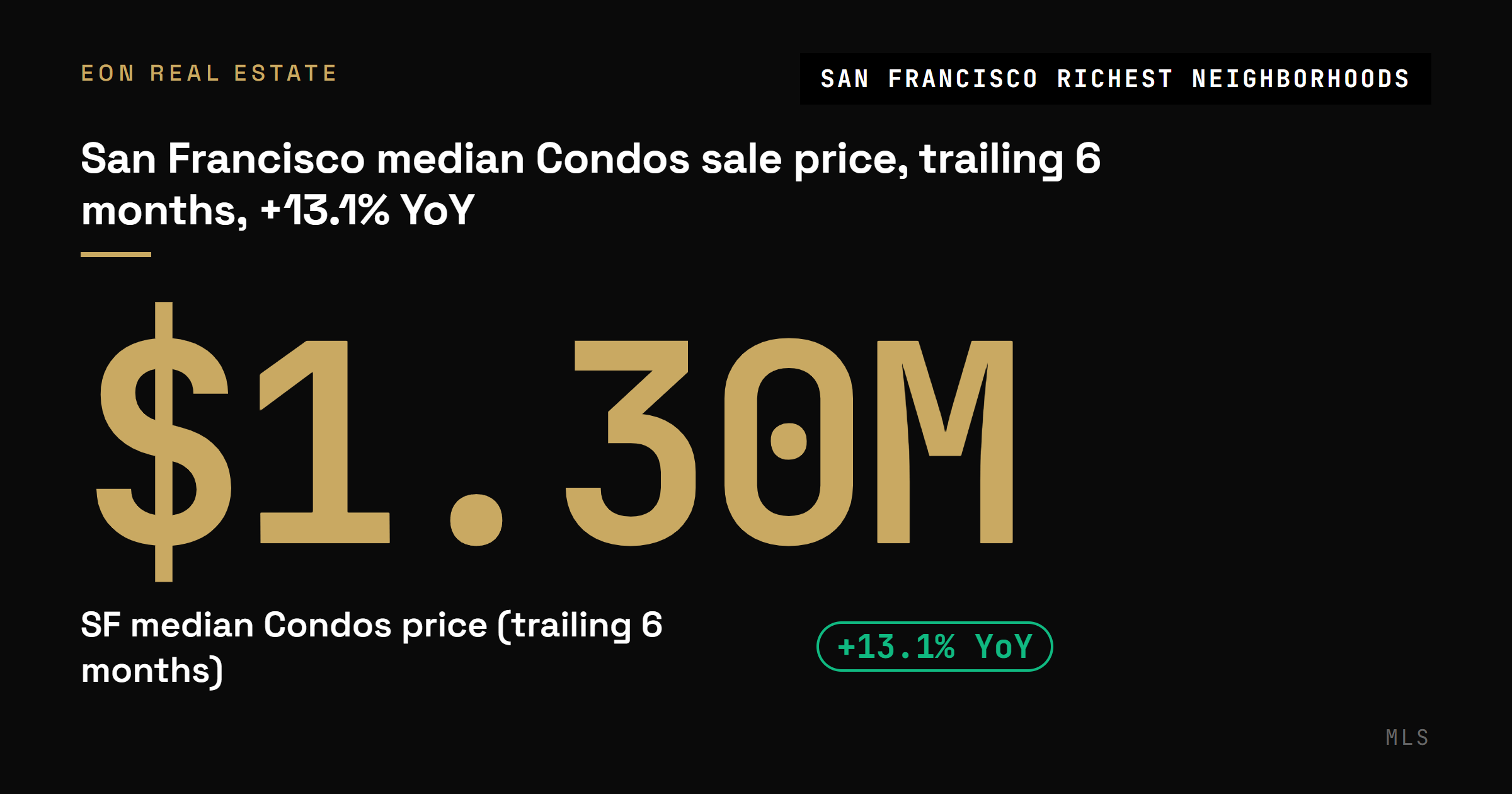
Behind the neighborhood rankings, the citywide picture divides cleanly by property type. Over the trailing 6 months, single-family homes closed at a $2.20M median across 973 sales, condos at $1.30M across 1,150 sales, and two-unit buildings at $2.13M across 138 sales. Single-family prices are up about 27.6% year over year and condos about 13.1%, the one long-range figure worth keeping in view while the rest of this guide stays on the last few months.
Property type is the fault line under every neighborhood number. In Pacific Heights, single-family homes closed at a $6.85M median while condos in the same neighborhood closed at $1.60M, a gap of more than fourfold inside one set of ZIP codes. That is why a single "neighborhood median" is close to meaningless in the richest parts of the city, and why the tables above keep houses and condos apart. When someone tells you what a neighborhood "costs," the first question back is always which property type they mean.
The most affordable single-family neighborhoods, for contrast, are Silver Terrace at a $1.06M median across 9 closings and Bayview at $1.07M across 17, both in District 10. The spread from there to Presidio Heights is nearly eightfold, wider than most buyers expect a single city to hold.
What to consider before chasing a "richest neighborhood"
A top-of-the-rank neighborhood is not automatically the right buy. Here are the tradeoffs I walk clients through before they anchor on a name from a list like this one.
A thin count can mislead you
The neighborhoods at the very top of the single-family list often have the fewest sales behind them. Presidio Heights (4 closings) and Alamo Square (4 closings) rank on small samples, so their medians are more volatile than deeper markets. If price certainty matters to you, weight neighborhoods with double-digit closing counts more heavily than the raw rank order.
Speed of sale varies more than the rank suggests
I don't sugarcoat this part: a high median does not mean homes there sell easily. Pacific Heights single-family homes took a median of 45 days to sell, more than five times Sea Cliff's 8, even though the two sit within a few million dollars of each other. In the slower pockets you have negotiating room; in the fast ones you need to be ready to move.
The tax and carrying cost scale with the price
An $8M purchase carries an assessed-value property tax bill that dwarfs a $1.3M one, and it resets to the new sale price at close. Before you fall for a headline median, run the annual carrying cost. My guide to how San Francisco property tax works lays out the base rate and the reassessment mechanics so the number does not surprise you in your first December bill.
Buyer and seller playbook for the top tier
If you are buying at the top of this ranking in 2026, the comp discipline that wins is narrow and recent. Pull the last 6 months of closings for the exact property type and, where the count allows, the last 90 days, because a $6M-plus market can shift faster than an annual average shows. In a neighborhood with only a handful of closings, widen the window before you widen the geography, and treat one trophy sale as an outlier until a second confirms it.
The offer itself turns on levers the median cannot show you: whether the seller has other offers in hand, whether the buyer is financing or paying cash, whether the home is vacant or occupied, and whether it is turnkey or needs work. A clean cash offer can beat a higher financed one, and a home that sat for 45 days is a different negotiation from one that sold in 8. On the sell side, price to the recent per-type comps rather than to the neighborhood's reputation, and lead with condition and parking, the two things that reliably move a top-tier number.
If you are selling, the same recency rule protects you. The trailing-6-month median in your neighborhood, segmented to your property type and stamped with its closing count, is the honest anchor. Reaching back to a year-old peak sale to justify a list price is the fastest way to earn the 45-day timeline instead of the 8-day one.
Where do the billionaires live in SF?
In 2026, the closed-sale data points to Presidio Heights, Russian Hill, and Cow Hollow, where single-family medians run $8.08M, $7.80M, and $7.13M over the trailing 6 months. We don't publish where any individual lives, and MLS data tracks sales, not residents. What the numbers do show is that the very top of the single-family market concentrates in the northern hills of Districts 7 and 8 rather than in any one building or street.
What is the most posh area in San Francisco?
By 2026 sale price, Presidio Heights is the single most expensive single-family area at an $8.08M median, though it rests on just 4 closings over the trailing 6 months. Pacific Heights is the deeper luxury market, with 25 single-family closings behind a $6.85M median, which makes it the more reliable read on sustained top-tier demand. Both sit in District 7, the priciest district in the city.
What neighborhood does Nancy Pelosi live in?
As a matter of policy in 2026, we don't publish where any named individual lives, and MLS data records sales rather than residents. The neighborhoods that carry the city's highest single-family medians are Presidio Heights at $8.08M, Russian Hill at $7.80M, and Pacific Heights at $6.85M over the trailing 6 months. Those District 7 and 8 pockets are the ones most associated with the top of the market.
Where is the billionaires row in San Francisco?
The phrase usually points at the top single-family blocks of Pacific Heights, which in 2026 posted a $6.85M median across 25 closings, the deepest high-end market in the city. Presidio Heights, just west, actually carries a higher $8.08M median over the trailing 6 months, though on only 4 closings. Both sit in District 7, which holds the city's highest district-level single-family median at $6.80M.
What is the wealthiest part of San Francisco?
Measured by 2026 closed prices, the wealthiest part of the city is District 7, whose single-family median is $6.80M across 44 closings over the trailing 6 months, the highest of any district. Within it, Presidio Heights ($8.08M), Cow Hollow ($7.13M), and Pacific Heights ($6.85M) lead. District 8, home to Russian Hill and Telegraph Hill, is the next tier down.
Where do most celebrities live in San Francisco?
We don't track or publish residents by name in 2026, so the sale record is the better guide: the neighborhoods with the highest single-family prices are Presidio Heights ($8.08M), Russian Hill ($7.80M), and Cow Hollow ($7.13M) over the trailing 6 months. The privacy-heavy, view-blessed blocks of Districts 7 and 8 are where the largest sales cluster, which is the closest the data comes to answering the question.
Talk to me about San Francisco's richest neighborhoods
If you want this ranking cut to your exact search, I can pull the per-type comp set for any neighborhood on these lists, segmented by house or condo, with the closing count and days-on-market behind every median so you see how solid the number really is. I'm Chris Chour, founder and broker of EON Real Estate, recognized in the top 1% of agents by Top Agent Network, and most of my work is single-family and condo transactions in SF's luxury neighborhoods. Send me the neighborhood and property type you are weighing, and I will send back the current comps.
Last updated: September 15, 2026