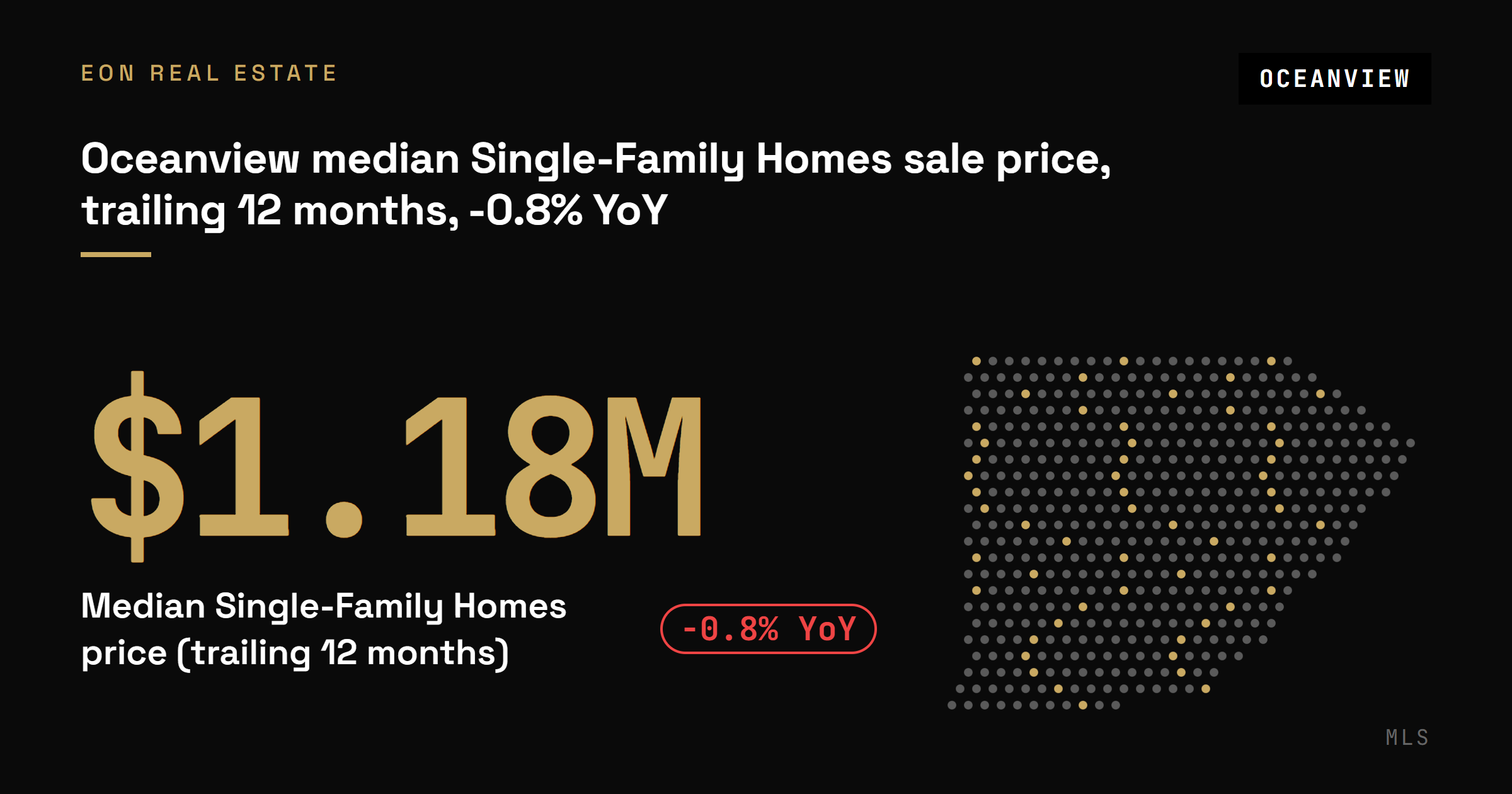
Oceanview single-family homes closed at a median of $1.18M over the trailing year through September 2026, at $785 per square foot, selling in a median of 20 days. The headline median hides the real story: renovated houses overbid this fall while as-is houses sold at or below list.
Unless otherwise noted, all market figures in this guide are from MLS data.
Oceanview sits at San Francisco's southern edge, inside the 94112 ZIP, a grid of compact early-20th-century houses on the hill above the M Muni line. It is one of the last parts of the city where a detached house trades with a one in front of the price instead of a two or a three. I have watched Oceanview trade through several cycles, and the split between renovated and as-is houses has never been wider than it is this fall. The blended citywide median sits at $1.75M, so a sub-$1.2M detached house reads like a bargain on paper. Whether it actually is depends almost entirely on what the last owner did to the kitchen and the foundation. Here is the breakdown by the numbers, the comps that set the range, the tradeoffs I would weigh, and where Oceanview sits against the city's priciest addresses.
Oceanview by the numbers
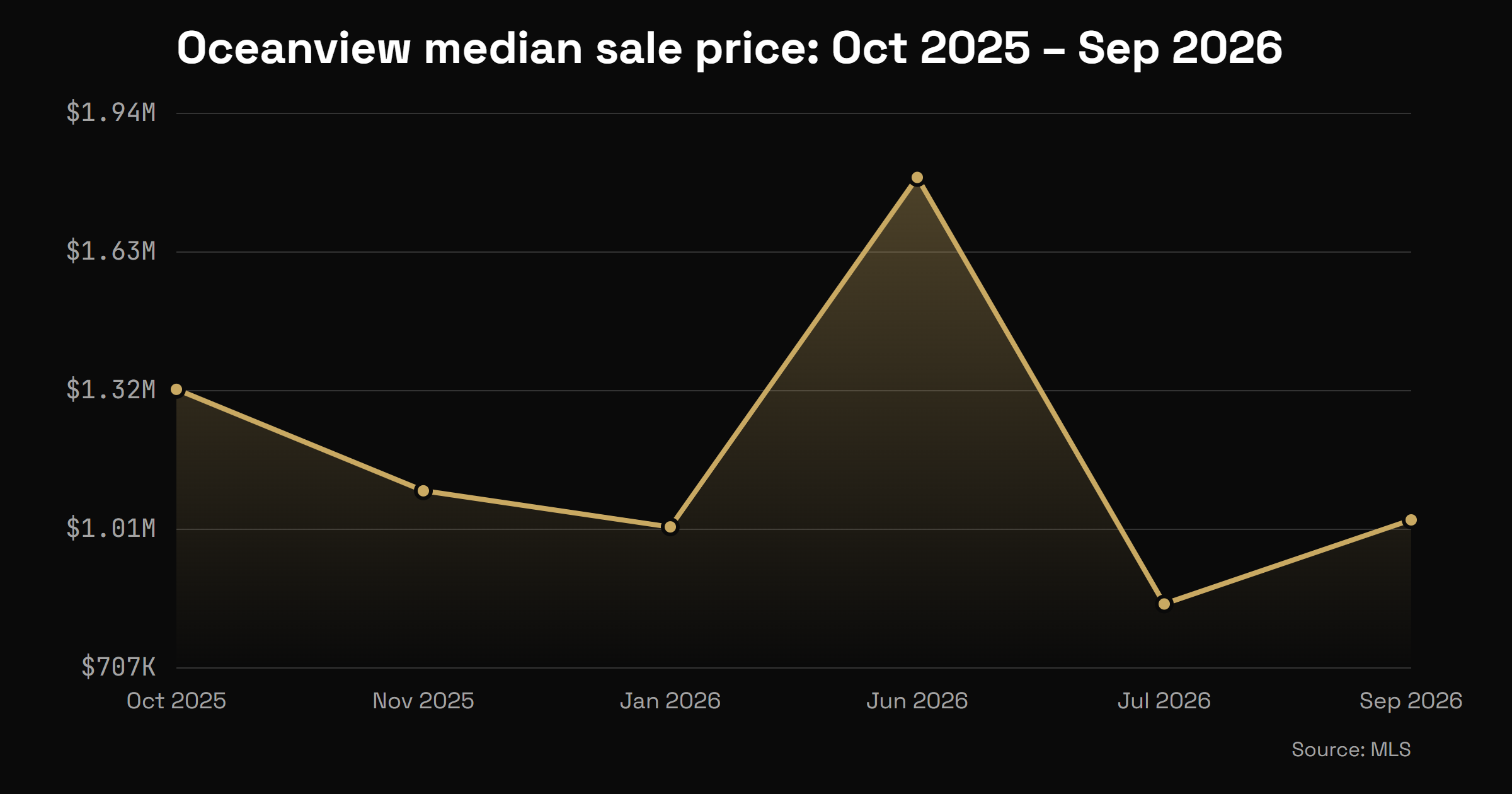
Ten single-family homes closed in Oceanview over the 12 months through September 2026, with one active listing on the market as of early October. That is thin volume, and it is worth saying plainly: in a neighborhood that turns over ten houses a year, a single median tells you less than the individual sales do. The median held almost flat, down 0.8% from the $1,187,500 of the prior 12 months, while the median price per square foot held near $785. What moved was not the average. It was the distance between the best and worst outcomes.
The renovated-versus-as-is spread
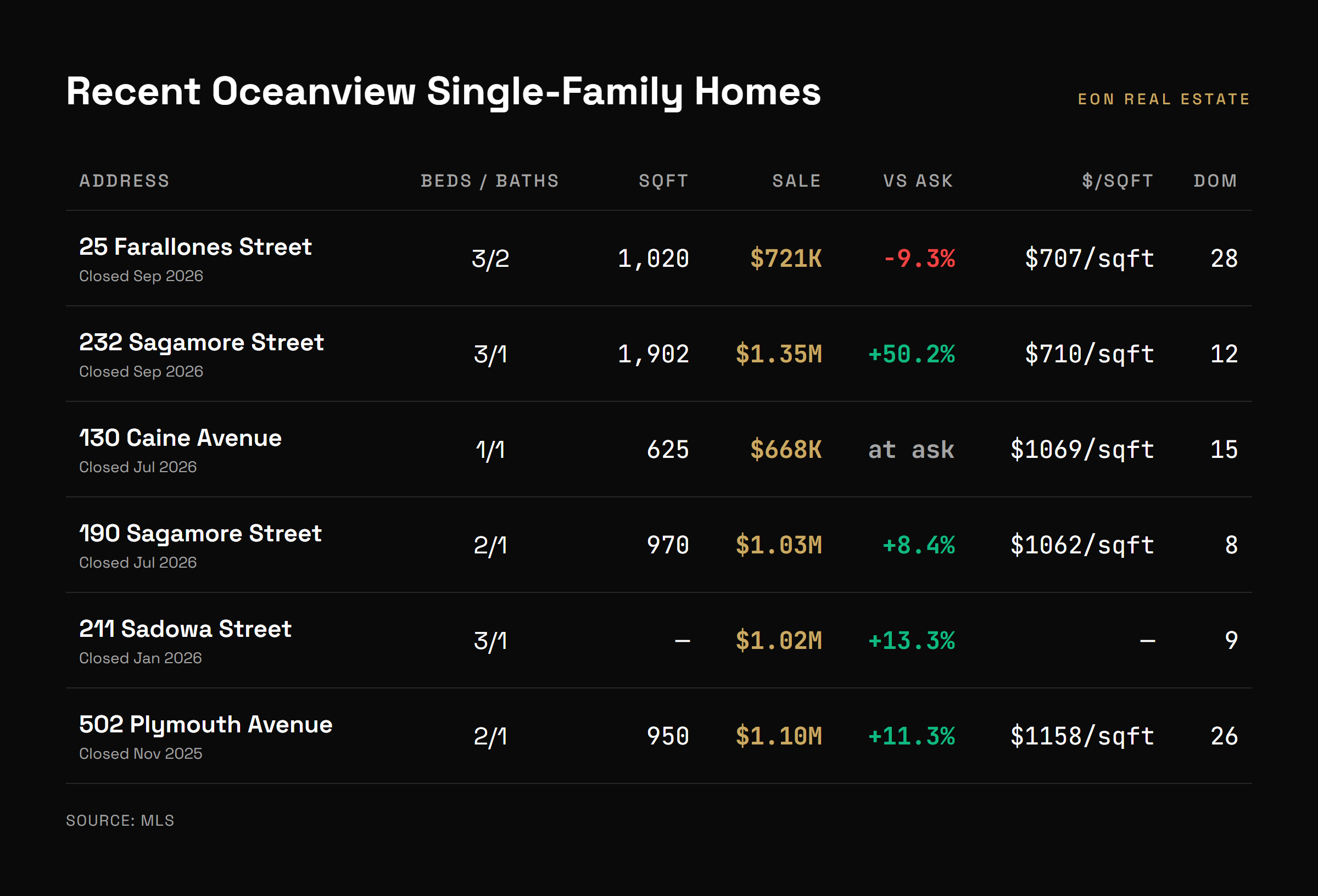
The two most recent closings frame the whole market. On September 10, 2026, 232 Sagamore Street, a three-bedroom listed at $899,000, closed at $1.35M, more than $450,000 over its asking price. Nineteen days later, on September 29, 25 Farallones Street, a three-bedroom from 1906 listed at $795,000, closed at $721,000, roughly $74,000 under list. Same neighborhood, same bedroom count, same month, and a $629,000 gap in the final numbers.
That pattern repeats across the year. The homes that overbid were the turnkey ones: 214 Minerva Street (four bedrooms, 1965) went from a $1,149,000 list to a $1.325M close in 13 days; 211 Sadowa Street, renovated with an updated kitchen, moved from $899,888 to $1.02M in nine days; 502 Plymouth Avenue closed at $1.1M on a $988,000 ask. The homes that sold at or below list were the ones a buyer would have to put work into. 130 Caine Avenue, a one-bedroom fixer, closed at its $668,000 list price with no premium at all. In my experience, the houses that stall are the ones priced to the turnkey comps without the finishes to match.
The takeaway for 2026 is that Oceanview is not one market. It is a renovated market trading in the $1.2M to $1.35M range and an as-is market trading in the high $600Ks to low $1M range, and the median simply lands between them. Price per square foot ran from $707 at 25 Farallones to $1,158 at 502 Plymouth, which is a wider range than you will see in a neighborhood where the housing stock is more uniform. Most of these houses date from 1906 to 1965, and how each one has aged since is the single biggest variable in its price. For a sense of how SF's older house styles get priced, our guide to how SF home styles are priced covers the same dynamic citywide.
What is driving the numbers
Three forces are shaping Oceanview right now. The first is relative value. With the blended citywide median at $1.75M, Oceanview's detached houses are among the most reachable in San Francisco proper, and that pulls in buyers who want a house rather than a condo but cannot clear a Noe Valley or Sunset price. The second is condition scarcity. Because the housing stock is old and the renovation rate is uneven, a genuinely updated house is rare enough to draw competing offers, which is why the overbids cluster so tightly on the turnkey listings. The third is transit. The M Ocean View light-rail line and the 54 Felton bus both stop within a short walk of the central blocks, and the area carries an 81 Transit Score and a 76 Walk Score, which matters to the commute-sensitive buyers who keep this segment liquid.
Weather is an underrated part of the pitch. National Weather Service readings put Oceanview's clear-hour share at 30.9% against a 12.8% citywide baseline, with a foggy-hour share of 3.7% versus 10.3% citywide. In practice the hill sits below the fog that pins the western neighborhoods and gets measurably more sun than the city as a whole. Nearby air readings averaged 6.24 micrograms per cubic meter of fine particulates over the sampling window, well inside clean-air territory. None of this shows up in a price-per-square-foot number, but it is a real part of why buyers who tour the area in person tend to come back.
Who lives here, and the house itself
Oceanview is an owner-occupier neighborhood. In the census block group around the central blocks, 267 of 272 housing units were owner-occupied, median household income was $201,333, and about 40% of workers reported working from home, per US Census ACS data. The median structure in that block group dates to 1944, which squares with the 1906-to-1965 build years on this year's comps. These are small, detached houses on modest lots, the kind of homes long-term owners hold for decades and sell once. That low turnover is exactly why annual sales volume is so thin.
On schooling, the attendance mechanics are worth understanding before you assume anything. San Francisco Unified uses a citywide choice system rather than strict neighborhood zoning, so an Oceanview address does not lock in a single school. Nearby public options include Cleveland Elementary on Athens Street and Sheridan Elementary on Capitol Avenue, with Balboa High on Cayuga Avenue and Lowell High on Eucalyptus Drive serving the broader south-side, per NCES records for the 2024 to 2025 year. Private campuses sit close as well, including Lick-Wilmerding High School on Ocean Avenue and Archbishop Riordan High School on Frida Kahlo Way. Confirm current assignment rules with the district directly, since the choice system changes.
What to consider before you buy here
Appraisal risk on the overbids
I will not pretend the appraisal math is simple here. When a $899,000 list closes at $1.35M, the sale sets a new high mark that the next appraiser may or may not support, especially with only ten comparable sales a year to lean on. If you are financing an overbid, budget for an appraisal gap and know how much cash you can bring if the valuation lands short. Thin comp volume cuts both ways: it protects a well-bought house and it exposes an aggressively bought one.
Condition is the whole game
The price spread this year is almost entirely a condition spread. A sub-$1M entry price is real, but it usually comes attached to deferred maintenance, an older foundation, or a kitchen and systems that need replacing. Before you treat a low asking price as a deal, price the work. The gap between the $721,000 and the $1.35M closings is roughly what a full renovation plus a premium can add, and you rarely capture all of it back on resale.
Thin inventory and timing
With one active listing and ten sales a year, you cannot count on a steady flow of choices. Buyers often wait months for a house that fits, then face competition the moment a good one lists. San Francisco runs two selling cycles, spring and fall, and the fall window is where this year's strongest Oceanview sales landed. If you are shopping, be ready to move when a turnkey house appears rather than expecting to compare several at once. Here is what I would confirm before writing an offer: the foundation report, the scope of any recent permits, and whether the price assumes renovated-comp value.
How much does a house in Oceanview cost in 2026?
A single-family house in Oceanview closed at a median of $1.18M over the 12 months through September 2026, at a median $785 per square foot (MLS). The practical range is wider than that median suggests: as-is houses closed from the high $600Ks to about $1M, while renovated houses closed between roughly $1.2M and $1.35M. The 2026 top sale was 232 Sagamore Street at $1.35M.
Are Oceanview home prices going up or down?
Essentially flat: the median single-family price fell 0.8% over the trailing 12 months through September 2026, from $1,187,500 to $1,177,500. Median price per square foot held near $785. With only ten closings in the window, that 0.8% move is inside the noise of a thin market, so the honest read is a stable neighborhood rather than one clearly rising or falling.
How fast do homes sell in Oceanview?
The median single-family home sold in 20 days over the trailing year through September 2026, which is fast. The strongest listings moved quicker: 190 Sagamore Street closed in eight days and 211 Sadowa Street in nine. As-is houses took longer, with 25 Farallones Street and 234 Sagamore Street each sitting 28 days before closing. Condition drives speed here as much as it drives price.
Is Oceanview good value compared with the rest of San Francisco?
On price per square foot, yes: Oceanview's $785 median over the year through September 2026 runs well below the $1,209 citywide figure. Its detached houses are among the most reachable in the city. The tradeoff is condition and scale, since these are small, older houses and the lower entry price often reflects work the next owner will fund. It is value for a buyer who will renovate, less so for one who wants turnkey at a discount.
What should I watch out for when buying a house in Oceanview?
As of 2026, the two risks are appraisal gaps and deferred maintenance. Because overbids on renovated houses set high new marks against thin comp volume, financed buyers should plan for a valuation that lags the contract price. On lower-priced houses, inspect the foundation, roof, and systems before you anchor on the asking number. Understanding how long the buying process really takes in SF also helps you time an offer when inventory is this thin.
Talk to me about Oceanview
If you are weighing an Oceanview house, I can pull the specific comp set for your block and separate the renovated sales from the as-is ones so you are not pricing off a blended median. EON is a member of Top Agent Network, the invite-only group for top-producing San Francisco agents (Top Agent Network). When you are ready to look at a particular house or price your own, reach out and I will send the sub-neighborhood numbers we used here.
I'm Chris Chour, founder and broker of EON Real Estate. Most of my work is single-family and condo transactions in SF's luxury neighborhoods.