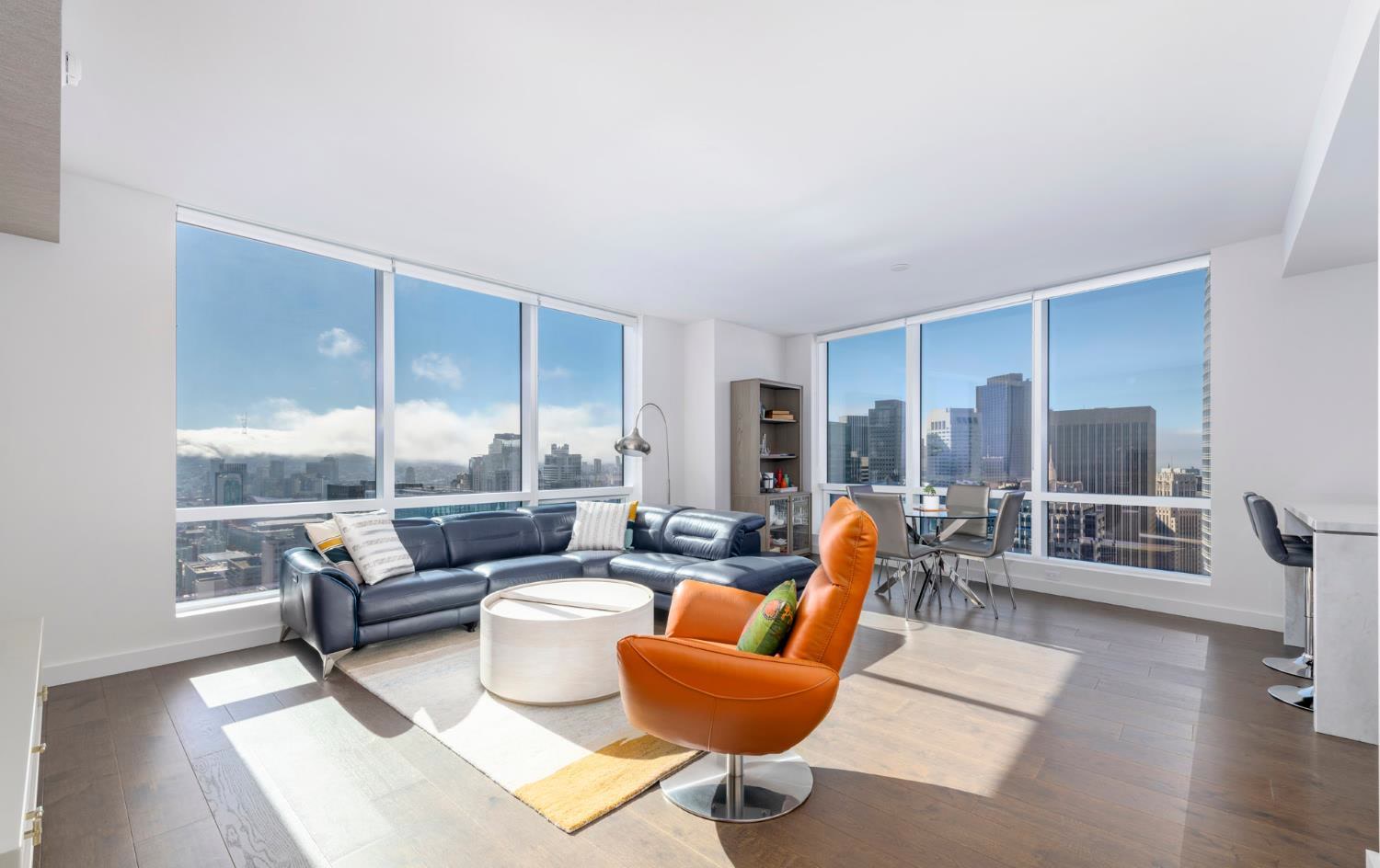
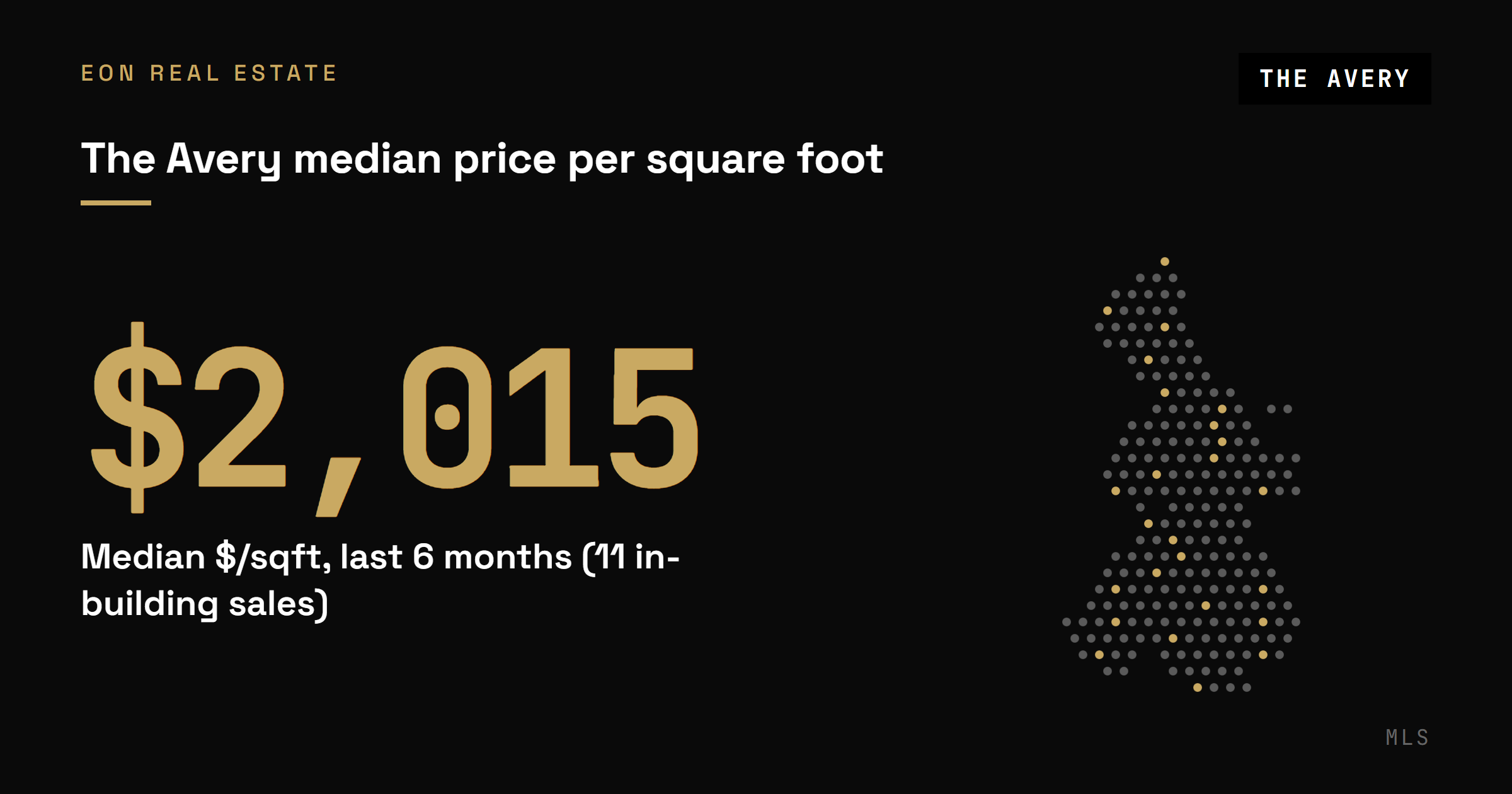
The Avery is a 2019-built condominium tower at 488 Folsom Street in San Francisco's South Beach. Over the six months ending in late September 2026, 11 units closed at a median of $3.65M, or $2,015 per square foot. Price here turns on floor level, view tier, and interior size, not on a single building average.
Unless otherwise noted, all market figures in this guide are from MLS data.
If you are shopping high-rise condos in the eastern waterfront corridor, The Avery is one of the buildings you will keep circling back to, and the question that stalls most buyers is simple: what does a unit here actually cost? The honest answer is that a one-number headline misleads you. A 2-bedroom on a middle floor and a full-floor residence near the top are both The Avery, and they are separated by millions of dollars. I'm Chris Chour, founder and broker of EON Real Estate. Most of my work is single-family and condo transactions in San Francisco's luxury neighborhoods, and I read a tower like this by the line, the floor, and the view rather than by a blended figure. What follows is the current in-building data, the drivers that move each unit's number, and the tradeoffs worth weighing before you write an offer.
How The Avery actually prices in 2026
The Avery is a new-construction tower, and a new-construction tower comps against itself. Across the 11 closings in the six months ending late September 2026, the median close price was $3.65M and the median was $2,015 per square foot. The full range tells you more than the median does: closings spanned $2.5M to $9.85M, and the sales in that set sat on floors 34 through 53.
Three variables explain almost all of that spread. The first is interior size. The smaller 2-bedroom floor plans in the set measured roughly 1,549 square feet, while the largest residence that closed ran 4,176 square feet. The second is floor level. Higher floors command a premium for the same plan, because the view lengthens as you climb. The third is the view tier itself. Every one of the 11 recent closings carried a city-and-water view, which is the top tier, so within this set the view did not vary much, and that consistency is part of why the per-foot numbers cluster the way they do.
Parking is the quiet constant. All 11 recent closings included parking, so a buyer here is generally not choosing between a spot and no spot, as you might in an older South Beach or South Beach building. For a sense of scale, San Francisco's citywide median close price was $1.75M over the trailing 12 months, so The Avery trades well above the city as a full-service view tower rather than as a typical condo.
The Avery by the numbers
What the comps say about price drivers
The cleanest way to use these sales is to hold two of the three variables steady and watch the third move the price. Here is how each driver reads in the current data.
Floor level, same floor plan
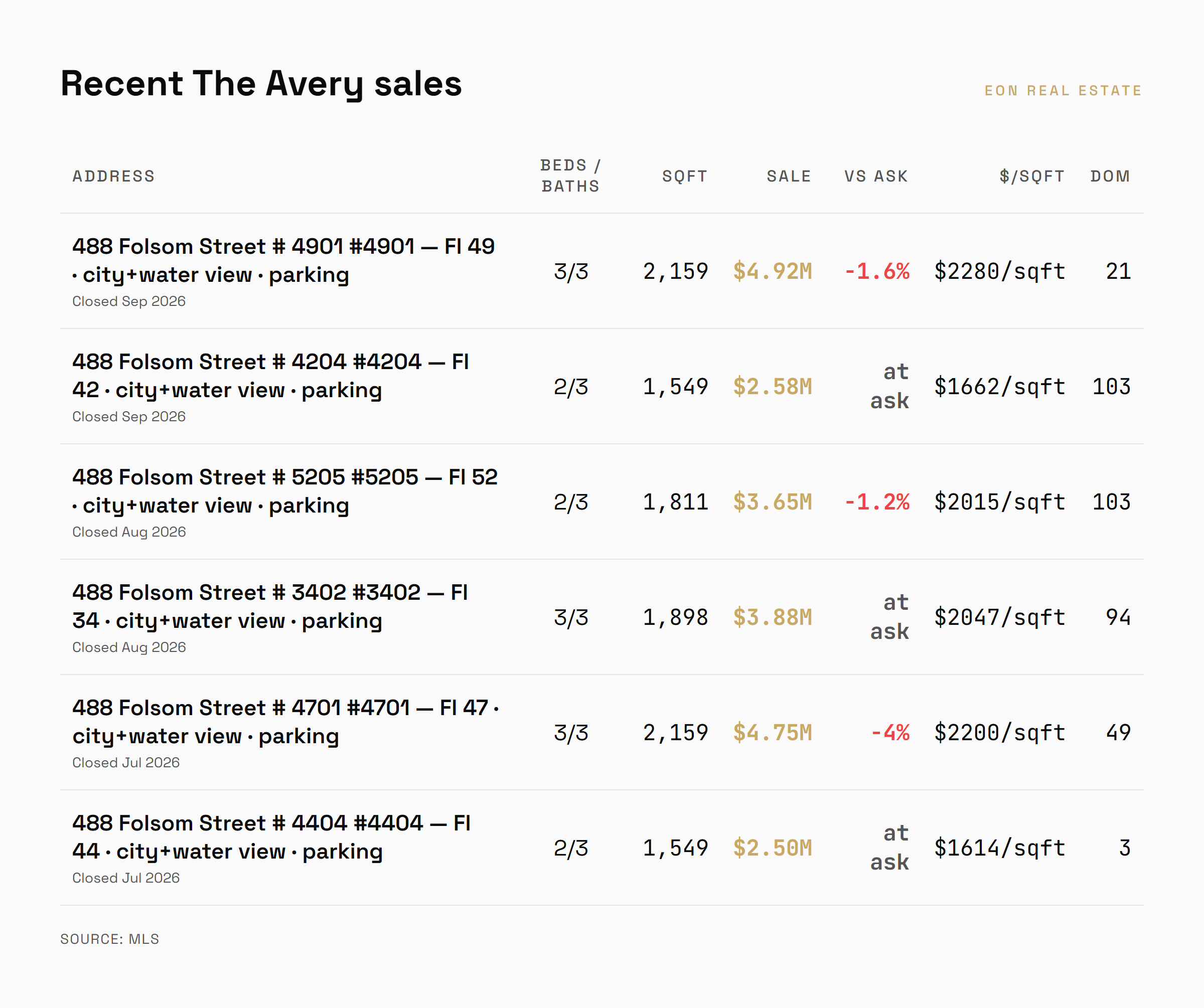
The clearest comparison in the set is two identical 3-bedroom plans of 2,159 square feet. Unit 4901, on the 49th floor, closed at $4.92M in September 2026, or $2,280 per square foot. Unit 4701, two floors lower, closed at $4.75M in July 2026, or $2,200 per square foot. Same layout, same building, same view tier: the two floors and a marginally longer sightline were worth about $172,000, close to 3.6 percent.
Size versus price per square foot
Bigger does not mean a higher per-foot number. The full-floor residence on the 53rd floor, at 4,176 square feet, closed at $9.85M, the top price in the set, yet its $2,358 per square foot sat below the set's per-foot leader. That leader was a 2,064-square-foot 3-bedroom on the 52nd floor at $5.4M, which penciled out to $2,614 per square foot. When you compare units, decide whether total budget or per-foot value is the number you actually care about, because the two can point at different units.
View tier and parking
Within this set the view tier is a constant rather than a variable, since all 11 closings were city-and-water. That matters for your expectations: a hypothetical lower-tier or partially obstructed line would not fetch these per-foot numbers, so do not price a city-only exposure off a city-and-water comp. Parking was likewise universal in the recent set, so a spot is the baseline here, not an upgrade to pay extra for.
What this looks like in practice
Say you are weighing two real paths into the building using the 2026 sales. The entry path is a middle-floor 2-bedroom. Unit 4404, a 1,549-square-foot 2-bedroom on the 44th floor, closed at $2.5M in July 2026, the lowest price in the set, at $1,614 per square foot. It closed in three days. That is the tightest point of entry the recent data shows, and its speed tells you a well-priced 2-bedroom here does not linger.
The step-up path is a larger, higher-floor residence. If your target is a full-floor home, the 53rd-floor residence at $9.85M is your anchor, with the understanding that you are paying for roughly 4,176 square feet and a position near the top of the tower, not for a higher per-foot rate. Between those poles sits the median: $3.65M buys you a mid-tower 2-bedroom or a smaller 3-bedroom, depending on the line that is available. When I model an offer for a client here, I start from the closest in-building plan and adjust up or down for floor and size, rather than reaching to another building for a comparison. The in-building sales are the valuation basis; nearby towers are context for what else the buyer could choose, not a substitute comp.
What to consider before you buy here
Here is what I would check before writing an offer, and where the honest tradeoffs sit.
The per-foot number is view-dependent
Every recent closing shared the top view tier, so the $2,015 median per square foot reflects city-and-water units specifically. If the unit you like has a shorter or partially blocked exposure, expect it to trade below that figure, and build that into your offer rather than anchoring to the headline.
Full-service carrying costs
I will not soften the monthly math. A full-service high-rise carries meaningful HOA dues that fund the amenities, staffing, and reserves, and those dues are a real part of your monthly cost on top of the mortgage and property tax. Confirm the current figure on the specific unit's disclosures before you commit, because it varies by line and square footage.
Financing and resale competition
High-rise condos can carry lender conditions tied to the building, so confirm warrantability with your lender early. On the resale side, your unit competes directly with other units in the same tower, and there were three active listings in the building at the time of this data. In the sales I watch, the units that sit are usually the ones priced off the top of the set rather than the comparable line: one recent 2-bedroom took 201 days to close while the well-priced one closed in three.
How much does a condo at The Avery cost in 2026?
As of the six months ending late September 2026, the median closed price at The Avery was $3.65M, or $2,015 per square foot, across 11 in-building sales. The range ran from $2.5M for a middle-floor 2-bedroom to $9.85M for a full-floor residence on the 53rd floor. Where your number lands depends mostly on the floor plan's size and how high in the tower the unit sits, since the recent sales all shared the same top view tier.
Does The Avery have parking?
Yes, all 11 of the building's closed sales in the six months ending September 2026 included parking, so a spot is effectively the baseline for a unit here rather than a line item you negotiate. Because parking was universal across the recent set, it does not explain the price spread between units; size, floor level, and view do that work instead. Confirm the exact parking arrangement on the individual unit's disclosures.
What views do units at The Avery have?
Every one of the 11 units that closed in the six months ending September 2026 carried a city-and-water view, the top exposure tier, reflecting the tower's height and its position near the San Francisco waterfront. That consistency is one reason the per-foot prices cluster as tightly as they do. If you are shown a lower-floor or partially obstructed line, treat it as a different tier and expect it to price below the city-and-water comps in this guide.
How fast do units at The Avery sell?
It varies sharply by pricing, which is the real lesson from 2026. In the six months ending September 2026, one well-priced 2-bedroom closed in just three days, while another unit took 201 days to find its buyer. Days on market here is less about the building's demand and more about whether the unit was priced to the comparable in-building line or reached for the top of the set. Price it to the line and it moves.
Is The Avery a good building to buy into in 2026?
For a buyer who wants a full-service, view-tier high-rise with parking, the 2026 data supports it: 11 closings in six months at a $3.65M median shows steady in-building demand. The tradeoffs are honest ones. HOA dues are substantial, your resale competes with other units in the same tower, and the per-foot premium is tied to the top view tier. Weigh those against the location and amenities, then price to the comparable line.
Talk to me about The Avery
If you are weighing a specific line at The Avery, the useful next step is a unit-level read rather than a building average. I can pull the full in-building comp set for any floor plan you are considering, show you how floor level and size move the number, and flag the carrying costs and warrantability questions worth raising before you write. When you are ready to compare it against a nearby tower like MIRA, or to map out how long the buying process takes, reach out and we will work through it together.