Selling at MIRA in 2026 is several different transactions wearing one address. A high-floor water-view two-bedroom and a low-floor interior unit trade on separate logic, and pricing either one off the building's blended median is how sellers leave money on the table or sit on the market too long.
Unless otherwise noted, all market figures in this guide are from MLS data. If you own at 280 Spear Street and you are weighing a sale this fall, the decision in front of you is not "what is MIRA worth." It is a narrower question: what is my specific line worth right now on my floor, with its particular view and parking, priced so the right buyer moves. The building gives us a clean answer because it comps against itself. Over the trailing six months of 2026, eight units closed, spanning a one-bedroom interior unit near the bottom of the range to a full-floor-view two-bedroom at the top. That spread is the whole story. I price every MIRA listing off the building's own closings, because a South Beach high-rise does not behave like the Victorian flats two neighborhoods west, and it does not even behave like the building next door. The waterfront amenity layer, the Transit Score of 100, and the walkability matter to your buyer, but they do not set your number. Your number comes from the last handful of sales in your own stack. What follows is the market as it actually printed, the three seller situations that come up most often in this building, and the pricing math to work through before we set a list price.
MIRA at 280 Spear Street: the market right now
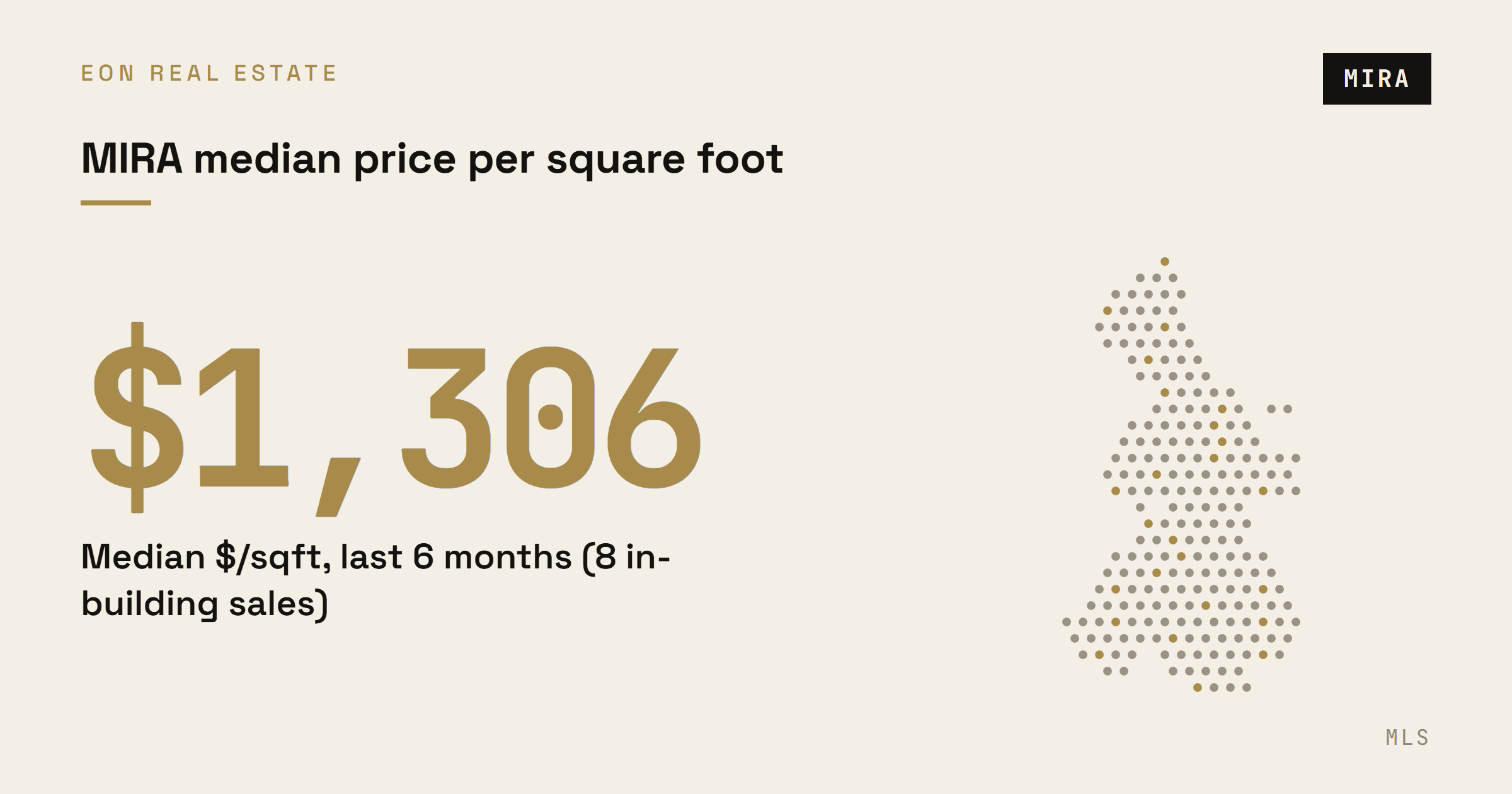
Across the eight closings in the building over the trailing six months of 2026, the median sale price was $1,493,444 and the median was $1,306 per square foot. The range is what matters for a seller: prices ran from $416,363 to $2,200,000, and the floors that traded ran from the 2nd to the 31st. That is not one market. It is a premium tier of high-floor view units, a deep core of mid-floor two-bedrooms, and a thinner set of lower-floor and interior homes that compete on price and parking.
Speed tracked quality of unit. The mid-floor two-bedrooms with a city-and-water outlook moved fast: 280 Spear Street #10D closed in 12 days and #10C in 13. The two trophy closings, a 17th-floor and a 31st-floor two-bedroom, each went under contract with no days on market, meaning they were spoken for at or before listing. At the other end, a smaller interior one-bedroom took 31 days and a 2nd-floor unit took 33, closing $28,000 under its $928,000 ask. For context, the citywide median days on market ran 12 in 2026, so the building's best inventory is selling at or faster than the city pace while its weaker units need patience.
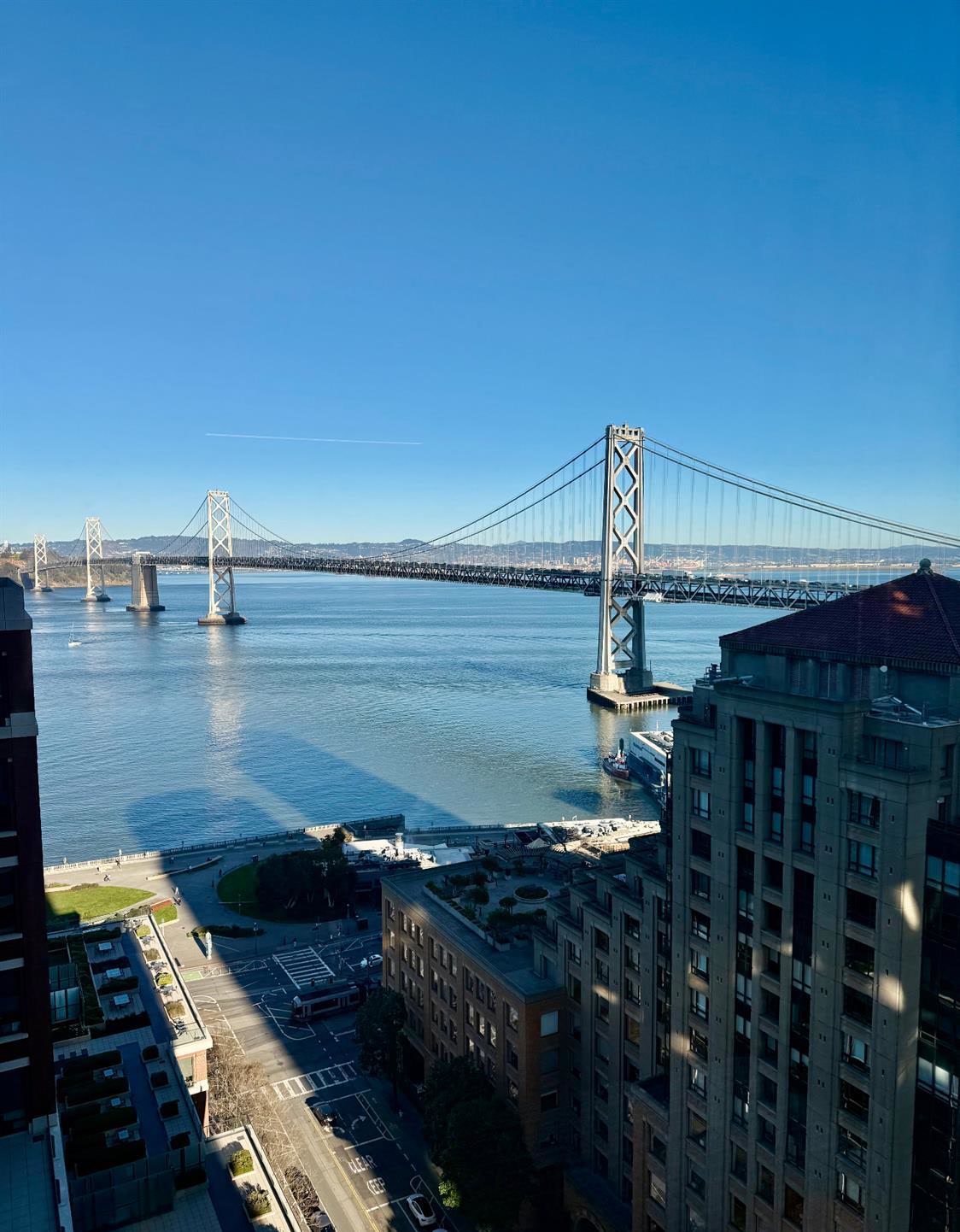
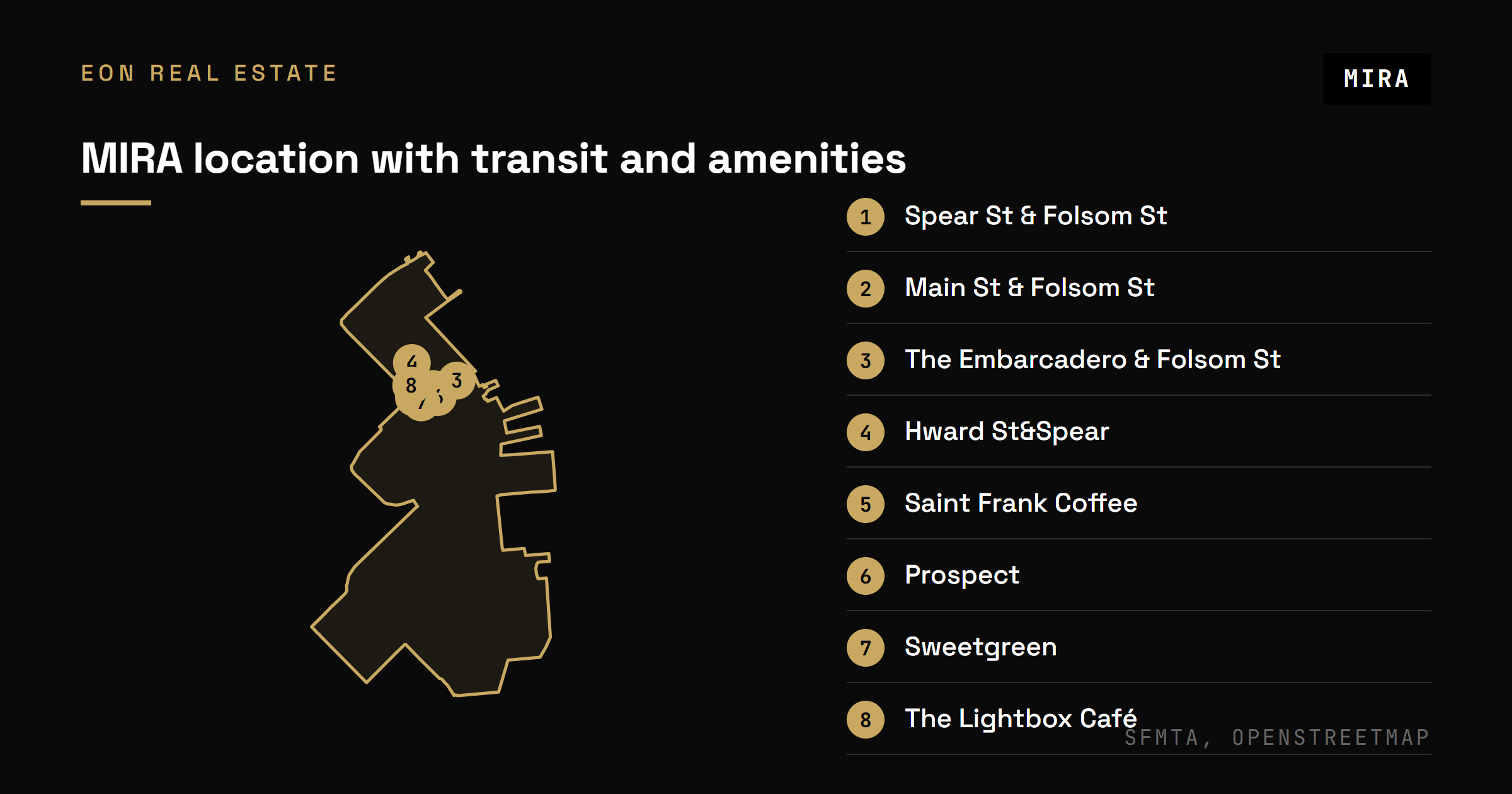
Location is the amenity that supports those numbers without setting them. MIRA sits a 23-second walk from the Spear and Folsom transit stop and roughly 150 meters from The Embarcadero, with Muni Metro and BART both reachable on foot alongside the F-line streetcar, which is what earns the 100 Transit Score and a 94 Walk Score. Rincon Park and Cupid's Span sit out front, with Boulevard and Waterbar among the dinner options (OpenStreetMap). The surrounding blocks skew heavily renter, with about 207 of 771 occupied units owner-occupied (Census ACS 2023), so a MIRA seller's buyer pool is largely owner-occupants and pied-a-terre buyers arriving from outside the immediate block.
MIRA by the numbers
Three seller scenarios at MIRA
Scenario 1: the high-floor view unit
If you own a high-floor two-bedroom with a city-and-water outlook, you own the scarcest inventory in the building, and the 2026 closings show it. 280 Spear Street #31A, a 31st-floor two-bedroom of 1,489 square feet, closed at $2,200,000 ($1,478 per square foot). A 17th-floor two-bedroom, #17E at 1,296 square feet, closed at $2,100,000, which works out to $1,620 per square foot, the highest per-foot figure in the building. Both went under contract with no days on market. The recommended approach is to price to the view tier and the specific line, then let a short, disciplined marketing window create competition among the handful of buyers who want exactly this. The tradeoff, and it is a real one: a zero-day sale at full ask can mean the home was priced correctly, or it can mean you accepted the first strong offer and never tested the ceiling. Do not price a trophy unit to sell in zero days by default; scarcity gives you pricing power, and the point of a proper listing is to find the true top of the market, not the first buyer.
Scenario 2: the mid-floor two-bedroom
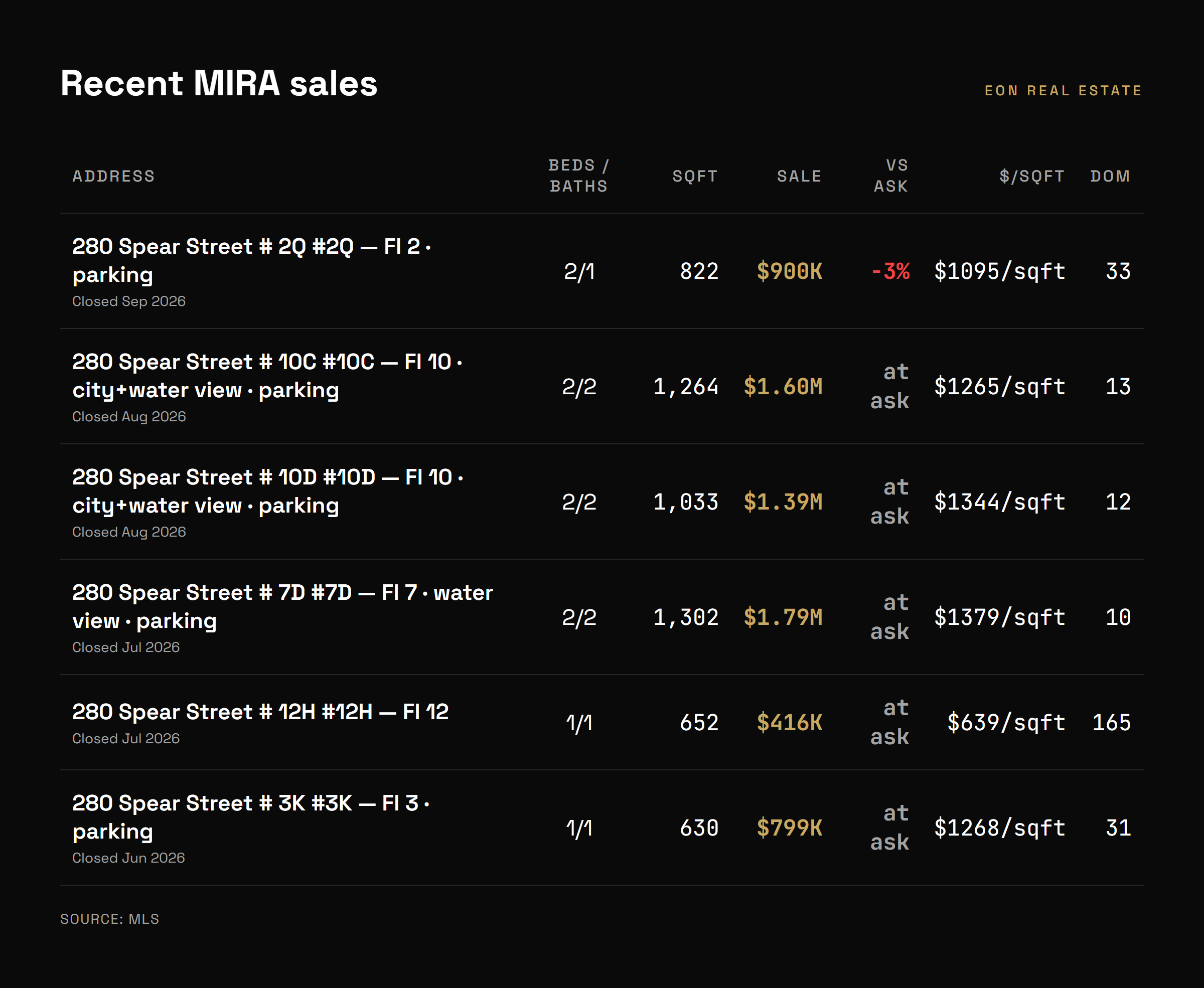
The core of MIRA is the mid-floor two-bedroom, and it is where pricing discipline pays off most because there are real comps. 280 Spear Street #10C, a 1,264-square-foot city-and-water two-bedroom with parking, closed at $1,598,888 in 13 days ($1,265 per square foot). #10D, a 1,033-square-foot unit on the same floor, closed at $1,388,000 in 12 days ($1,344 per square foot). #7D, a 1,302-square-foot water-view two-bedroom, closed at $1,795,000 in 10 days ($1,379 per square foot). The recommended approach is to anchor to the same-tier, same-line comp and price to move inside two weeks, which this segment reliably does. The tradeoff is that square footage and view tier swing the per-foot number by more than a hundred dollars, so a seller who prices off the wrong comp either overshoots and stalls or undershoots a larger, better-positioned unit.
Scenario 3: the lower-floor or interior unit
Lower-floor and smaller units with no view are a slower, more price-sensitive sale, and parking becomes decisive. 280 Spear Street #3K, a 3rd-floor one-bedroom of 630 square feet with parking, closed at $799,000 in 31 days ($1,268 per square foot). The 2nd-floor #2Q, an 822-square-foot two-bedroom, closed at $900,000 after 33 days, $28,000 under its $928,000 ask. Then there is the outlier: #12H, a 652-square-foot interior one-bedroom with no parking and no view, closed at $416,363 after 165 days, at $639 per square foot, far below every other sale in the building. The recommended approach here is honest pricing from day one and a clear story about parking and layout. The tradeoff: do not let a unit like #12H, which sat for 165 days and printed a per-foot number detached from the rest of the building, anchor your expectations. Something specific to that sale explains it, and it is not a market comp for a standard resale.
What to consider before you list at MIRA
The HOA litigation disclosure
Recent listings in the building have disclosed HOA litigation. I flag this early because it is the single item most likely to surprise a seller mid-escrow. Confirm the building's current litigation and warrantability status with your lender and the HOA before you list, since it can affect a buyer's financing and therefore your price and buyer pool. Do not assume it is settled or that it is a dealbreaker; treat it as a disclosure to get in front of, not a problem to discover at the appraisal stage.
Mispricing against the wrong floor
The building's per-foot range runs from $639 to $1,620, and floor is not the only driver: the 17th-floor #17E beat the 31st-floor #31A on a per-foot basis. Do not price off the trophy sale if you own a mid-floor unit, and do not discount a well-positioned mid-floor home because a higher unit sold for more in absolute dollars. Price off your own line.
The amenity layer is not your comp basis
The waterfront and the 100 Transit Score are what a buyer pays to be near, but they do not set your list price. Buyers in this building also weigh comparable South Beach and East Cut towers as alternatives, so your marketing should sell the building's position, while your pricing stays anchored to in-building closings. The same waterfront-tower dynamics hold in our guide to selling a condo at 181 Fremont.
Pricing discipline: setting your list price
Here is the math I would walk you through. Take a mid-floor, city-and-water two-bedroom around 1,100 square feet. Its closest in-building comps are 280 Spear Street #10D (1,033 square feet, closed $1,388,000, $1,344 per square foot) and #10C (1,264 square feet, closed $1,598,888, $1,265 per square foot). Anchor to the per-foot figures of that same tier: roughly $1,265 to $1,344 per square foot brackets about $1.39M to $1.48M for 1,100 feet, before you adjust for parking, line, and condition. From there, add the premium a true view earns, because #17E, the 17th-floor city-and-water two-bedroom, closed at $1,620 per square foot, and subtract for a lower floor or a blocked outlook. Parking is not a rounding error: 88% of recent closings carried a deeded space, and the one no-parking, no-view unit printed the lowest per-foot number in the building. The discipline is to build the price from two or three genuine in-line comps and the specific drivers of your unit, not from the building's median, which blends a 2nd-floor interior home with a 31st-floor view unit and answers a question no buyer is asking.
Staging and the marketing window
A high-rise condo stages differently than a flat, and at MIRA the view is what you are selling. Here is what I would tell you to spend on before listing: good light and photography shot to frame the outlook rather than the room, plus furniture scaled to the floor plan. Do not over-furnish a view unit and crowd the window lines; the buyer is paying for the glass, and bulky staging fights the one thing your competitors at lower floors cannot offer. For an interior or lower-floor unit, the job flips: stage for space and flow, and lead the marketing on parking and layout rather than a view you do not have. On budget, our San Francisco home staging cost guide gives real ranges. On timing, San Francisco runs a fall selling cycle from late August through Halloween before the market quiets toward Thanksgiving, so a September or early-October launch puts you in front of the most active buyers of the season, which matters when your best-case outcome is the kind of 10-to-13-day sale the mid-floor two-bedrooms posted.
Choosing off-market versus an MLS listing
For most MIRA units, a full MLS listing wins, because price discovery and buyer competition are what push a fast, clean sale, and the building's core inventory clearly has the demand for it. Off-market makes sense in a narrower case: a scarce high-floor view unit with a known, waiting buyer pool, or a seller who values privacy and timing over testing the absolute ceiling. Both 2026 trophy closings went with no days on market, which tells you the top of this building can transact quietly. As a member of Top Agent Network, an invite-only group for top-producing San Francisco agents (Top Agent Network), I can float a high-floor unit to that pool discreetly before we decide. I do not pretend off-market is always the answer; for the mid-floor two-bedrooms, going to the open market is how you find the real number.
How much does a condo at MIRA sell for in 2026?
In 2026, MIRA condos posted a median sale price of $1,493,444 and a median of $1,306 per square foot across eight in-building closings over the trailing six months. Sale prices ranged from $416,363 for a small interior one-bedroom to $2,200,000 for a 31st-floor view two-bedroom. Your unit's number depends on its floor and view tier, its size and its parking, not on the building-wide median, which blends very different homes.
How fast do MIRA condos sell?
In 2026, MIRA's best-positioned units sold quickly: mid-floor city-and-water two-bedrooms closed in 10 to 13 days, and two high-floor view units went under contract with no days on market. Smaller interior and lower-floor units took longer, from 31 days to an outlier at 165. The citywide median days on market ran 12 in 2026, so well-priced MIRA inventory matches or beats the city pace while weaker units need patience and sharper pricing.
Does a parking space change the price at MIRA?
Yes, and in 2026 it was decisive: 88% of MIRA's recent closings carried a deeded parking space, and the single unit that sold without parking or a view, 280 Spear Street #12H, printed the lowest price per square foot in the building at $639 after 165 days on market. Parking is a material value driver in a transit-first South Beach tower, so a deeded space should be priced in, and its absence should be priced out, rather than glossed over.
Should I sell my MIRA condo off-market or on the MLS?
For most MIRA units in 2026, a full MLS listing wins, because the building's core two-bedroom inventory has enough buyer demand to sell in 10 to 13 days and benefits from open competition and price discovery. Off-market suits a narrower case: a scarce high-floor view unit with a waiting buyer pool, or a seller prioritizing privacy over testing the ceiling. Both 2026 trophy units transacted with no days on market, showing the top of the building can move quietly.
Does the HOA litigation at MIRA affect selling?
As of 2026, recent MIRA listings have disclosed HOA litigation, which can affect a buyer's mortgage warrantability and therefore your pricing and buyer pool. It is not automatically a dealbreaker, and it is not something to hide. Confirm the building's current litigation and warrantability status with your lender and the HOA before listing, so the disclosure is handled up front rather than surfacing during appraisal or underwriting and costing you the deal.
Talk to me about selling at MIRA
When you are ready to put a number on your unit, I can pull the in-building comp set for your exact line and floor, model the view and parking adjustments, and show you what a September or October launch looks like against the building's recent pace. I'm Chris Chour, founder and broker of EON Real Estate. Most of my work is single-family and condo transactions in San Francisco's luxury neighborhoods, and at a building like MIRA the right price starts with the building's own closings, not a headline median. Reach out and we will build your number from the data.