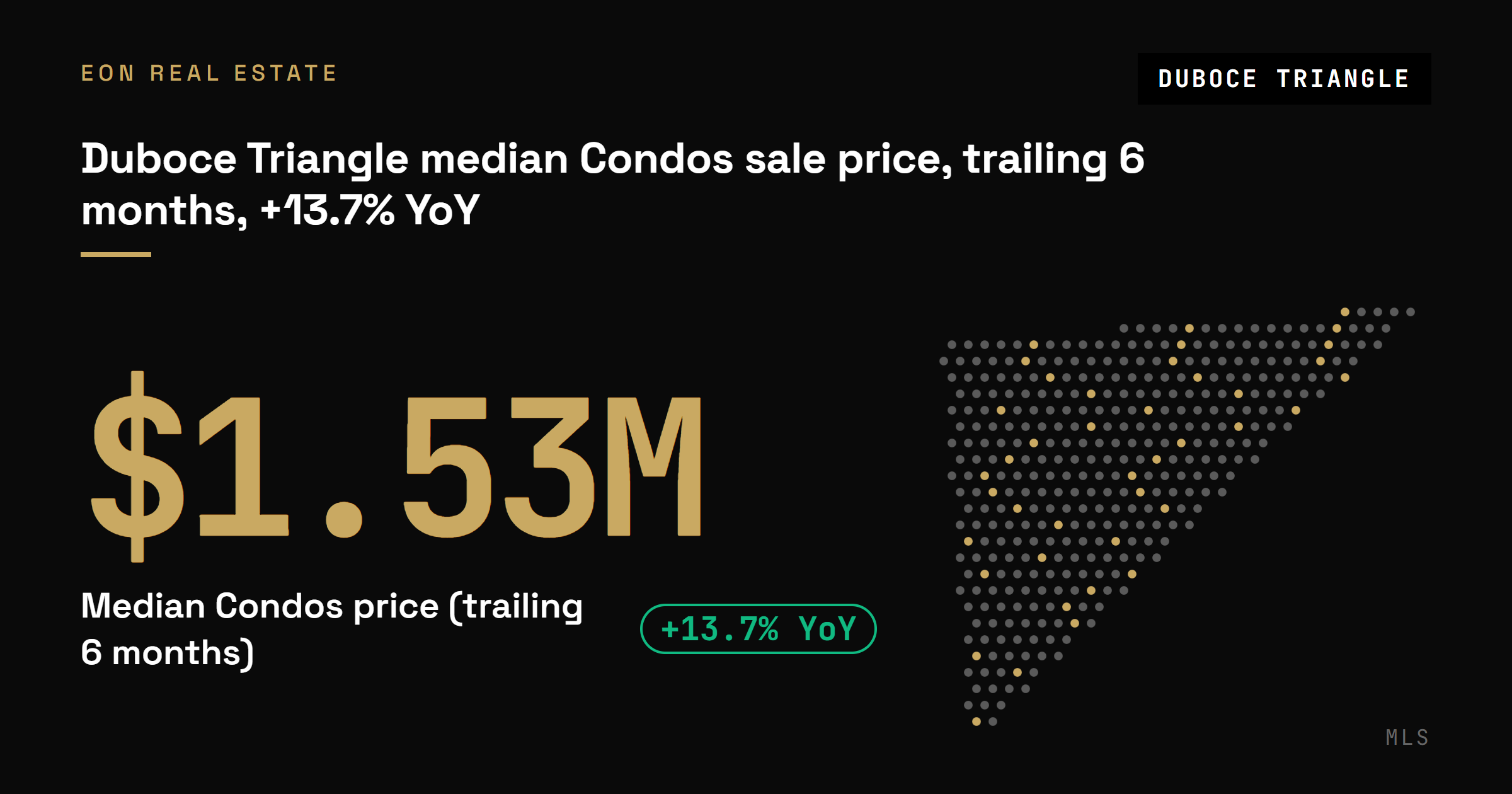
Buying in Duboce Triangle, San Francisco in 2026 means choosing among condos at a $1.535M six-month median, TICs at $2.325M, single-family houses at $3.43M and duplexes at $4.55M. Unless otherwise noted, all market figures in this guide are from MLS data. Rent rules and transfer-tax tiers shape the deal as much as price.
Duboce Triangle is small. On the city's realtor neighborhoods map it is bordered by Market Street on the southeast, Castro Street on the west and Duboce Avenue on the north (Wikipedia). Inside those three lines the MLS recorded 16 closings in the last six months, from a $775,000 one-bedroom condo at 2238 Market Street to a $6.775M sale on Belcher Street.
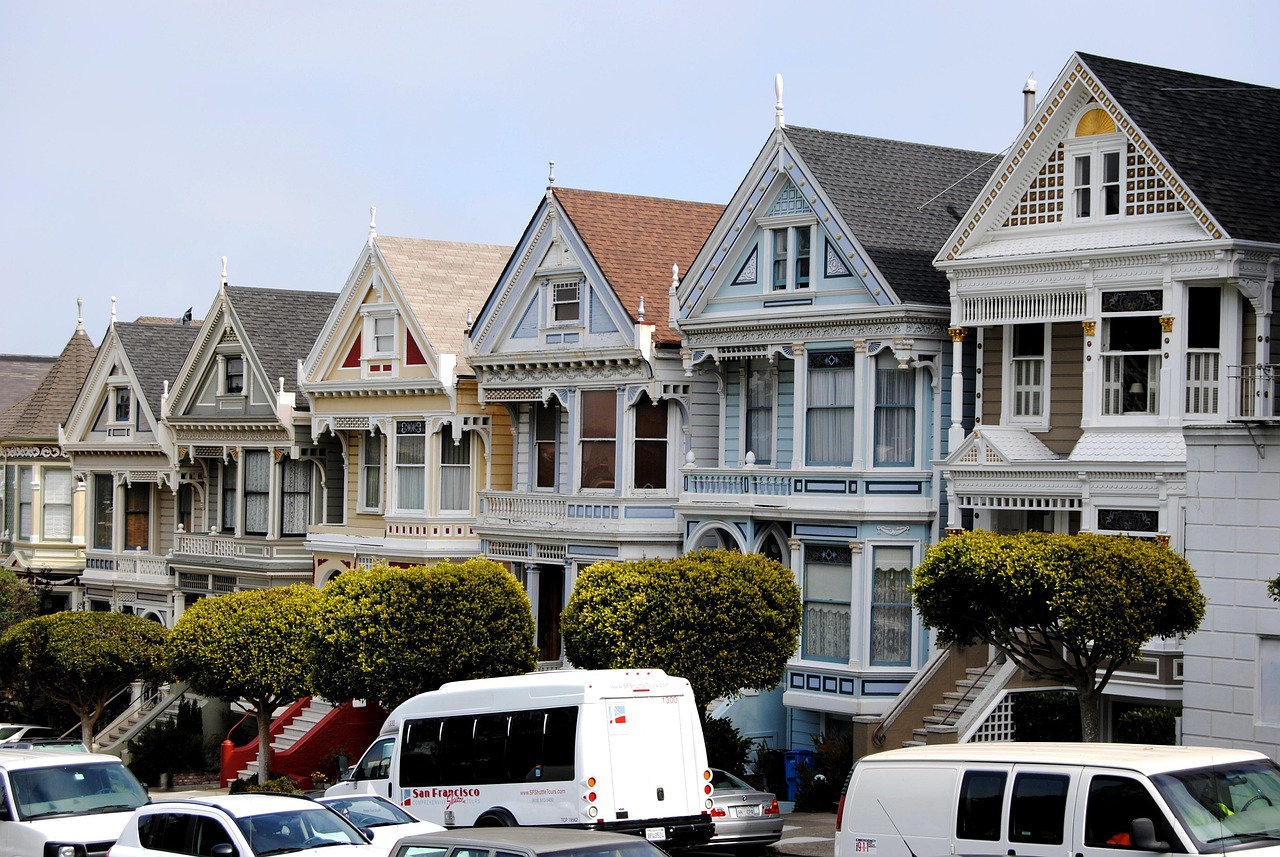
Most of what sells here is old. Many of the houses are 1906 flats in the classic revival style, with the earliest houses dating from the 1870s (Wikipedia), and the median structure in the Census block group at the neighborhood's center was built in 1938 (US Census ACS 2023). Old buildings raise two questions buyers tend to underweight: whether the unit you are buying, or the units around it, fall under the San Francisco Rent Ordinance, and how the property is held, as a deeded condo, a TIC share or a whole building.
I'm Chris Chour, founder/broker of EON Real Estate. Most of my work is single-family and condo transactions in SF's luxury neighborhoods. Here is how I would walk you through Duboce Triangle: the rules first, then the decision tree by property type, then a worked example from this year's closings.
How the rules actually work in Duboce Triangle
Where the neighborhood starts and stops
Boundaries matter because comps should stay inside them. The realtor map draws Duboce Triangle with Duboce Avenue as its northern edge, while a 2006 definition by the Mayor's Office of Neighborhood Services pushes the northern boundary to Waller Street, which takes in Duboce Park (Wikipedia). The MLS figures in this guide follow the realtor map, so ask which map a listing's neighborhood label follows before you compare it to these numbers. The name itself comes from Victor Duboce, a lieutenant colonel of the First California Volunteer Infantry regiment in the Philippines during the Spanish-American War (Wikipedia).
The Rent Ordinance and the 1979 line
The San Francisco Rent Ordinance is the city law that limits rent increases and the reasons a landlord can end a tenancy. According to the City, many residential units built on or before June 13, 1979 have both rent control and eviction protection. Units built after June 13, 1979, and most single-family homes and condos where the tenant moved in on or after January 1, 1996, have eviction protections but not rent control (sf.gov). In Duboce Triangle that date splits the inventory cleanly: of the 32 closing records in the last 12 months, 28 were in buildings built in 1941 or earlier. The exceptions were three units at 2238 Market Street, built in 2022, and one condo at 305 Castro Street, built in 1986.
Owner move-in
If you plan to live in a unit that is rented today, the relevant path is an owner move-in: the City lists a landlord planning to move into the unit, or to move in an immediate family member, among the grounds for ending a tenancy (sf.gov). It is a regulated process with its own requirements, and it is the part of a tenant-occupied purchase I would never price without a San Francisco real estate attorney reviewing the specific unit first.
The transfer tax tiers
San Francisco's transfer tax is due when a document transferring the property is recorded, and the rate applies to the entire price, not just the amount above a threshold. The City's schedule is $3.40 per $500 for sales above $250,000 and below $1,000,000, $3.75 per $500 from $1,000,000 up to $5,000,000, and $11.25 per $500 from $5,000,000 up to $10,000,000 (sf.gov). Converted, those are 0.68%, 0.75% and 2.25%. Because the higher rate applies to the whole price, a sale at $5,000,000 owes $112,500 while a sale at $4,999,999 owes $37,500. Your purchase contract says which side pays it, so read that line before you sign. For the seller's side of this math, see what seller closing costs cover in San Francisco.
Schools do not follow the address
San Francisco Unified School District assigns students through a citywide lottery rather than guaranteed neighborhood attendance zones, so a Duboce Triangle address does not lock in a specific public school (SFUSD). Price the property on its own merits, not on an assumed school assignment.
The decision tree by property type
Over the last 12 months the MLS recorded 32 closings in Duboce Triangle: 12 condos (37.5%), 7 TICs (21.9%), 6 single-family residences (18.8%), 3 duplexes, 3 mixed-use buildings and 1 fourplex. One building appears twice in that count (more on that in the tradeoffs section). Each type prices on its own logic, so start by deciding which branch you are on.
Branch 1: Condominiums
A condo is a separately deeded unit plus a share of the common areas. In the last six months, Duboce Triangle condos closed at a $1.535M median across 5 sales, at a median $1,193 per square foot and a median 18 days on market. The split inside that figure is building age. The three condos in buildings from 1874 to 1901, at 843 14th Street, 2190 15th Street and 300 Castro Street, closed between $1.535M and $2.16M, and all three closed over their list prices. The two new-construction units at 2238 Market Street, built in 2022, closed under list after 62 and 113 days.
Branch 2: Tenancy in common (TIC)
In a tenancy in common (TIC) you buy a percentage share of the whole building together with the right to occupy a specific unit under a written agreement among the owners, rather than a separately deeded unit. Duboce Triangle TICs closed at a $2.325M median across 4 sales in the last six months, at a median $1,348 per square foot, above the condo figure, though only three of the four reported a size. The range is wide: two three-bedroom units at 160 and 162 Noe Street closed at $3.2M and $3M, while 221 Noe Street #6, an 890-square-foot two-bedroom, closed at $1.2M on a $1.015M list. Before you write on a TIC, ask your lender how it finances TIC shares, read the agreement and ask counsel whether the building could ever convert to condos.
Branch 3: Single-family houses
In the last six months, single-family houses closed at a $3.43M median across 4 sales, at a median $1,093 per square foot and a median 15 days on market. 72 Castro Street, a renovated 1909 four-bedroom of 1,712 square feet with parking, listed at $2.5M and closed at $3.2M in 11 days. 176 Castro Street, a 3,537-square-foot 1905 house sold as-is, listed at $2.8M and closed at $3,660,176 in 14 days. 871 14th Street, a 1905 six-bedroom with a separate-entrance one-bedroom ADU (accessory dwelling unit) on the ground floor, closed at $2.208M on a $1.888M list. If you are weighing architectural periods, the San Francisco home styles guide covers how Victorians and Edwardians price.
Branch 4: Two- to four-unit buildings
Small apartment buildings are a real share of this market. In the last six months, duplexes closed at a $4.55M median across 3 sales. 53-55 Sanchez Street, a renovated 1890 duplex, listed at $5.195M and closed at $6.65M on October 9, 2026, the only closing in the last 30 days. 81-83 Noe Street, a duplex with a vacant owner's unit and a tenant-occupied upper unit, closed at $2.025M. 983-985 14th Street, a 1906 fourplex delivered with two units vacant and two tenant-occupied, listed at $1.998M and closed at $2.65M in 12 days. If you plan to live in one unit and rent the others, the tenancies and the Rent Ordinance become part of the price.
Duboce Triangle by the numbers
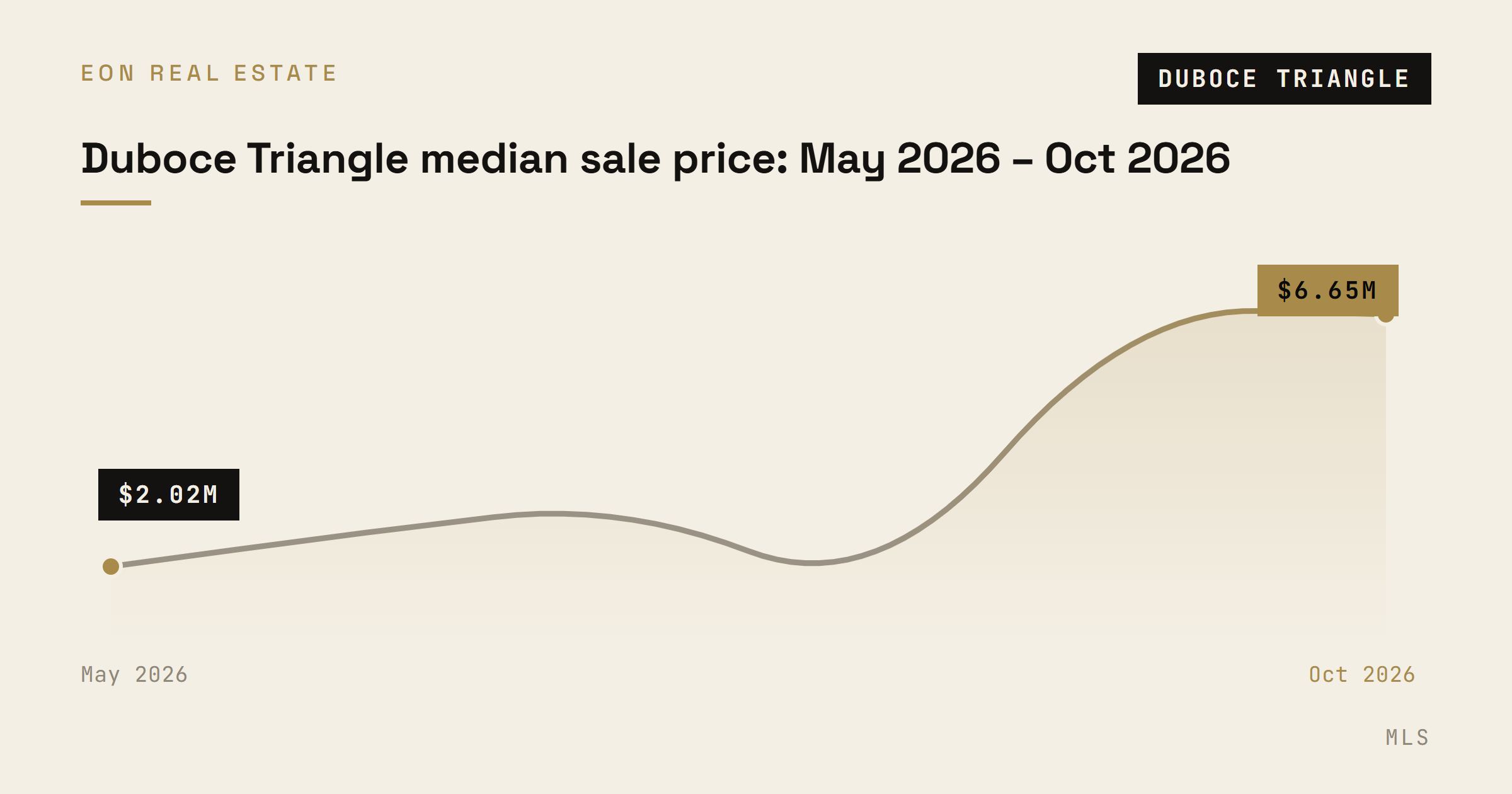
Read the monthly chart with care. With five or fewer closings in any month, one sale sets the month: October's point is the single 53-55 Sanchez Street duplex, and September's is one Belcher Street property recorded twice. That is why I price each property type separately and treat the monthly line as noise, not a trend.
What this looks like in practice
Here is how I would price a condo offer in Duboce Triangle using only this year's closings. Start with the in-neighborhood condo comps.
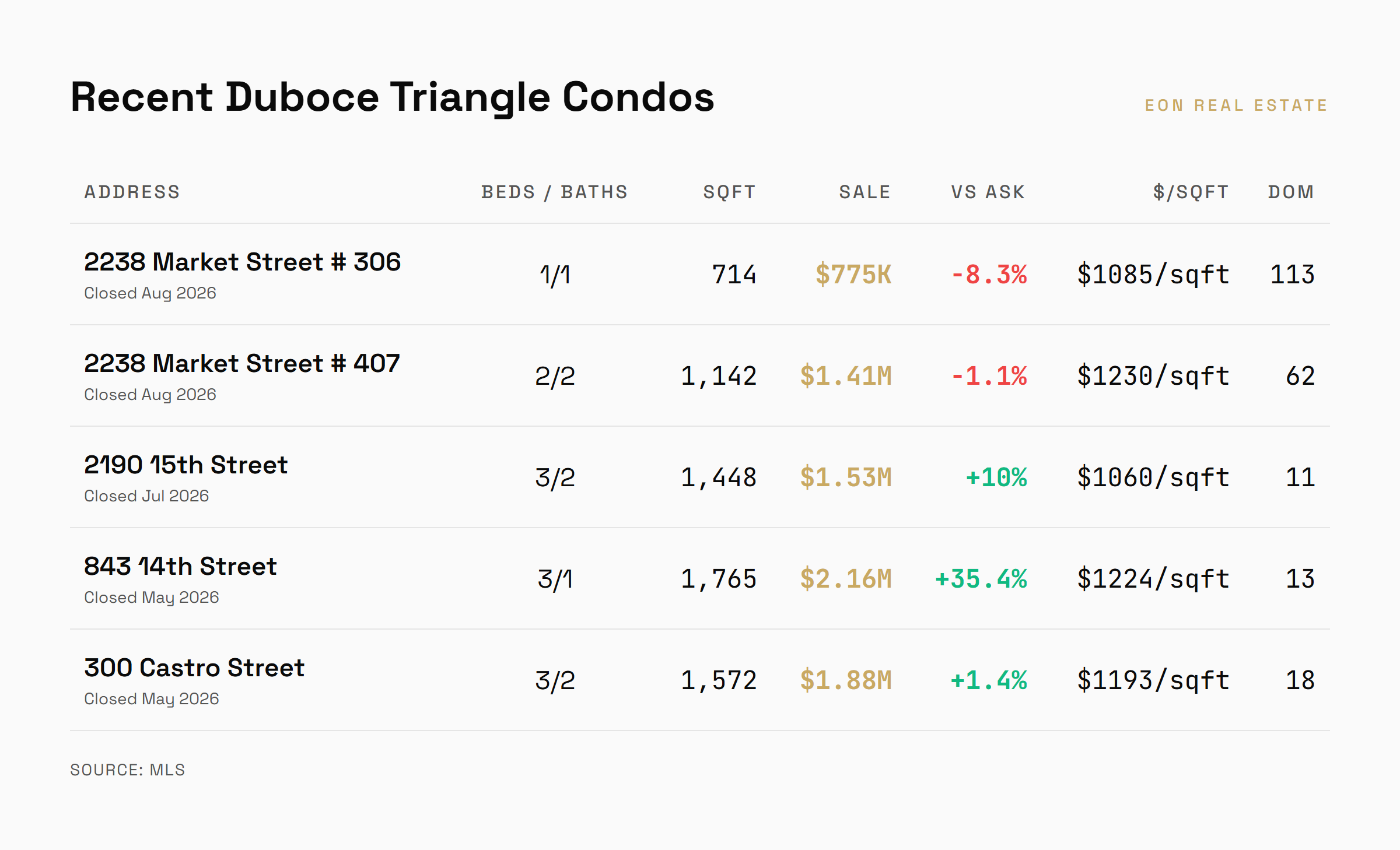
843 14th Street, a renovated 1,765-square-foot three-bedroom, one-bath condo in a 1901 building, delivered vacant with parking, listed at $1.595M and closed at $2.16M on May 28, 2026, after 13 days, or $1,224 per square foot. 2190 15th Street, a 1,448-square-foot three-bedroom in a 1900 building, listed at $1.395M and closed at $1.535M after 11 days, or $1,060 per square foot. At 2238 Market Street, built in 2022, #407 (a 1,142-square-foot two-bedroom with parking) listed at $1.42M and closed at $1.405M after 62 days, and #306 (a 714-square-foot one-bedroom) listed at $845,000 and closed at $775,000 after 113 days.
Now apply that to a two-bedroom condo of 1,871 square feet in a 1904 building, currently listed in the neighborhood at $1.949M, about $1,042 per square foot. At the $1,193 six-month condo median, the same 1,871 square feet works out to roughly $2.23M. The asking price sits below the comp line, the same pattern as 843 14th Street and 2190 15th Street, both of which closed over list.
Then add the transfer tax. At 2190 15th Street's $1.535M price, the tax at $3.75 per $500 comes to $11,512.50 (sf.gov). At 53-55 Sanchez Street's $6.65M price, the $11.25 rate applies to the full amount: $149,625. Had that duplex closed at $4,999,999, the bill would have been $37,500.
The comps are the starting point, not the answer. What wins at the table depends on whether you are paying cash or financing, how many offers are in, whether the unit is vacant or tenant-occupied, its condition, and whether it has parking or outdoor space. The two 2238 Market Street units show the other side: new construction with parking still closed under list, after 62 and 113 days on the market.
What to consider: the tradeoffs and common mistakes
Pricing off the wrong median
The 12-month median across every Duboce Triangle closing is $2M, a number that matches no typical condo, TIC or house here. I don't let buyers anchor on it. Use the figure for the property type you are buying, and weight the last 30 to 90 days more heavily than the full year.
Reading a thin month as a trend
September's monthly median rests on one property. The MLS carries two records for the Belcher Street sale, one as the 67-69 Belcher Street mixed-use building and one as 67 Belcher Street, a single-family residence, both closing at $6.775M on September 25, 2026, after 433 and 463 days on the market. Count closings by address, not by record, before you read anything into a month.
Buying a building with tenants in it
In the Census block group at the neighborhood's center, 39.5% of occupied housing units are owner-occupied and the median gross rent is $3,203 (US Census ACS 2023). Many buildings here have renters, and most were built before the Rent Ordinance's 1979 date. If a unit is tenant-occupied, the tenancy and its protections are part of what you are buying, and that deserves legal advice before you remove contingencies.
Treating a TIC like a condo
A TIC share is not a deeded unit. Read the TIC agreement and confirm your financing before you write, not after, and do not price a TIC on the assumption that the building will convert to condos.
Expecting every sale to reach the open market
Since July 2021, 17 Duboce Triangle sales were reported to the MLS as off-market sales, 16 of them condos, at a $1.56M median. Some inventory never appears on public search, which is one reason I track the neighborhood beyond its active listings.
How much does a home in Duboce Triangle cost in 2026?
As of October 2026, a Duboce Triangle condo costs a $1.535M median and a single-family house a $3.43M median, based on the last six months of MLS closings. TICs closed at a $2.325M median and duplexes at $4.55M. Over the last 12 months, prices ran from $775,000 for a one-bedroom condo at 2238 Market Street to $6.775M on Belcher Street, so the answer depends almost entirely on the property type.
Are Duboce Triangle prices going up or down?
Up for condos: as of October 2026, the six-month Duboce Triangle condo median of $1.535M is 13.7% higher than a year earlier, per MLS data. Most recent sales also closed over list, including 843 14th Street at $2.16M on a $1.595M list. With only 16 closings in six months and one in the last 30 days, treat any single month as noise and price off the property-type medians.
Is a TIC or a condo the better buy in Duboce Triangle?
It depends on your financing and exit plan: in the six months to October 2026, Duboce Triangle TICs closed at a median $1,348 per square foot against $1,193 for condos, per MLS data. Only three of the four TIC sales reported a size, so treat that gap as thin data. The condo gives you a separately deeded unit; the TIC gives you a share of the building under a co-owner agreement, which affects financing and resale.
Does rent control apply to Duboce Triangle buildings?
Often, yes: as of 2026, the City says many residential units built on or before June 13, 1979 have both rent control and eviction protection, and 28 of the 32 Duboce Triangle closing records in the last 12 months were in buildings from 1941 or earlier, per MLS data. Most single-family homes and condos, for tenants who moved in on or after January 1, 1996, have eviction protection but not rent control (sf.gov).
How fast do Duboce Triangle properties sell?
Fast, for most: as of October 2026, Duboce Triangle closings over the last six months had a median of 17 days on market, per MLS data. Some moved in under two weeks, as 72 Castro Street closed in 11 days at $3.2M on a $2.5M list. Others waited: the 67-69 Belcher Street sale closed under list after more than 430 days, and 2238 Market Street #306 took 113 days to close at $775,000.
Is Duboce Triangle walkable?
Yes: as of October 2026, Duboce Triangle scores a 98 Walk Score, rated a Walker's Paradise, with a 94 Transit Score and a 91 Bike Score at the neighborhood's center point. The nearest Muni stop, 14th Street and Noe Street on the 37 Corbett line, is about 81 meters from that point per SFMTA transit data, and the Church Street Muni Metro station, serving the K, L and M lines, is about 280 meters away.
Talk to me about Duboce Triangle
If you are weighing a condo against a TIC, or a building with tenants in it, I can pull the in-neighborhood comps for that exact property type and walk you through what the numbers and the rent rules support before you write. For more San Francisco context, the Alamo Square buyer's guide and the Hayes Valley market update are good next reads.