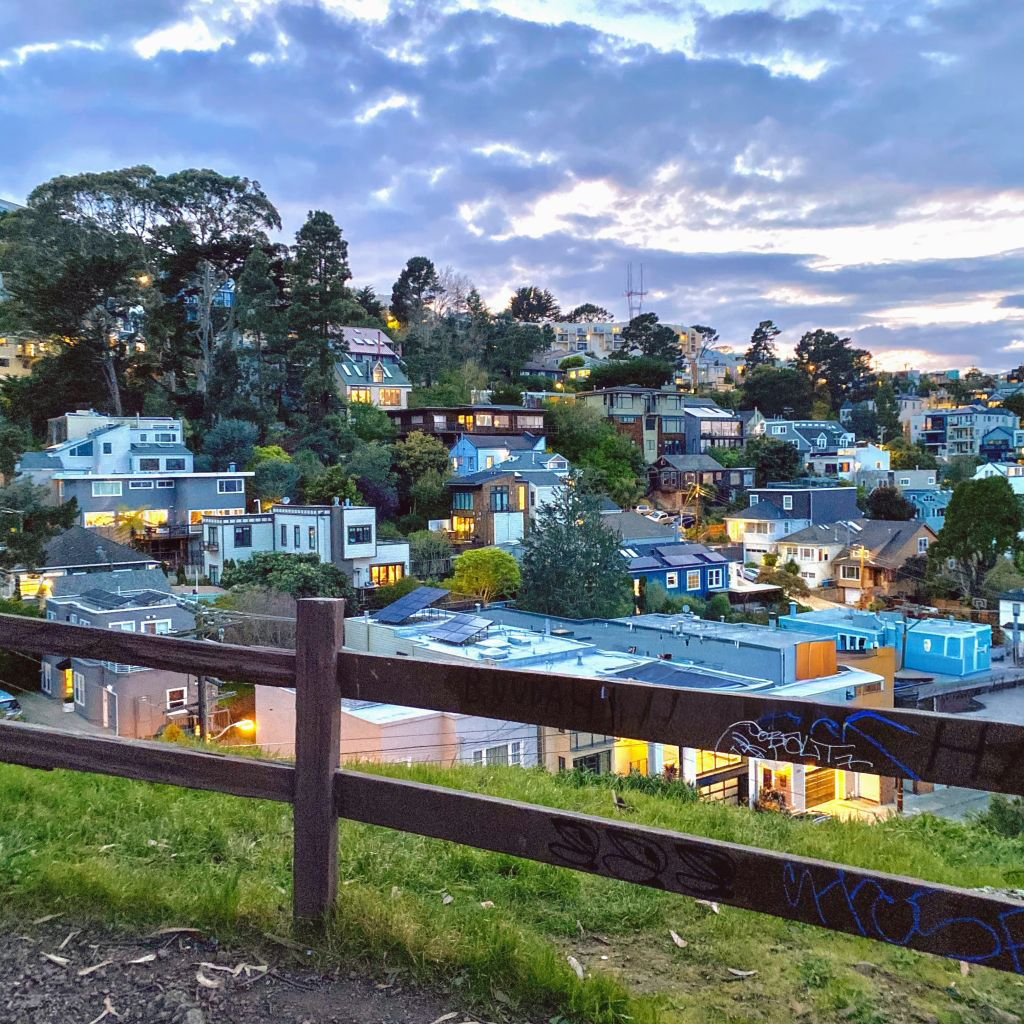
Noe Valley is one of San Francisco's most consistently demanded central neighborhoods, anchored by the 24th Street retail corridor and a sunnier-than-average microclimate. Over the last 30 days the median sale price was $2.41M, single-family houses ran a $3.0M median, and homes took 13 days to sell. Unless otherwise noted, all market figures here are from MLS data.

Start with the weather, because it explains a lot about why people pay to live here. National Weather Service station readings logged clear skies in 31% of recent local observations against 13% citywide, and fog in just 3.7% of readings against 10.3% across the city. The temperature runs about the same as the rest of San Francisco, within a third of a degree, so the draw is not heat — it is light. Twin Peaks and the hills to the west break up the fog that smothers the Sunset and the Richmond, and the valley sits in the clear behind them.
The name goes back to Jose de Jesus Noe, the last Mexican alcalde, or mayor, of Yerba Buena, who was granted Rancho San Miguel in 1845 — the land that became this neighborhood (per Wikipedia). Locals call it Stroller Valley, a nickname tied to its share of young families rather than its weather (per Wikipedia). The commercial heart is 24th Street, formally the 24th Street-Noe Valley Neighborhood Commercial District under San Francisco Planning Code Sec. 728, running the length of 24th Street from Chattanooga to Diamond. That designation matters: it is why the corridor stayed small-storefront retail instead of going to chain frontage.
Noe Valley is one of the neighborhoods I track block by block. After running comp sets across dozens of closings here this year, the pattern is clear to me: this is a deep, fast market with a wide price range, and the headline median hides as much as it reveals.
Noe Valley by the numbers

Read those figures with recency in mind. The 30-day median of $2.41M and the trailing-six-month median near $2.3M are what an active buyer or seller needs this quarter; the full-year median of $2.08M is older data, dragged down by the slower months. Against a citywide 12-month median of $1.83M, Noe Valley closings run roughly 14% higher. Speed is the other tell: 13 days to sell over the last 30 days is about the same pace as the city as a whole, and a sign of steady demand rather than the multiple-offer frenzy of the peak years. Year over year, the median is up 4.8% and price per square foot is up about 13%.
The price tiers, walked end to end
The most useful way to read Noe Valley is by price tier, because each one is a different property type and a different buyer. Over the last twelve months, the $1M–$2M segment did the most volume, 92 closings, about 39% of the market, and it is condo-heavy: 42 condos against 16 tenancy-in-common units. This is the entry point to the neighborhood, and it is mostly two- and three-bedroom attached homes. A renovated condo like 4125 24th Street #4 closed at $935K in June 2026; a larger TIC such as 1155 Guerrero Street closed at $2.5M the same month.
The $2M–$3M tier (56 closings, 24%) is where single-family houses take over — 35 of those 56 sales were detached homes, most of them three- and four-bedroom. This is the classic Noe Valley house segment, and condition drives the spread. 442 Vicksburg Street, a tenant-occupied three-bedroom, closed at $2.25M in May 2026; 4370 Cesar Chavez Street, a trust sale that needed work, also closed at $2.25M in March. Buy in this tier expecting to inherit either a tenant or a renovation budget.

The $3M–$5M tier (49 closings, 21%) is almost entirely renovated single-family houses, 40 of 49 sales, and four-bedroom homes dominate it. 714 Duncan Street, a renovated three-bedroom, closed at $3.4M in May 2026; 356 Valley Street, a 2,078-square-foot renovated house, topped the recent run at $4.575M in April. Above $5M, the market thins to 15 closings a year, again overwhelmingly detached houses, and the buyers are paying for finished, larger-lot property. At the bottom, the sub-$1M tier (22 closings, 9%) is entirely TICs and condos — the smallest one- and two-bedroom homes, the most affordable way into the ZIP code.
The blocks that trade most
Turnover is not evenly spread. The 300 block of San Jose Avenue saw nine closings over the past year at an $800K median and $961 per square foot — the busiest block in the neighborhood, and a TIC-and-condo cluster that carries a 99 Walk Score, near-perfect for getting around on foot. It sits at the flat, transit-rich eastern edge near the J Church line, which is why it turns over fast and prices low per unit.
Climb west and the math inverts. On the 400 block of Clipper Street, which carries a 96 Walk Score, four homes closed at a $3.36M median; the 600 block of 28th Street saw three closings at a $3.5M median. These are single-family blocks on the slope, where the homes are bigger and the prices follow. The 500 block of Grand View Avenue, higher still toward the western ridge, closed five sales at a $1.13M median and carries a 78 Walk Score — very walkable, but a clear step down from the valley floor, and a reminder that a few blocks of elevation change both the property type and the daily walk to 24th Street.

For amenities, the spine is 24th Street and the blocks around the Noe Valley Town Square at 3861 24th Street, which hosts the Saturday farmers market from 8am to 1pm year-round. The Sally Brunn Branch Library and Noe Valley Ministry anchor the civic layer, with Douglass Playground, Billy Goat Hill, and the Duncan-Castro Open Space giving the western blocks their green edges (landmarks per OpenStreetMap). The restaurant row of Chez Marius, Hamano Sushi, The Valley Tavern, Vive La Tarte, and Contigo keeps the corridor busy without spilling into the residential streets.
How the homes break down
This is an old neighborhood, and the building inventory shows it. Per SF Assessor parcel records, about 41% of parcels were built between 1900 and 1909 and another 20% between 1910 and 1929 — roughly two-thirds of Noe Valley predates 1930, the Victorian-and-Edwardian core that gives the streets their bay-windowed row-house rhythm. The median build year across the neighborhood is 1938 (American Community Survey). A second wave, about 21% of parcels, went up between 1950 and 1979, and only around 4% dates to 2000 or later, a figure that understates new completions, since assessor records lag recent construction.
By property type over the last year, single-family houses were 44% of closings, condos 26%, and TICs 14%, with duplexes and small multi-unit buildings making up most of the rest. That mix is the practical story: a buyer here is choosing among a detached Victorian, a flat carved into a two- or three-unit building, or a condo conversion, and each one comps and prices on its own terms. A blended "neighborhood median" would average a $3.0M house against a $1.14M TIC and tell you nothing useful.
What to consider before buying here
The tradeoffs are where the real decision lives, so here are the three I raise with buyers most often.
Parking and the old-house reality
With two-thirds of the homes built before 1930, garages are small, tandem, or absent. Many flats have no dedicated parking at all. The flat eastern blocks lean on street parking and transit; the western slope gives you more single-family garages but a steeper daily climb. If a car is non-negotiable, filter for it early, because it meaningfully narrows the list.
Schools run on a lottery, not your address
SFUSD assigns students through a city-wide lottery, so a Noe Valley address does not lock in a specific public school (per SFUSD). Alvarado Elementary at 625 Douglass Street sits in the neighborhood, along with McKinley, Sanchez, and Harvey Milk Civil Rights Elementary, but the address-area preference is a tiebreaker, not a guarantee. If schools drive your purchase, read our San Francisco private school admissions guide and plan around the lottery, not the ZIP.
Condition is doing most of the pricing
I don't sugarcoat this part — the spread inside a single tier is mostly condition, and it is wide. In the $2M–$3M house segment this year a renovated home and a trust-sale fixer closed at the same $2.25M number, leaving the renovation budget for whoever bought the fixer. Tenant-occupied listings add San Francisco's owner-move-in rules and timing on top. Read the condition before you read the price.
How to actually buy in Noe Valley in 2026
If you're buying here this year, anchor your offer to the right comps: same property type, same tier, ideally from the last 30 to 90 days. Then read the deal at the table. Recent closings give you the range; the outcome turns on the levers most buyers underweight. Is the seller looking at one offer or six? Is your financing clean against a competing cash bid? Is the unit vacant or tenant-occupied, carrying the owner-move-in rules and timing that follow? Does it have parking, outdoor space, or a renovation already done? Each of those moves the number more than another week of waiting for the perfect comp.
For sellers, the data says preparation pays. Renovated houses are clearing the $3M–$5M tier in under two weeks, while as-is and tenant-occupied listings sit longer and trade at a discount that often exceeds the cost of the work avoided. The 13-day median over the last 30 days is real, but it belongs to turnkey homes. If you're new to the math, our first-time buyer tips for San Francisco walk through offer structure, and the broader how to choose the right San Francisco neighborhood piece sets Noe Valley against its neighbors. When you're ready, I'll pull the block-level comp set for the specific tier you're shopping.
Is Noe Valley a nice place to live?
By the 2026 numbers, it is one of the most stable neighborhoods in San Francisco: a 13-day median time to sell over the last 30 days, a 96 Walk Score, and excellent transit on the J Church line plus the 24, 35, and 48 bus routes. Clear skies in 31% of recent local weather readings (National Weather Service) make it brighter than most of the city. The trade-offs are tight parking and high prices.
What is the average income in Noe Valley?
In 2023, the Census block group around 24th Street reported a median household income near $238,000 (American Community Survey), with a median home value around $2.0M. About 38% of workers there reported working from home, which fits a high-earning professional base. Those are block-group figures, so they describe the 24th Street core rather than every street, but they place Noe Valley among the city's higher-income neighborhoods.
Why is Noe Valley so popular?
As of 2026, the draw is a combination the data backs up: a sunnier microclimate, with clear skies in 31% of local readings versus 13% citywide (National Weather Service); a 96 Walk Score; and a protected small-storefront retail spine on 24th Street under San Francisco Planning Code Sec. 728. Add a deep market of 234 closings in the last year and you get steady demand with real liquidity at most price points.
Why is it called Noe Valley?
In 2026, Noe Valley still carries the name of Jose de Jesus Noe, who in 1845 was granted Rancho San Miguel, the land that became the neighborhood (per Wikipedia). He was the last Mexican alcalde, or mayor, of Yerba Buena, present-day San Francisco. The "valley" is literal: the area sits in a sheltered pocket between Twin Peaks and the hills to the west, which is also why it stays clearer of fog than the neighborhoods around it.
Is Noe Valley a rich neighborhood?
By the 2026 data, yes, it is one of San Francisco's higher-income, higher-value neighborhoods. The Census block group around 24th Street reported a median household income near $238,000 in 2023 (American Community Survey) and a median home value around $2.0M. Single-family houses carry a $3.0M median sale price over the last year (MLS), and the top tier clears $5M, though TICs and condos below $1M still offer an entry point.
Talk to me about Noe Valley
If you're weighing a move into Noe Valley, or thinking about selling here, I'm happy to walk you through the comps for your specific block and price tier, no pressure, just the data. I'm Chris Chour. As founder and broker of EON Real Estate, this is one of the neighborhoods I track most closely. Reach out when you'd like to see the numbers behind your own search!