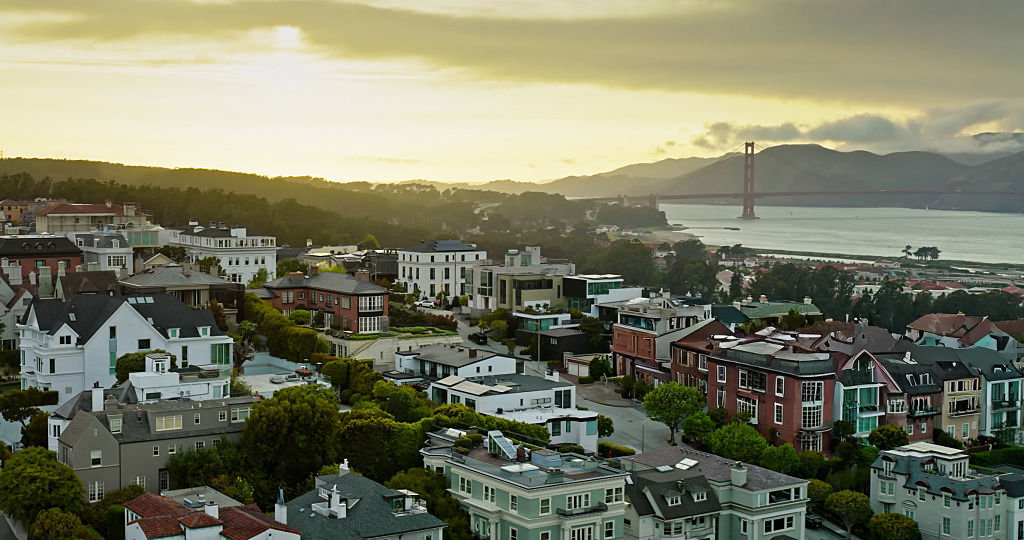
As of Q3 2026, Pacific Heights runs on two markets: condos and co-ops, where the trailing-12-month median condo closing is $1.54M, and single-family homes, where it is $6.8M. Sales close in a 13-day median, the last 30 days averaged $1,494 per square foot, and inventory sits at just 16 active listings.
Unless otherwise noted, all market figures in this guide are from MLS data.

Pacific Heights is the neighborhood people describe by what you can see from it: the Golden Gate Bridge, San Francisco Bay, Alcatraz, the Palace of Fine Arts, and the Presidio all sit in its sightlines (per Wikipedia). The weather cooperates more than most of the city's, too. In a May 2026 sampling window, National Weather Service station readings near the neighborhood logged fog on none of the observations, against roughly 10% of readings citywide.
But the views don't explain the pricing. What explains the pricing is a split market. Condos made up about 60% of the 224 closings in the year ending July 2026, at a $1.54M median. Single-family homes were under 20% of sales, at a $6.8M median, and the top of that segment is where the headlines live: 2830 Pacific Avenue closed at $27.5M in April 2026, 2880 Vallejo Street at $26.5M in June, and 2606 Jackson Street at $24M in May. A buyer shopping the one-bedroom condo tier and a buyer shopping the view blocks of Vallejo Street are technically in the same neighborhood, but they are in different markets.
I'm Chris Chour, founder/broker of EON Real Estate. Most of my work is single-family and condo transactions in SF's luxury neighborhoods, and Pacific Heights is one I comp constantly. What follows is the current data, block by block and tier by tier, plus the parts of the neighborhood pitch you should pressure-test before you write an offer.
Pacific Heights by the numbers
The recent windows matter more than the annual roll-up, so read them in order. The last 30 days: 19 closings, a 13-day median time on market, and $1,494 average per square foot. The last 90 days: 80 closings at a 14-day median. The last 180 days: 130 closings, still a 13-day median. Velocity has been remarkably stable across every window this year; what moves is the mix. The 30-day slice was condo-heavy, 15 of the 19 sales, which is worth remembering any time a single month's blended figure looks soft. For the one-line backdrop: the neighborhood's median closing is up about 10.5% from a year ago, average price per square foot is up 4.7%, and average days on market fell by 13 days.

The five price tiers, walked honestly
Under $1M. This tier exists here, which surprises people: 20 closings in the trailing 12 months, about 9% of the market. Seventeen were condos and three were TICs, and 17 of the 20 were one-bedrooms. The one-bedroom segment overall carries a $1.07M median at 846 average square feet, so the sub-$1M buys are the smaller or plainer end of that inventory. A recent example on the TIC side: 2735 Clay Street #4, a renovated one-bedroom, closed at $740,000 in March 2026.
$1M–$2M. The workhorse tier and the biggest, with 78 closings, about 35% of the market. It is almost entirely condos (69 of 78), split between two-bedrooms (38) and one-bedrooms (27). Two-bedroom properties across the neighborhood carry a $1.65M median at 1,447 average square feet. This is where most first-time Pacific Heights buyers actually land, and it is the most liquid segment in the neighborhood.
$2M–$3M. Thirty-six closings, and the tier where three-bedrooms take over: 17 of the 36 sales. The buyers here are mostly trading up within the condo and co-op inventory rather than crossing into houses; only 3 of the 36 were single-family sales. Recent comps that define the tier: 1859 Vallejo Street #3, a three-bedroom condo that closed at $2.35M in May 2026, and 2001 Sacramento Street #3, a 1,912-square-foot three-bedroom that closed at $1.9M in June after 60 days on market.
$3M–$5M. Forty-three closings, and the most mixed tier by property type: 20 condos, 8 single-family homes, 5 co-ops, plus small multi-unit buildings. This is where renovated condition starts commanding real premiums. 2450 Vallejo Street, a renovated three-bedroom condo that lives like a house per its listing, asked $4M and closed at $4.55M in April 2026 after 11 days. On the co-op side, 2100 Pacific Avenue #3B, a four-bedroom, closed at $4.495M in June.
$5M and up. Forty-seven closings, a full 21% of the market, and single-family homes dominate: 33 of the 47 closings, and 27 sales in the tier had five or more bedrooms. The five-plus-bedroom segment carries a $6.35M median at 6,191 average square feet. Renovated examples set the pace: 1913 Sacramento Street, described in its listing as a renovated 1900 Italianate Victorian half a block from Lafayette Park, asked $4.5M and closed at $5.55M in March 2026 in 7 days. Above all of it sit the trophy sales already named: $24M, $26.5M, and $27.5M closings between April and June 2026.

Where homes actually trade, block by block
Turnover concentrates in a handful of block ranges, and they behave differently enough to price differently.
The 2200 block of Sacramento Street leads the neighborhood with 10 closings in the trailing 12 months, at a $1.45M median and $1,491 average per square foot, with a 93 Walk Score. The 2200 block of Pacific Avenue follows with 7 closings at a $1.46M median and a 97 Walk Score; there's a separate guide to valuing units at 2200 Pacific Avenue on the EON blog if that building is on your list.
The 1700 block of Jackson Street posted 6 closings at a $1.33M median, tied for the most walkable block range in the data set with a 99 Walk Score. The 2100 block of Green Street matches that 99 Walk Score, with 5 closings at a $2.1M median. The 1800 block of Jackson Street did 5 closings at a $2.55M median.
Two blocks tell the top-of-market story. The 1900 block of Broadway Street closed 4 sales at a $2.87M median and $1,655 average per square foot, the highest per-foot figure among the high-turnover blocks. And the 1900 block of Jackson Street closed 4 sales at an $8M median, the signature of large single-family homes clustering on a single block range.
Getting around without a car is realistic across all of these blocks. The 1 California, 22 Fillmore, 24 Divisadero, and 45 Union-Stockton Muni lines all stop within a half-mile of the neighborhood's center (SFMTA), and the core carries an 81 Transit Score. The food layer is dense too: b Patisserie, SPQR, Jackson Fillmore Trattoria, Florio Bar & Café, and The Snug all operate inside or on the edges of the neighborhood, and Alta Plaza Park and Lafayette Park are the two green anchors (OpenStreetMap).

How the building inventory breaks down
By sales volume, Pacific Heights is a condo neighborhood with a single-family crown. Condos took 60.3% of trailing-12-month closings, single-family homes 19.6%, stock cooperatives 7.1%, and TICs 3.1%, with the balance in small multi-unit buildings. The co-op share is the number to notice; at a $3.59M median, co-ops here are not a budget path, they are a distinct luxury segment with their own rules.
The buildings are old. The census block group at the neighborhood's center reports a median year built of 1938 (US Census ACS), and the recent comp set is full of earlier vintages: 2880 Vallejo Street dates to 1902, 2830 Pacific Avenue to 1910, and 2459 Buchanan Street occupies a 1900 building. Listing records in the current comp set describe a renovated 1900 Italianate Victorian on Sacramento Street and an Arts and Crafts flat on the 2800 block of Jackson Street. New construction is the exception; 2606 Jackson Street, built in 2002, was the only post-2000 house among the year's three biggest sales.
The same census block group sketches who owns here: median household income of $225,438, median gross rent of $3,315, and a median home value the survey literally cannot express, top-coded at $2,000,001 (US Census ACS).
What to consider before buying (or selling) here
List prices are an opening bid, not a forecast
I don't sugarcoat this part: the gap between asking and closing prices here can be enormous, and it cuts both ways. In March 2026, 2459 Buchanan Street asked $2.395M and closed at $3.4M, a full $1M over. 2851 Clay Street asked $1.95M and closed at $2.51M in 5 days. Meanwhile 2001 Sacramento Street #3 sat for 60 days and closed $5,000 over its $1.895M asking price. If you calibrate your budget to asking prices, you will lose the competitive listings and overpay for the stale ones.
Inventory is structurally thin, and what's active skews high
Sixteen active listings against 224 closings in the trailing year means roughly one home on the market for every fourteen that traded. The active set also prices well above the closed set: the median asking price is $3.7M as of July 2026. Patient buyers in the $1M–$2M condo tier will see steady flow; buyers with a specific single-family profile may wait quarters for the right listing to surface.
Old buildings demand forensic diligence
With a 1938 median year built (US Census ACS) and trophy homes dating to 1902, condition separates outcomes here more than location does. The comp set shows it: renovated properties like 2450 Vallejo Street and 1913 Sacramento Street drew fast, over-ask closings, while as-is and estate situations traded on different terms; 2573 California Street, a trust sale requiring court confirmation, still closed $805,000 over its asking price in May 2026. Co-ops add another layer; they were 7.1% of sales, and their days on market ranged from 3 days at 1940 Broadway Street #2W to 114 days at 2100 Green Street #206. Budget for inspections and lender questions accordingly.
The school map is not the school assignment
Cobb Elementary sits inside the neighborhood at 2725 California Street, with Sherman Elementary and the K-8 Lilienthal nearby, and Galileo and Wallenberg as the public high school options in the radius (NCES school directory data). But SFUSD assignment runs through a citywide process, not a simple address map, so verify current assignment rules with the district before you underwrite a purchase around a specific public school. The private cluster is unusually deep: Town School for Boys, The Hamlin, Convent & Stuart Hall, and San Francisco University High all operate within the same radius. I covered how those admissions cycles interact with home purchases in the private school admissions guide.
Buyer playbook, seller playbook
If you're buying in Pacific Heights in 2026, here's what I'd tell you to do before writing anything. First, comp strictly within your property type; a condo comps against condos, a co-op against co-ops, and blending them produces numbers that mean nothing in a neighborhood where the condo median is $1.54M and the single-family median is $6.8M. Second, weight the last 30 and 90 days over anything older; with 80 closings in the last 90 days there is enough recent signal that you never need stale comps. Third, read the situation, not just the comps: whether you're financed or cash, how many offers are in, whether the property is vacant or tenant-occupied, and whether it's turnkey or needs work each move the number. Two of the recent multi-unit closings carried vacant-delivery terms, and the trust sale at 2573 California Street shows court-confirmation properties can still draw fierce bidding.
If you're selling, the data argues for pricing as an instrument rather than a wish. The listings that priced near or below recent same-type comps drew the fast, over-ask outcomes: 2298 Pacific Avenue #3 closed $616,000 over its asking price in 2 days, and 2510 Steiner Street closed $350,000 over in 13 days. The listings that priced to aspiration sat. Timing matters too: this year's spring cycle showed up clearly in the closing data, with March through June each posting 20 to 36 closings against 3 in January and 5 so far in July. One more lane worth knowing: quiet sales happen here. MLS records show 16 off-market Pacific Heights closings in 2026 to date at a $3.69M median, so if discretion matters to you, the off-market channel is real and one I work regularly.
Is Pacific Heights a good place to buy a home in 2026?
If the budget supports it, yes: 224 sales closed in the 12 months ending July 2026, and the last 30 days ran a 13-day median time on market. Demand is steady across every tier, from a $757,000 closing to a $26.5M house sale in June 2026. The honest caveats are thin inventory, 16 active listings, and asking prices that routinely understate final numbers.
How much does a home in Pacific Heights cost in 2026?
As of mid-2026, the median condo trades around $1.54M and the median single-family home around $6.8M, based on trailing-12-month closings. One-bedroom units carry a $1.07M median, two-bedrooms $1.65M, and three-bedroom properties $3.06M. The last 30 days averaged $1,494 per square foot. Entry points below $1M exist: 20 sales closed under $1M in the past year, 17 of them one-bedrooms.
Is Noe Valley or Pacific Heights better for buying a home?
In 2026, Pacific Heights is the stronger fit for condo, co-op, and view-property buyers: roughly 60% of its 224 trailing-12-month sales were condos, with co-ops adding another 7%, and its single-family median of $6.8M is a steep entry. If a house at a lower price point is the priority, compare the numbers in my Noe Valley guide before deciding; the right answer is property-type-specific, not neighborhood-loyal.
How fast do homes sell in Pacific Heights?
Fast: the median time on market over the 30 days ending July 14, 2026 was 13 days, and the 90-day median was 14 days. Well-priced properties move quicker still; 1940 Broadway Street #2W closed in 3 days in June 2026 and 2298 Pacific Avenue #3 in 2 days in May. The exceptions are mispriced or complicated listings, which sat anywhere from 60 to 126 days in the recent comp set.
Is Pacific Heights more expensive than the rest of San Francisco?
Yes, and 2026 data quantifies it: over the 12 months ending July 2026, the neighborhood's median closing of $2.33M ran about 27% above the citywide median of $1.825M. Its $1,348 average price per square foot ran about 10% above the city's $1,227. The gap is widest in the single-family segment, where the median closing was $6.8M against a $1.54M condo median inside the same boundaries.
Do homes in Pacific Heights sell over asking price?
Often, and by wide margins in competitive segments during 2026: 2459 Buchanan Street asked $2.395M and closed at $3.4M, 2851 Clay Street asked $1.95M and closed at $2.51M in 5 days, and 2573 California Street, a trust sale, asked $2.795M and closed at $3.6M. It is not universal, though; 2001 Sacramento Street #3 took 60 days and closed $5,000 over its asking price.
Talk to me about Pacific Heights
EON Real Estate is ranked in the top 1% of agents by Top Agent Network. If you're weighing a purchase or a sale here, I can pull the comp set for your exact segment, same property type, same tier, last 90 days, and walk you through what it says about your number. No pitch attached; the data conversation is useful whether or not we ever work together.