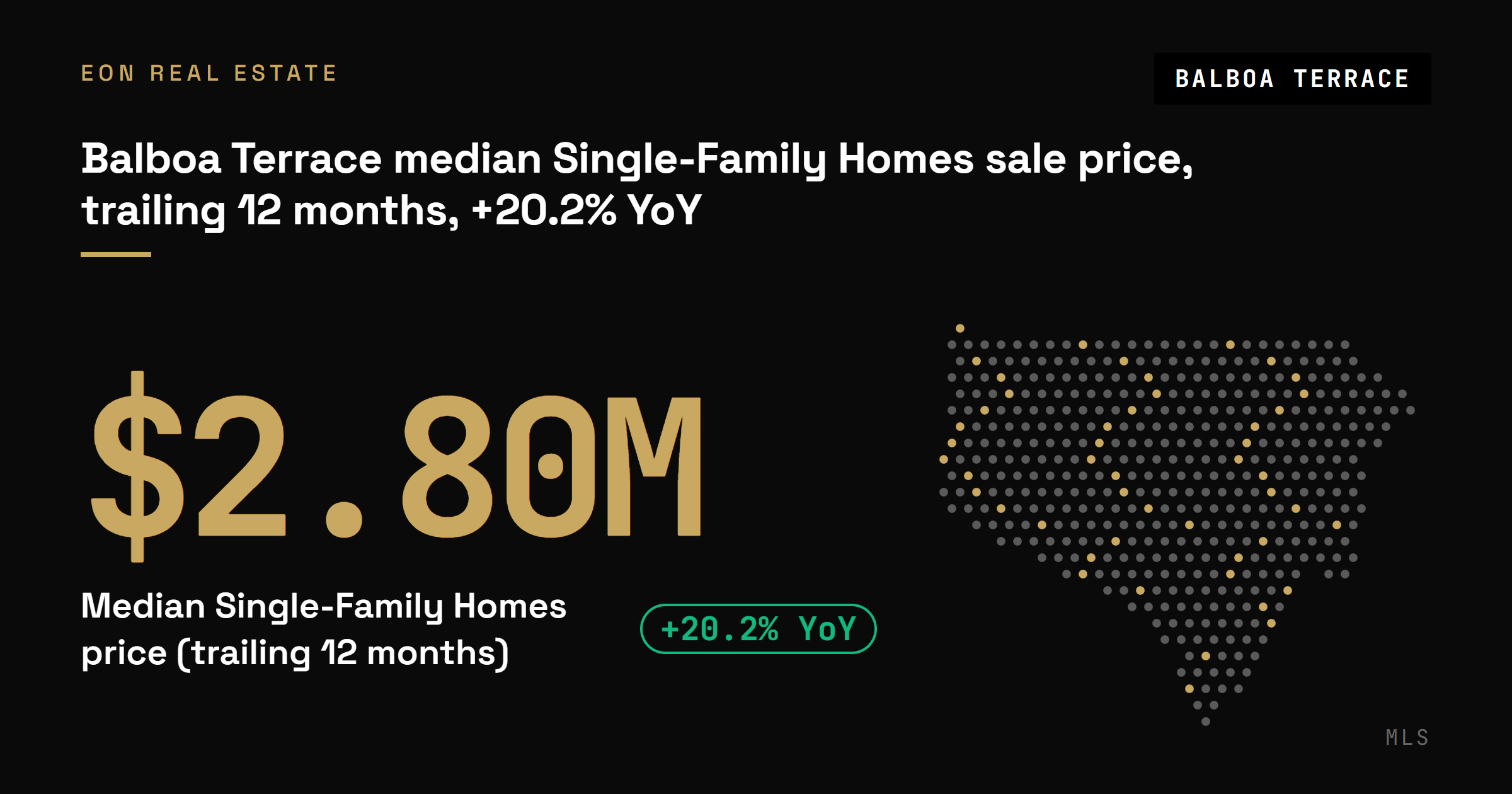
Selling a home in Balboa Terrace in 2026 means pricing into a very small, very fast market. Seven single-family houses closed in the 12 months to October 2026 at a $2.80M median, every one of them above its list price, after a median 8 days on market. With so few sales, the comp set you choose decides the number.
Unless otherwise noted, all market figures in this guide are from MLS data, current to October 29, 2026. I'm Chris Chour, founder/broker of EON Real Estate. Most of my work is single-family and condo transactions in SF's luxury neighborhoods. Balboa Terrace is a small grid of 1920s and 1930s single-family houses near Ocean Avenue, and it trades unlike most of the city. There are no condos to dilute the data; the seven 2026 closings were single-family houses built between 1922 and 1938. That uniformity is a gift and a trap. It makes the homes easy to compare, but a sample of seven means one sale can swing the median by hundreds of thousands of dollars. As of Q4 2026, the fall selling cycle is winding toward Thanksgiving, and not one home closed in the last 30 days. Most sellers here are weighing a single question: list into the thin late-fall window, or prepare now and launch after Valentine's Day when the spring cycle opens. The sections below cover the current numbers, three seller situations anchored to real closings, the per-square-foot math behind a list price, and the tradeoffs worth pricing in before you sign a listing agreement.
Balboa Terrace's market right now
The trailing-12-month picture is seven single-family closings at a $2.80M median, an average of $3.02M, and a range from $2.36M to $4.708M. Average price per square foot was $1,178, and the average home spent 10 days on market (median 8). Tighten to the last 180 days and four homes closed at a $2.815M median, averaging $1,124 per square foot. The last 90 days hold a single sale: 135 San Rafael Way at $4.708M in September 2026. That one closing is why a 90-day "median" of $4.708M would mislead you, and why any honest pricing conversation here uses the 180-day and 12-month windows together.
Direction is up. The 12-month median rose 20.2% from $2.329M a year earlier, and average price per square foot rose 12.9% from $1,043 to $1,178, while average days on market fell from 13 to 10. Volume is the constraint: seven closings, down from nine in the prior 12 months, and only one active listing as of late October 2026, asking $4.995M.
The segment split is narrow. Five of the seven closings (71.4%) landed between $2M and $3M; the other two (28.6%) landed between $3M and $5M. Nothing closed under $2M and nothing above $5M. By bedroom count, four-bedrooms are the center of the market at four of seven sales (57.1%), with a $2.85M median and an average of 2,436 square feet. The 300 block of San Benito Way alone produced three of the seven closings, at a $2.90M median.
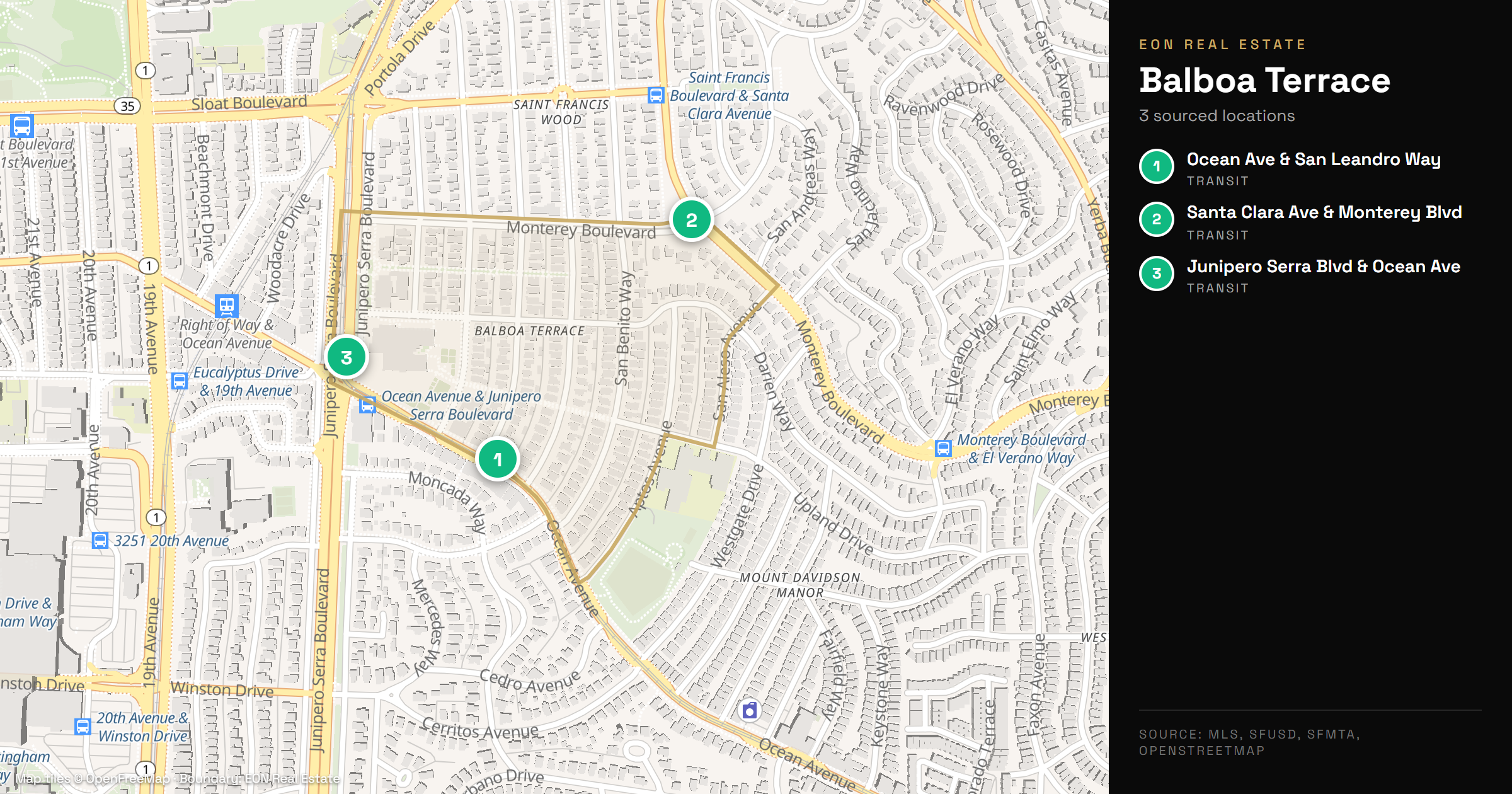
For buyers comparing schools and commutes, the facts are simple to state. Commodore Sloat Elementary is at 50 Darien Way and Aptos Middle at 105 Aptos Avenue (NCES), and the K Ingleside Muni line stops at Ocean Avenue and San Leandro Way, about 181 meters from the neighborhood's center (SFMTA).
Balboa Terrace by the numbers
Three seller scenarios
With one property type and a tight age range, nearly every Balboa Terrace listing falls into one of three situations. The right list strategy differs for each.
Scenario 1: The renovated four-bedroom on the San Benito Way core
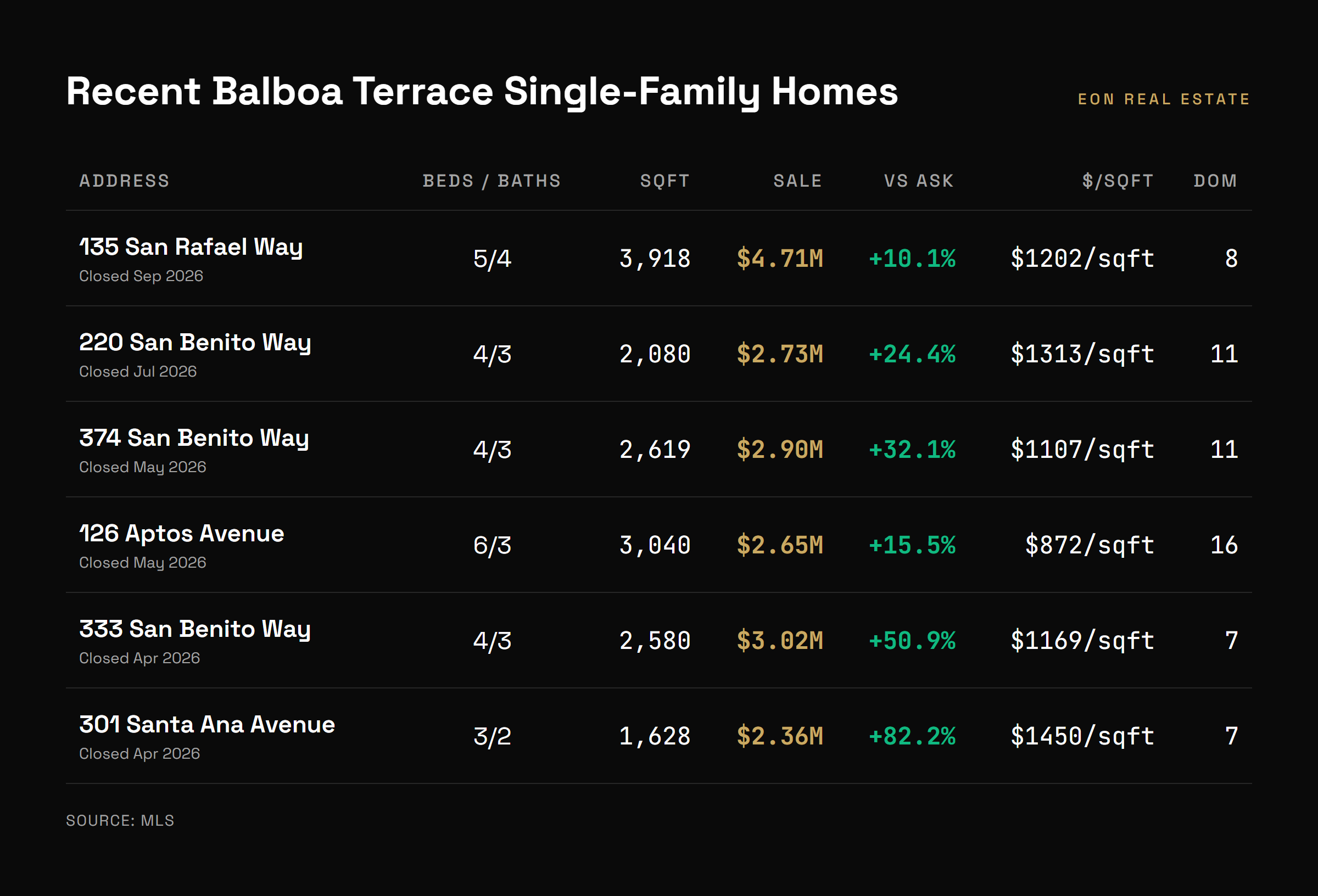
This is the market's center. Four of the seven 2026 closings were four-bedroom, three-bath houses between 2,080 and 2,619 square feet, and three of them sit on the 300 block of San Benito Way. 315 San Benito Way, a remodeled detached Spanish Revival house of 2,465 square feet, listed at $2.295M and closed at $2.80M in 8 days. 374 San Benito Way (2,619 square feet, renovated, ocean view) listed at $2.195M and closed at $2.90M in 11 days. 333 San Benito Way (2,580 square feet, two parking spaces) listed at $1.998M and closed at $3.015M in 7 days. What I'd tell you to do is list close to the low end of the recent closings and let competing offers set the price, because every four-bedroom in 2026 closed between $2.73M and $3.015M. The tradeoff: this only works when the house truly shows move-in ready. Don't list an unrenovated kitchen at a renovated-comp strategy; buyers will price the work plus a risk premium and the under-list becomes your ceiling.
Scenario 2: The large five- or six-bedroom house
Size does not scale price evenly here. 135 San Rafael Way (5 beds, 4 baths, 3,918 square feet) listed at $4.278M and closed at $4.708M in 8 days, $1,202 per square foot and the top sale of the year. 126 Aptos Avenue (6 beds, 3 baths, 3,040 square feet, four parking spaces) listed at $2.295M and closed at $2.651M after 16 days, the slowest closing in the set and the lowest at $872 per square foot. Per-square-foot value did not rise with bedroom count: the six-bedroom closed at the lowest per-square-foot price in the set, and the five-bedroom with four baths closed at the highest total. My recommendation for a large house is to price it closer to expected value than the four-bedrooms do, and to sell the floor plan room by room rather than leading on the bedroom count. The tradeoff is a thin buyer pool: only two of the seven closings topped $3M, so an over-ambitious list price on a big house has few buyers to correct it.
Scenario 3: The smaller three-bedroom entry home
The smallest homes draw the widest pool. 301 Santa Ana Avenue (3 beds, 2 baths, 1,628 square feet, ocean and water views, two parking spaces) listed at $1.295M and closed at $2.36M in 7 days. That is $1,450 per square foot, the highest in the 2026 set, and a sale price 82.2% above list. The recommended approach is still a below-comp list price, because this is the home most buyers can stretch to, and the competition is what drives the per-square-foot premium. The tradeoff is appraisal exposure. When a financed buyer pays far above list, the lender's appraisal must reach the contract price or the buyer has to cover the gap in cash. Don't accept the highest number without weighing the buyer's down payment and appraisal terms; a slightly lower offer with an appraisal-gap commitment or all cash can be the stronger contract.
Pricing discipline: setting the list price from the comps
I set a Balboa Terrace list price from per-square-foot math against the closest in-neighborhood closings, then adjust for condition, parking, view and the offer strategy. The 12-month median is $1,169 per square foot across all seven sales, but the useful range is the four four-bedroom closings: $1,107 (374 San Benito Way) to $1,313 (220 San Benito Way, 2,080 square feet, closed at $2.73M in 11 days).
Run that on a renovated 2,500-square-foot four-bedroom. At $1,107 per square foot it pencils to about $2.77M; at $1,313 it pencils to about $3.28M. That is the expected-value range, not the list price. In 2026 the four-bedroom houses on San Benito Way listed between $1.998M and $2.295M and closed between $2.73M and $3.015M, so a list price somewhat below the expected range is how this market concentrates its buyers into one weekend. Don't push the list price below a number you would accept, though. If a single offer comes in near list, you are negotiating from your own published number.
Closed-sale prices and addresses are public record, which is why they are named here. Active and pending listings stay address-private per MLS rules, so a seller's view of the competing inventory comes through me. For the costs that come out of your proceeds, see what seller closing costs really cover in San Francisco.
Staging, photography, and the marketing window
The seven 2026 closings were all single-family houses built between 1922 and 1938, and the marketing should follow that era. The renovated comps led with remodeled kitchens and breakfast areas, light-filled formal dining rooms and, where they had them, ocean views from the upper level. Three of the seven closings carried an ocean view in their listing data, including 301 Santa Ana Avenue (82.2% over list) and 374 San Benito Way (32.1% over list). If your house has a view from any room, shoot it on a clear afternoon and put it in the first five photos. Keep the original period details rather than painting over them (126 Aptos Avenue's listing data notes a built-in hutch in the breakfast room); for how buyers price each era's finishes, our San Francisco home styles seller's guide breaks it down. Every 2026 closing had parking, so show the garage clean and empty. Plan a two-weekend launch: the fastest closing took 7 days and the slowest 16. Don't over-renovate for the sale. A full gut remodel rarely pays back against comps that top out near $1,313 per square foot for a four-bedroom, and cosmetic prep plus a pre-sale inspection protects the short timeline that defines this market.
Off-market versus listing on the MLS
For most Balboa Terrace sellers in 2026, the open MLS listing is the better tool, because the data shows what full exposure does: all seven closings went above list, from 10.1% over at 135 San Rafael Way to 82.2% over at 301 Santa Ana Avenue. Price discovery in a seven-sale market comes from competing buyers, not from a private conversation. Off-market makes sense when privacy matters more than the last dollar, when your timing does not fit the spring or fall cycle, or when you want to test a number quietly before committing. As a member of Top Agent Network (an invite-only network of top-producing agents, per Top Agent Network), I can show a house privately to active buyers before it goes live, then move it to the full MLS if the private round does not deliver. The move to avoid is a long, quiet off-market campaign on a renovated four-bedroom that the open market would bid up in a single weekend.
What to consider before you list
Three tradeoffs matter more here than in larger neighborhoods.
A seven-sale market moves on one closing
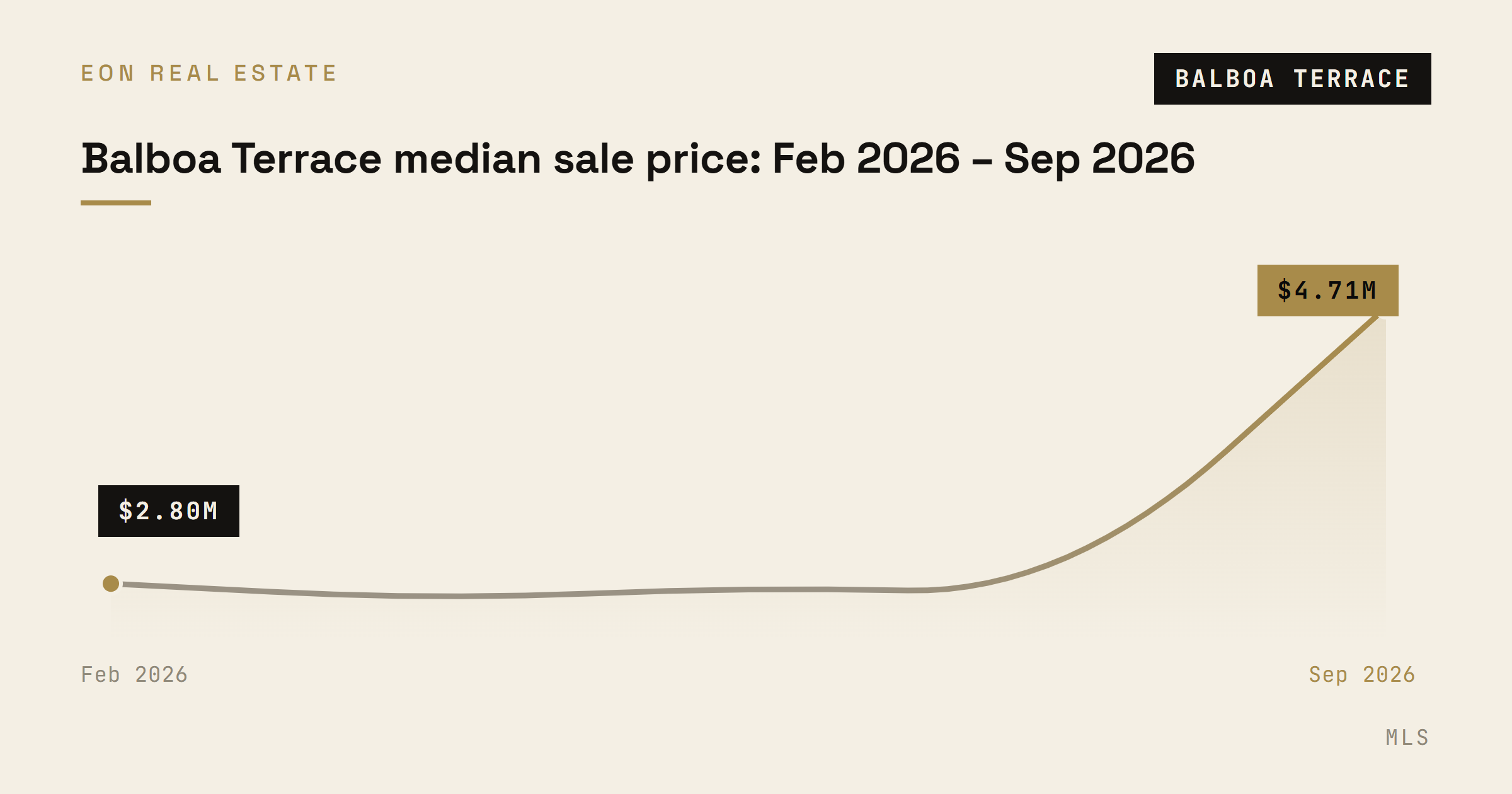
The 90-day median is a single $4.708M sale, and the September 2026 monthly figure on the chart above is that same house. Buyers, appraisers and agents all read the same thin data. Price from the full set of comparable closings, and don't let a single outlier, high or low, anchor your number.
The late-fall window is short
No home closed in the last 30 days, and the one active listing is asking $4.995M. San Francisco runs two selling cycles, spring from after Valentine's Day through June and fall from late August toward Thanksgiving. Of the seven 2026 closings, five came between February and May. A listing launched in November has fewer buyers to compete; a house prepared over the winter and launched in late February meets the cycle that produced most of this year's sales.
Above-list sales need a strong appraisal file
When a house closes 50.9% above list, as 333 San Benito Way did, the appraisal has to support the contract price. Give the appraiser the full comp set and a list of improvements with dates. The cost of a weak appraisal file is a renegotiation late in escrow.
If you are weighing Balboa Terrace against a nearby neighborhood with more inventory, the Miraloma Park seller's guide covers the same seller questions for that neighborhood.
How much do homes sell for in Balboa Terrace in 2026?
In 2026, Balboa Terrace single-family homes closed at a $2.80M median over the trailing 12 months and $2.815M over the trailing 180 days. Four-bedroom houses, the most common sale, carry a $2.85M median, while the two five-plus-bedroom sales had a $3.68M median. The range ran from $2.36M for a 1,628-square-foot three-bedroom to $4.708M for a 3,918-square-foot five-bedroom. There were no condo sales.
Are Balboa Terrace home prices going up or down?
Up, as of October 2026. The trailing-12-month median rose 20.2% year over year, from $2.329M to $2.80M, and average price per square foot climbed 12.9%, from $1,043 to $1,178. Read the direction with care: the gain rests on seven sales, down from nine in the prior 12 months, so a single high or low closing moves the median more here than in a larger neighborhood.
How fast do homes sell in Balboa Terrace?
Very fast in 2026. The seven single-family homes that closed in the trailing 12 months had a median of 8 days on market and an average of 10, down from a 13-day average a year earlier. The quickest, 301 Santa Ana Avenue and 333 San Benito Way, took 7 days each; the slowest, 126 Aptos Avenue, took 16. Speed held across the $2.36M to $4.708M price range.
Do Balboa Terrace homes sell over asking?
Yes, every one in 2026. All seven single-family closings in the trailing 12 months sold above list, from 10.1% over at 135 San Rafael Way to 82.2% over at 301 Santa Ana Avenue. Several houses listed well below the neighborhood's closed prices: 301 Santa Ana Avenue listed at $1.295M, below the lowest 2026 sale of $2.36M. The list price here is a starting signal, so sellers should judge offers against the closed comps rather than the asking price.
When is the best time to sell a home in Balboa Terrace?
In 2026, spring produced most of the sales: five of the seven single-family closings came between February and May, with one in July and one in September. San Francisco's spring cycle runs from after Valentine's Day through June. With no closings in the last 30 days and one active listing in late October, a seller who is not ready now usually does better preparing over the winter for a late-February launch.
Is Balboa Terrace walkable?
Yes, with an 89 Walk Score (Very Walkable) at the neighborhood's center as of October 2026. It also carries a 70 Transit Score (Excellent Transit) and a 68 Bike Score (Bikeable). The K Ingleside Muni line stops at Ocean Avenue and San Leandro Way, about 181 meters away, and the 23 Monterey and 57 Parkmerced bus lines stop within about 300 meters (SFMTA).
Talk to me about selling in Balboa Terrace
When you are ready to see what your house would do in this market, I can pull the closings most like yours, run the per-square-foot math against the last 180 days and 12 months, and lay out which prep is worth paying for before a spring or fall launch. No pressure and no obligation, just the real numbers for your house.