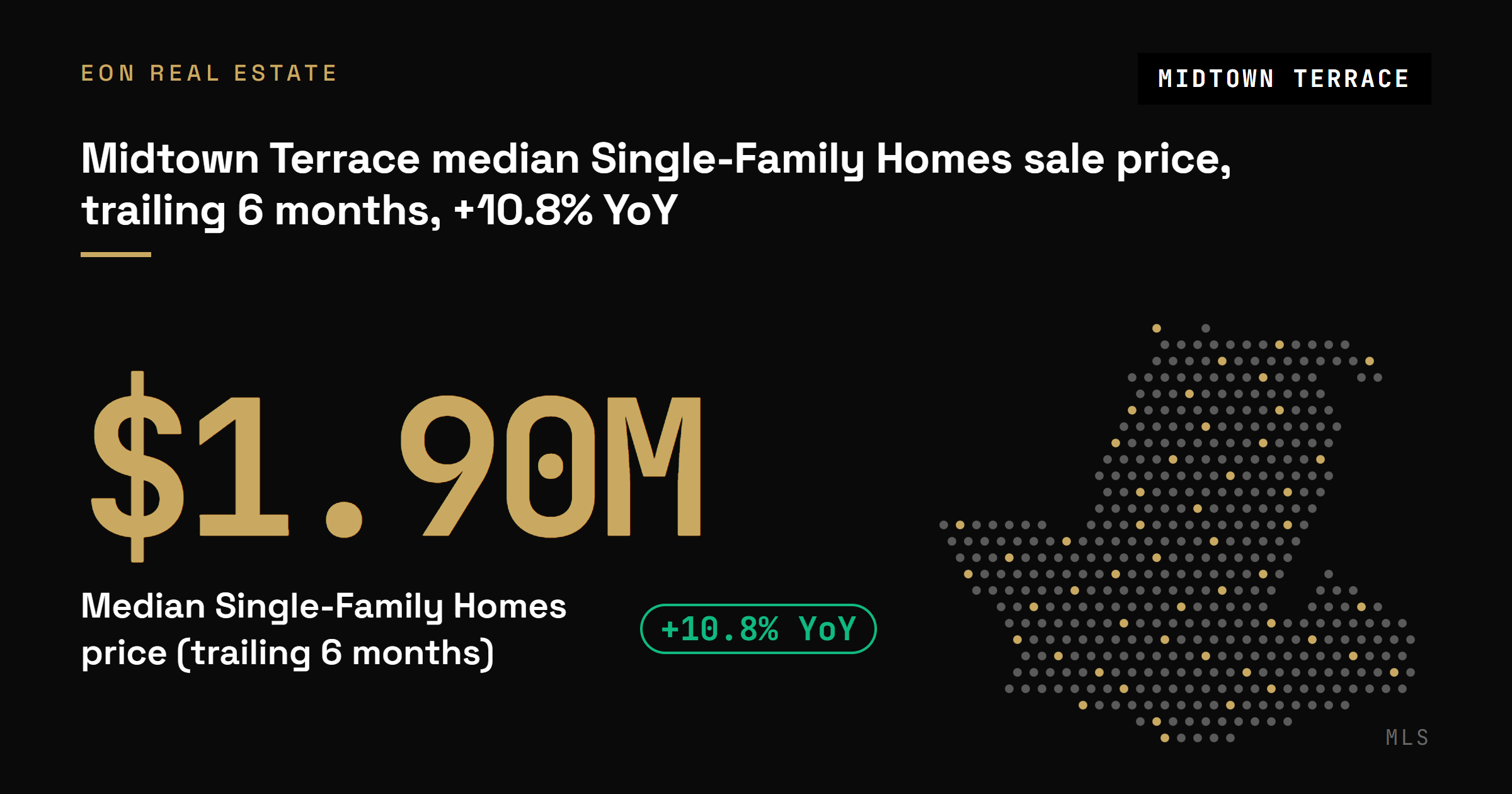
Midtown Terrace is one of San Francisco's smallest and sunniest single-family pockets, and in September 2026 it is behaving like a seller's market: detached homes closed at a $1.9M median over the trailing six months, up 10.8% from a year earlier, and they sold in about 10 days. Unless otherwise noted, all figures in this update are from MLS data.
Tucked on the east slope of Twin Peaks under Sutro Tower, Midtown Terrace is a compact grid of mid-century houses that rarely comes up for sale. Only 10 single-family homes closed here in the last six months, so every listing carries weight, and the ones that show well draw competing offers. The headline is simple: prices firmed, timelines stayed short, and the spread between the cheapest and priciest closing came down to condition and view more than size. One I track block by block for exactly that reason. Below is the September 2026 picture, the comp set that explains the range, what the setting adds, and the tradeoffs a buyer should weigh before writing an offer up here.
Midtown Terrace by the numbers (trailing 6 months, 2026)
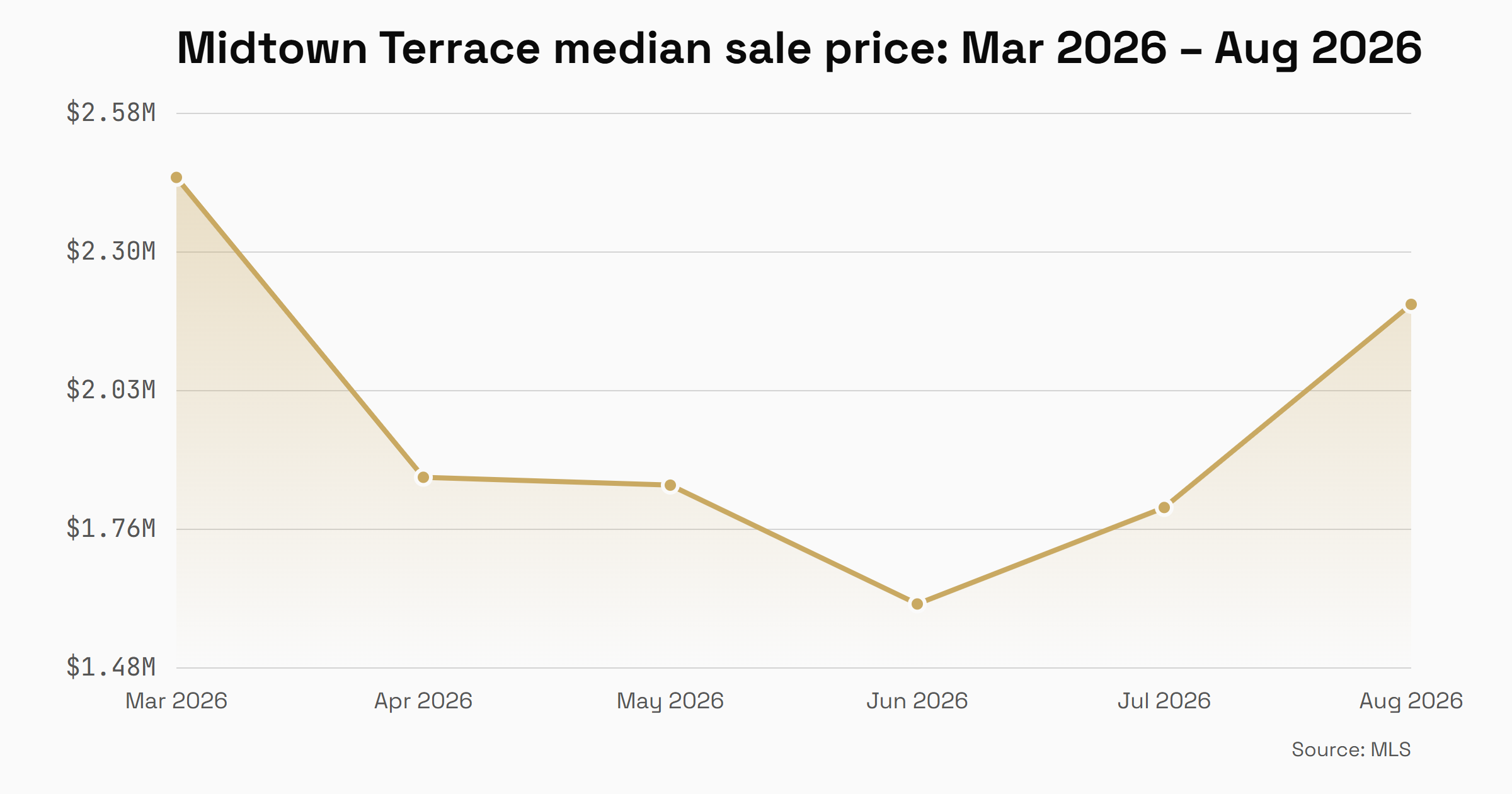
For a directional read, single-family prices are up 10.8% year over year and price per square foot is up about 6% over the same span, while the average time to sell shortened by roughly four days. With one or two closings in some months, the month-to-month line is noisy, so the trailing six-month and 12-month figures are the honest base. The 12-month median sits near $1.9M across 22 sales, a level Midtown Terrace has held while the citywide single-family market climbed alongside it.
Put next to the rest of the city, Midtown Terrace reads as a mild premium pocket rather than a trophy one. The citywide median across the whole city is $1.75M over the trailing 12 months, and the citywide price per square foot runs about $1,201 (MLS). Midtown Terrace single-family homes at a $1.9M median and roughly $1,267 per square foot sit modestly above both, which is what you would expect from a detached-house neighborhood with a sun advantage and almost no attached inventory to drag the number down. It is not a Pacific Heights price, and it is not trying to be. It is a mid-price detached market where the premium is paid for the setting and the condition of the specific house, not the address alone.
The comp set: what moved prices
The six-month range, $1.61M to $2.4M, is not about square footage. It is about condition, view, and whether the house was vacant. The renovated three-bedrooms clustered in the high $1s to low $2s, while occupancy and finish level explain the outliers on both ends.
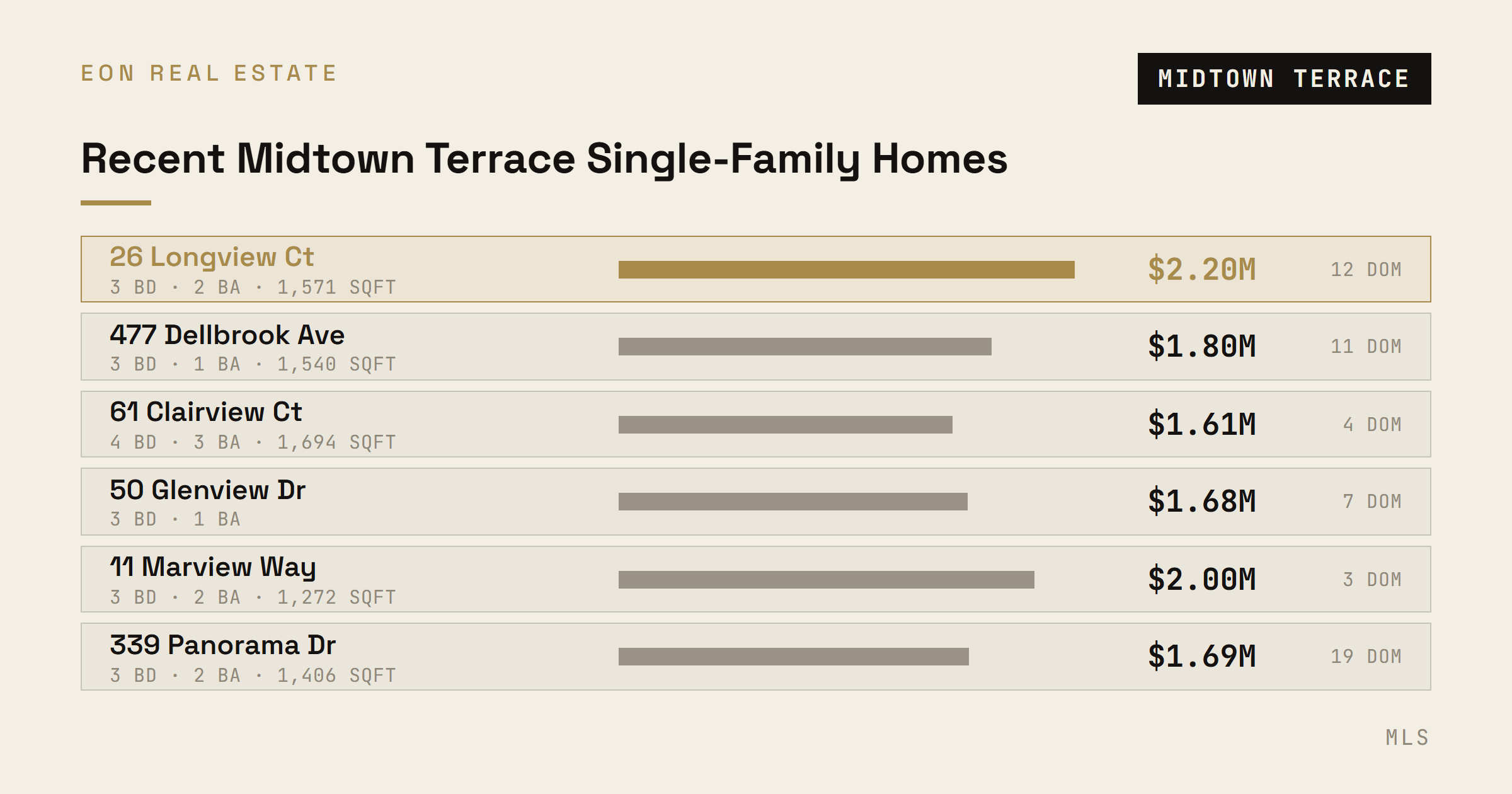
At the top, a vacant four-bedroom on Clairview Court reached $2.4M in five days, and a renovated three-bedroom on Longview Court with ocean and Sutro Tower views closed at $2.2M, a $500,000 jump over its $1.7M list. A renovated three-bedroom on Midcrest Way took $2.03M in nine days. Even an as-is three-bedroom on Marview Way sold for $2.005M in three days, carrying the highest price per square foot in the set at about $1,576, because a Twin Peaks view and a small footprint push the per-foot number up. At the bottom, a tenant-occupied four-bedroom on Clairview Court traded at $1.61M despite its size, a clean example of the discount an occupied unit carries under San Francisco's tenant-protection timing. The renovated three-bedroom on Dellbrook Avenue at $1.8M and the updated three-bedroom on Glenview Drive at $1.683M fill in the middle. The pattern I read here is consistent: renovated and vacant sells at a premium, and views on this hillside are worth real money.
What makes Midtown Terrace different
The setting is what buyers are really paying for here, and it is measurable. Midtown Terrace logs clear skies about 18 percentage points more often than the citywide average and is foggy less often, because it sits on the sheltered east face of Twin Peaks (National Weather Service). That is a real amenity in a city where two neighborhoods a mile apart can have very different summers. The homes themselves are a coherent set: detached houses built mostly in the mid-1950s, the median year built is 1954 (Census data), on hillside lots that almost all include one or two parking spaces. Owner-occupancy is high, with 171 of 290 units owner-held (Census), which is a large part of why so few trade each year.
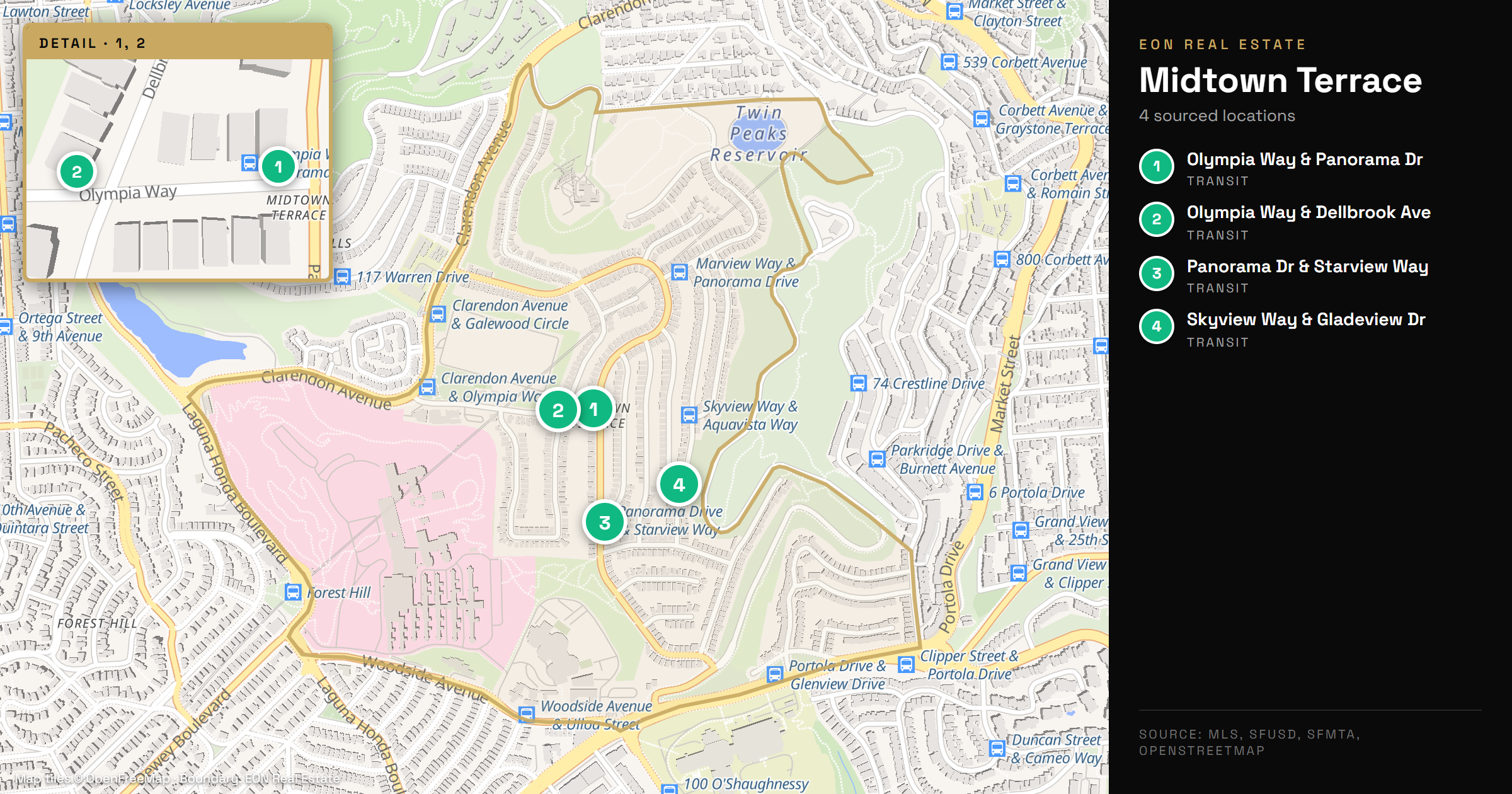
On movement, the neighborhood scores a 73 Transit Score, rated excellent transit, against a 42 Walk Score, rated car-dependent. In plain terms: the Muni 36 Teresita line stops on Olympia Way within a short walk of most homes, but daily errands mean driving down the hill. If you want the wider District 4 context around Twin Peaks, the Diamond Heights market update covers the neighborhood just to the south, and you can see where the pocket lands citywide in our ranked look at San Francisco prices.
What to consider before you buy here
Midtown Terrace rewards a specific buyer, and it is worth being honest about the tradeoffs before you fall for the views.
Car-dependent daily life
The 42 Walk Score is not a rounding error. There is no retail spine inside the neighborhood, so groceries, coffee, and schools mean a drive or the 36 Teresita bus. The transit connection is genuinely good, but this is not a walk-out-your-door errands neighborhood.
Thin, unpredictable inventory
Ten single-family closings in six months means you may wait months for the right house, and when it lists, expect company. Several 2026 closings ran under two weeks and closed well over list, so a buyer needs financing lined up and a willingness to move fast.
Hillside homes and condition
These are 1950s houses on slopes. The price gap between the renovated closings and the as-is and tenant-occupied ones was hundreds of thousands of dollars, so budget honestly for the work a fixer needs, and read the inspection reports on the hillside and drainage before you commit.
How buyers and sellers should read this market
In a pocket this thin, the median is a starting point and the deal turns on levers that a citywide number never captures. On the buy side, condition and finish are the first fork: the 2026 closings spanned $1.61M to $2.4M, hundreds of thousands of dollars apart on similar-sized houses, so decide early whether you want turnkey or a project and price the work honestly before you offer. View is the second lever: renovated homes with ocean or Twin Peaks outlooks, like the Longview Court and Midcrest Way closings in the low $2Ms, commanded clear premiums over comparable no-view houses. On the sell side, vacancy matters more than square footage here, since the one tenant-occupied closing this year traded at the low end of the range despite being a four-bedroom, so a seller weighing whether to deliver the house vacant should run that math with real numbers. And because winning offers here are frequently over asking and financed against a fast clock, a buyer with financing fully lined up, or a clean cash position, has a real edge over a higher offer that still needs weeks.
What to watch this fall
San Francisco runs a fall selling cycle from late August to around Halloween, and in a low-turnover pocket like this, that window may bring only a handful of listings. The signal to watch is not the median, which swings on one or two sales, but the gap between list and close: 2026 closings here regularly closed six figures over asking, and if that holds through the fall, demand is intact. If rates climb from the mid-6s where the 30-year fixed sat this September, expect the widest overbids to narrow on the homes that need work first. For buyers, the move I would make is to get pre-underwritten now so you can act the week a renovated house lists, since the winners here are decided in days, not weeks. I will refresh these figures as the fall closings come in.
How much does a home in Midtown Terrace cost in 2026?
In 2026, single-family homes in Midtown Terrace closed at a $1.9M median over the trailing six months, with a $1,267 median price per square foot (MLS). The six-month range ran from $1.61M for a tenant-occupied four-bedroom to $2.4M for a vacant one. Prices are up 10.8% from a year earlier, so this small pocket has firmed rather than cooled, and renovated three-bedrooms are the heart of the market.
Is Midtown Terrace a good place to buy in San Francisco?
For a detached house near the geographic center of the city, Midtown Terrace is one of the steadier bets in 2026: single-family homes closed at a $1.9M median in about 10 days, faster than the citywide 12-day median time to sell (MLS). The tradeoffs are a 42 Walk Score, meaning you drive for most errands, and thin supply, with only 10 single-family closings in six months. It fits a buyer who values the setting over walkability.
Why do Midtown Terrace homes sell so fast?
As of 2026, Midtown Terrace single-family homes averaged about 10 days on market, well under the citywide pace, because supply is tight and renovated mid-century houses with Twin Peaks and Sutro Tower views draw competing offers (MLS). Several closings this year ran 3 to 12 days and closed six figures over their list prices, including a Longview Court home that jumped $500,000 above asking. Short timelines here signal genuine demand, not a fluke.
Does Midtown Terrace get fog like the rest of San Francisco?
As of 2026, no, not the way the western neighborhoods do: Midtown Terrace logs clear skies about 18 percentage points more often than the citywide average, and fog settles in less often (National Weather Service). It sits on the east slope of Twin Peaks, which shields it from the ocean fog that grays out the Sunset and Parkside. That sunnier microclimate is a measurable part of what buyers pay a premium to live here.
What kind of homes are in Midtown Terrace?
As of 2026, Midtown Terrace is almost entirely detached single-family houses built in the mid-1950s, the median year built is 1954 (Census data), on hillside lots with one or two parking spaces. The typical closing this year was a renovated three-bedroom, two-bath of roughly 1,400 to 1,600 square feet (MLS). Owner-occupancy is high, with 171 of 290 units owner-held, which keeps turnover low and inventory scarce year-round.
Talk to me about Midtown Terrace
If you are weighing a house up here, I can pull the full comp set by street, condition, and view, and walk you through what a specific listing should trade for. I am Chris Chour, founder and broker of EON Real Estate. Most of my work is single-family and condo transactions in San Francisco's core neighborhoods, and Midtown Terrace is a pocket I know block by block. When you are ready, I will run your numbers. For a sense of timing, here is how long the SF buying process really takes.
Last updated: September 18, 2026